
Delcy Rodríguez defends Venezuela's unity after US aggression
 3 Min Read
Acting President Delcy Rodríguez says Venezuela remains stable and united one month after US aggression, calling for diplomacy and national sovereignty.
-
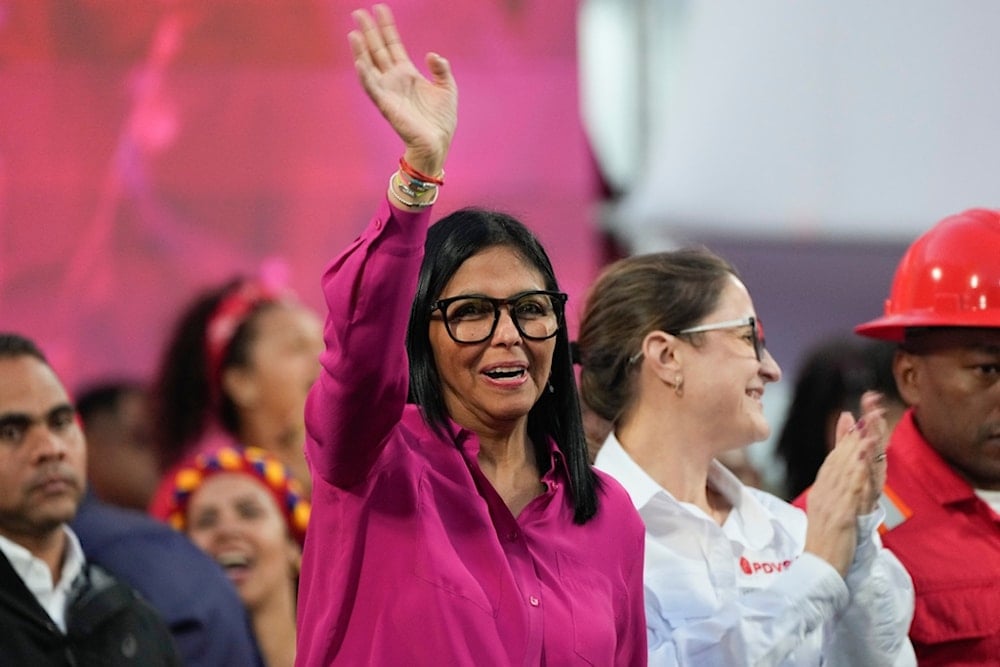
Venezuela's acting President Delcy Rodriguez greets oil workers and government supporters at the Miraflores Palace during a rally backing an oil reform bill in Caracas, Venezuela, Thursday, January 29, 2026. (AP Photo/Ariana Cubillos)
One month after the United States carried out a military attack against Venezuela on January 3, acting President Delcy Rodríguez affirmed that the country has remained stable, peaceful, and united despite ongoing external attempts at destabilization.
Speaking from the Miraflores Palace alongside the President of the National Assembly, Jorge Rodríguez, and Vice President for Political Sovereignty, Security, and Peace, Diosdado Cabello, Rodríguez emphasized the political maturity of the Venezuelan people in confronting foreign aggression and advancing national reconciliation.
She stressed that Venezuela's response to the pressure from abroad has been marked by calm and resolve, and reaffirmed that all differences with the United States must be addressed through diplomatic channels and political dialogue.
“Differences must be addressed with respect for international law and through dialogue,” Rodríguez stated.
She confirmed that she had held phone conversations with US President Donald Trump and Secretary of State Marco Rubio as part of efforts to manage Venezuela–US tensions through political mechanisms.
Read more: Venezuela proposes 2026 Amnesty Law for political violence
Extremist sectors isolated as state institutions mobilize
Rodriguez noted that extremist factions have been fully marginalized from national life and urged them to respect Venezuela’s constitutional and legal framework.
She reiterated that Venezuelan political affairs must be decided by its own people and directed toward preserving peace and stability across the country.
Following the January 3 incident, Rodríguez said Venezuela’s institutions responded immediately to guarantee internal order. While acknowledging that a minority supported the external military action, she stressed that such views do not represent the will of the Venezuelan people.
“They do not correctly interpret what the Venezuelan people want,” she affirmed.
Energy law reform advances amid pressure
Highlighting the resilience of the country, Rodríguez called Venezuela’s current political stability “a great victory of the Venezuelan people” over efforts to sow chaos. She attributed social calm to the strength of the state and collective unity in the face of adversity.
She also referred to the recent enactment of the Organic Hydrocarbons Law, which incorporates management models from the Anti-Blockade Law. The legislation enables development in “green fields,” or areas that have not been previously exploited, in accordance with international standards.
Read more: Beyond oil: Why Washington is eyeing Venezuela’s strategic minerals
Diplomatic outreach from Miraflores Palace
As part of Venezuela’s foreign policy efforts, Rodríguez led a diplomatic session where she received the credentials of new ambassadors from Italy, Nicaragua, and Qatar. She reaffirmed that Venezuela's international agenda remains rooted in dialogue, cooperation, and mutual respect.
Despite ongoing challenges, Rodríguez said the Bolivarian Revolution continues to pursue a national agenda based on respect for sovereignty, peace, and bilateral engagement.
“The path of the Bolivarian Revolution continues to be the construction of a working agenda grounded in mutual respect, national sovereignty, and peace,” she concluded.


