
Democratic party divisions deepen over war on Iran before midterms
 3 Min Read
Divisions within the Democratic Party are intensifying as progressives and moderates clash over the war on Iran ahead of key US midterm elections.
-
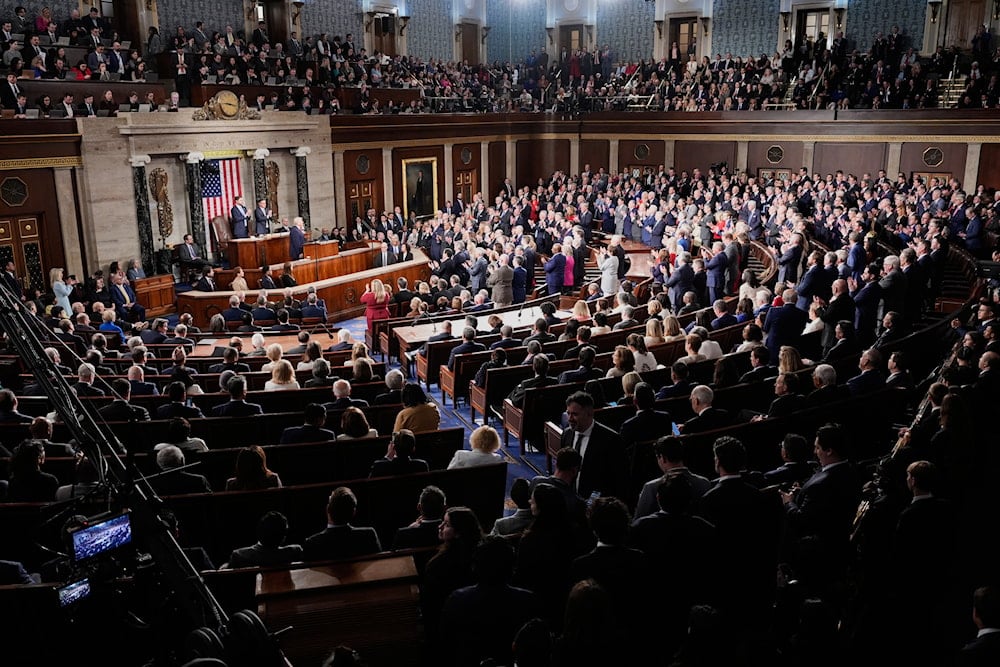
Republican members of Congress stand while Democrats keep their seats during President Donald Trump's State of the Union address to a joint session of Congress in the House chamber at the US Capitol in Washington, Tuesday, Feb. 24, 2026 (AP)
Divisions within the Democratic Party are intensifying ahead of November’s midterm elections, as the US-Israeli war on Iran emerges as a central point of contention in several closely watched primary races across the United States, Reuters reported.
A review of key contests in Michigan, Colorado, Illinois, Maine, and North Carolina shows a growing number of progressive candidates challenging moderate or establishment-backed Democrats over their stance on the war on Iran. At least half a dozen progressive contenders have accused their rivals of failing to strongly oppose the war and of maintaining close ties to defense contractors and pro-"Israel" lobbying groups.
The disputes reflect a broader internal struggle over the party’s direction as Democrats attempt to recover from their 2024 election losses and begin laying the groundwork for the 2028 presidential race.
Progressive candidates argue that the war on Iran has reignited longstanding concerns about US military involvement abroad and the influence of corporate and defense industry funding in politics. They are calling for an end to what they describe as American-led wars, while pushing for greater focus on domestic priorities such as economic equality and civil rights.
Campaigns target ties with defense firms, AIPAC
Several campaigns have centered their messaging on financial ties between moderate Democrats and defense contractors, as well as organizations linked to the American Israel Public Affairs Committee. Progressives claim such funding undermines the credibility of candidates who publicly oppose the war.
“It’s difficult to trust politicians who take money from weapons manufacturers and AIPAC, all of whom are for this war, and for those politicians to then stand up and say they are against the war,” Abdul El-Sayed, a Senate primary candidate in Michigan, told Reuters.
El-Sayed and others argue that opposing the war on Iran requires more than rhetoric, insisting that candidates should reject donations from defense-related and pro-"Israel" groups. Moderate Democrats have pushed back strongly, saying they have already voiced opposition to the war and accusing progressives of exploiting the issue for political gain.
The divisions were evident in a recent Democratic House primary in Illinois, where progressive candidate Kat Abughazaleh, who made opposition to the war on Iran and AIPAC-backed candidates central to her campaign, finished just over three percentage points behind Evanston Mayor Daniel Biss in a crowded race.
Despite the primary-season clashes, Democratic lawmakers in Congress have largely presented a unified front against the war on Iran, which polls indicate is unpopular with a majority of Americans. However, the internal disputes risk undermining what could otherwise be a political advantage for the party, particularly as Republicans enter the midterms facing significant headwinds.
At the core of the disagreement is a familiar strategic debate: whether Democrats should prioritize appealing to swing voters or focus on energizing their base. The tensions also extend beyond foreign policy, touching on economic reform and the party’s relationship with corporate interests.
“The day after the midterms are over in November these tensions will burst forth,” said Bill Galston, highlighting concerns that the divisions could deepen in the months ahead.


