
Extended war on Iran 'more akin to Gallipoli than Vietnam': RS
 5 Min Read
US veterans warn that a potential ground invasion of Iran could become a bloody quagmire with high casualties, low morale, and strategic overextension.
-
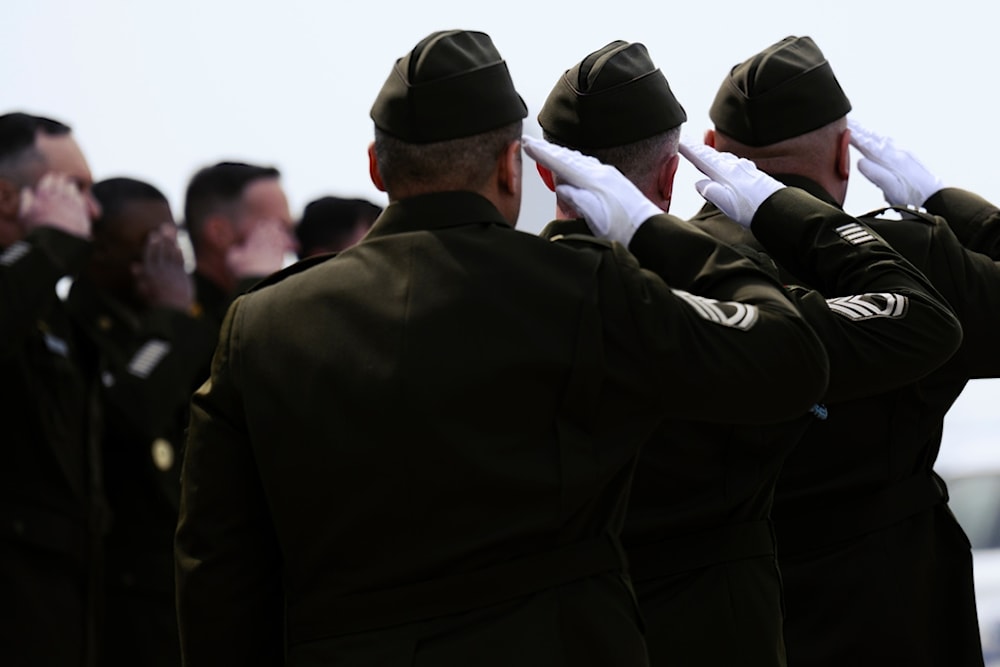
Soldiers salute during the dignified transfer of Army Sgt. Benjamin N. Pennington, 26, of Glendale, Ky., at Godman Army Airfield in Fort Knox, Ky., on Friday, March 20, 2026 (AP)
As the Trump administration mulls a ground deployment in Iran, veterans fear a grueling, long-term campaign lies ahead, warning that the US military may be ill-prepared to sustain a war that could become a bloody quagmire, Responsible Statcraft reported.
Two Marine Expeditionary Units (MEUs), each carrying more than 2,000 Marines, are currently en route to the region, pointing to an extended and perilous endeavor. Some veterans have already described a potential seizure of Iran's Kharg Island as a "suicide mission".
"Why are we going into something that could be so protracted?" asked Virginia Burger, a Marine veteran and senior defense policy analyst at the Project on Government Oversight's Center for Defense Information. "Iran has a vote in this, right? We don't exist in a vacuum. The Marines aren't just going to walk onto Kharg Island unopposed. What is that going to look like, as far as loss of American lives, loss of American equipment?"
Strategic overextension
Although the US has the tactical means and personnel to plant boots on the ground, troops deployed will likely face frequent attacks, casualties, and strategic setbacks, according to John Byrnes, a veteran and strategic director for Concerned Veterans for America.
"I am certain we can get our boots on the ground. I am more concerned about a long-term operation," Byrnes told Responsible Statecraft. "Every step along the way in a ground deployment, there's going to be some US casualties, and what generals might think is going to take a week suddenly might take a month or two months."
James Webb, a national security consultant who served in Iraq as a Marine infantryman, warned that Iran's mountainous geography could be a logistical nightmare for a ground deployment. He also noted that Iran's population of approximately 90 million people is prepared to defend their homeland.
"When you start talking about the geography and the population of Iran, the geography is not conducive to offensive operations at all. It's their home turf. As somebody who's fought on the home turf of another country, you're always at a disadvantage," Webb said.
"When you're taking a look at the conduct of the war from the Iranian side, they have measured this in every single way that they possibly could. They were prepared to fight," he added. An extended war in Iran might "be something more akin to Gallipoli than Vietnam," Webb said, referring to the failed Allied campaign to capture Turkish straits during World War I that resulted in heavy casualties.
Read More: Iran defense official to US troops: 'Come closer'
Depleting US military resources
On moving munitions from critical locations to keep up the war effort, the US is showing signs of overextension. The Department of War has moved defensive interceptor missiles from South Korea to the Middle East, a move that Virginia Burger said was "not insignificant".
"Senior military officials are wondering if these moves are weakening our ability to respond to any other situation, specifically in the Pacific," she said.
Military leaders see "how much we're expending our already dwindling stockpiles of munitions, and questioning what we would be able to do if we did have to go into a war that was not a war of choice," Burger added. "The sheer lack of strategic forethought that the administration put into this shows you how little they care about the safety and considerations of our armed service members."
Low morale and dissent
As prospects for extended operations in Iran grow, veterans warn that low morale among service members, some of whom see little reason for the US to be at war with Tehran, could fuel a long-term crisis of confidence.
"We don't have a justification from the White House. We don't have solid messaging or anything that elicits any confidence from the Secretary of Defense," Burger said. "You're going to create this disillusionment that's going to cause retention problems and recruitment problems down the line."
Some service members are seeking conscientious objector status. Mike Prysner, a veteran and Executive Director of the Center on Conscience & War, told RS that many soldiers cite the US attack on a school in Minab, Iran, in late February, as well as broader disenchantment with US foreign policy, as reasons to object to the war.
"Service members watched the Gaza war happen," Prysner said. "And then, the first big war that the US embarks on since the war on terror starts with the US doing something that looks exactly like one of the worst war crimes Israel did in the Gaza war."
For those who stay and fight, low morale risks hindering the war effort.
"If your head and your heart is not in it when you go to war, it's going to be a lot more difficult to accomplish your objectives, if at all," Webb said. "That's the bottom line."
Read More: Iran military command to enemies: Are you negotiating with yourselves?


