
Fidan urges credible Palestinian administration before Hamas disarms
 4 Min Read
Turkey’s Hakan Fidan says Hamas cannot disarm without a credible civil administration and trained police force, warning of global failure if the ceasefire plan stalls.
-
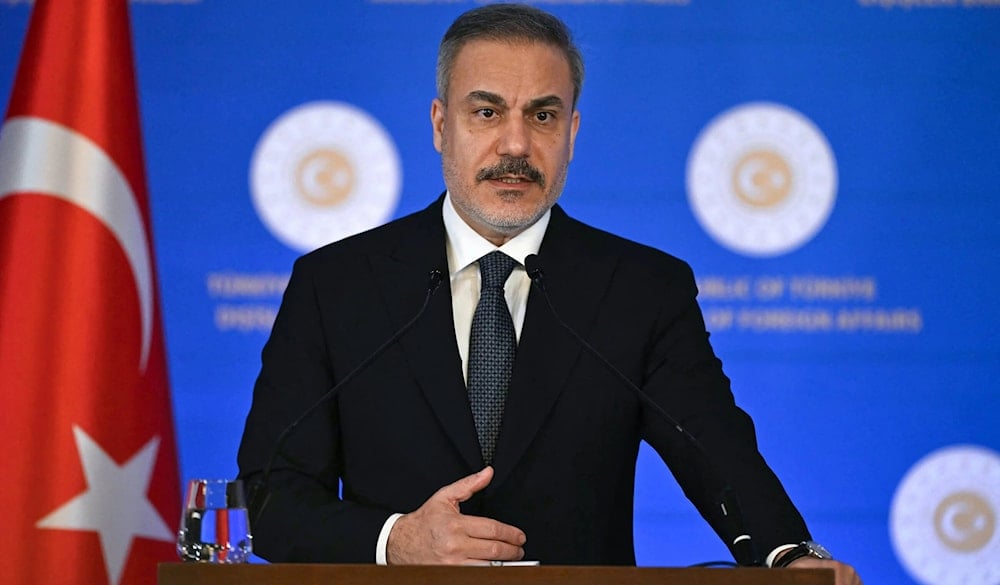
Turkish Minister of Foreign Affairs Hakan Fidan addresses the audience during a press briefing meeting in Istanbul, on 10 January 2025 (AFP)
Turkish Foreign Minister Hakan Fidan said Saturday that the establishment of a credible Palestinian civil administration and a professionally trained police force is essential before Hamas can consider laying down its arms, adding that the movement has expressed readiness to hand over governance of the Gaza Strip. His comments were made in an interview with Reuters on the sidelines of the Doha Forum.
Fidan stressed that without these two steps, “expecting Hamas to give up its weapons in the first stage of a ceasefire agreement is unrealistic and unworkable.” He explained that the proposed police force would exclude Hamas members and would be backed by an international presence to help stabilize the situation on the ground. He also noted that Washington is pressuring the Israeli occupation regarding Turkey’s push to participate in this force.
The Turkish foreign minister warned that failure by the international community to move the ceasefire plan to its next phase would represent a “miserable failure” for the world and for Washington, pointing out that US President Donald Trump has “personally led these efforts.”
Hamas says disarmament off table until end of occupation
A senior member of the Palestinian movement Hamas, Mohammad Nazzal, said in October that the disarmament of the resistance is inseparable from the continuation of the Israeli occupation, emphasizing that weapons will no longer be needed once the occupation ends.
“The question of whether the movement should have weapons is tied to the occupation, and calls to disarm, lay down arms, or keep them if it ultimately means disarming the resistance are unacceptable,” Nazzal told RIA Novosti.
He added that “the historical memory of peoples and the historical memory of the Palestinian people itself testify that when a person surrenders his weapons to the enemy, the enemy will slaughter him like a sheep, so the possession of weapons is linked to the existence of the occupation. When the occupation ends, there will be no need for weapons.”
Nazzal also revealed that Hamas will present its vision for the post-war administration of the Gaza Strip once negotiations resume, signaling the group’s readiness to engage in future discussions on governance and reconstruction.
Israeli policies a major obstacle in Syria
Turning to Syria, Fidan said that the US-backed, Kurdish-led Syrian Democratic Forces show “no intention” of integrating into the country’s state institutions and are instead attempting to circumvent the process. He stressed that Ankara does not give Damascus a “blank cheque” to suppress minorities, insisting that all communities in Syria must feel safe and free.
Fidan added that the Israeli occupation’s destabilizing actions in Syria remain “the main obstacle” to efforts aimed at restoring unity and rebuilding the country.
Syrian President Ahmed al-Sharaa warned on Saturday that the Israeli occupation’s demand for a demilitarized zone in southern Syria would place his country at grave risk, as Israeli forces continue operations across the frontier.
The Israeli occupation recently sent troops into a UN-patrolled demilitarized zone that has separated Israeli and Syrian forces on the Golan Heights since the 1974 agreement. Sharaa’s forces toppled President Bashar al-Assad on December 8 of last year.
Since then, the Israeli occupation has conducted repeated incursions deeper into Syrian territory, including airstrikes, while insisting on the establishment of a wider demilitarized area in the south. Addressing the Doha Forum, Sharaa stressed that Syria remains committed to the 1974 agreement, describing it as “a successful arrangement” that has helped maintain relative stability for more than five decades.
He cautioned that any attempt to amend or bypass the accord, which he said enjoys broad international support and the backing of the UN Security Council, could “lead us to a dangerous place.” Damascus, he added, rejects new proposals that would impose additional demilitarized zones beyond what was already negotiated in 1974.


