
Gulf states reassess security after US failures exposed: NYT
 5 Min Read
The US-Israeli war on Iran and Tehran’s retaliatory strikes have exposed Gulf states’ vulnerability and undermined confidence in US protection.
-
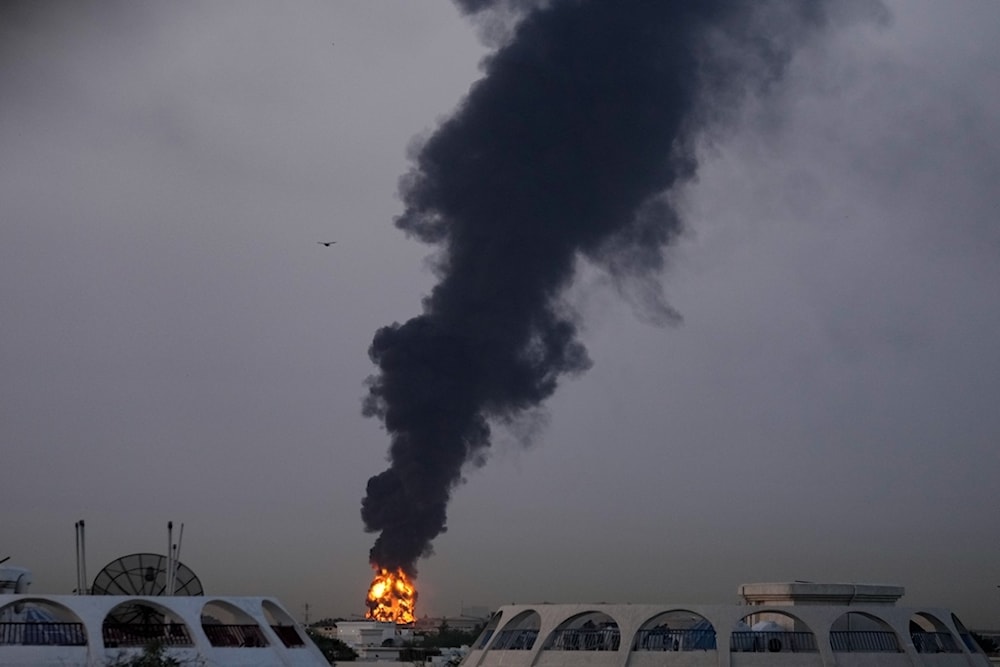
Fire and plumes of smoke rise after a drone struck a fuel tank, forcing the temporary suspension of flights. near Dubai International Airport, in the United Arab Emirates, early Monday, March 16, 2026 (AP)
After weeks of US-Israeli aggression on Iran triggered a wave of retaliatory strikes across the region, Gulf Arab states are confronting a transformed security landscape following the announcement of a fragile ceasefire between the United States and Iran, the New York Times reported.
According to the report, the war has shattered long-standing assumptions among Gulf governments that their wealth and strategic partnerships, particularly with Washington, would shield them from direct confrontation. Instead, Iranian missile and drone operations reached deep into countries hosting US military bases, reflecting their exposure as frontline actors in a war they did not directly initiate.
Iran’s response largely targeted US and Israeli-linked assets across the region, including military installations and infrastructure tied to the American presence, as part of its retaliation following the February 28 US-Israeli aggression on Iranian territory.
The fallout has left Gulf states facing both material damage and economic strain, with energy exports disrupted and uncertainty surrounding the Strait of Hormuz, one of the world’s most critical oil transit routes, continuing to weigh on outlooks. Analysts say the crisis has exposed how deeply regional economies remain tied to a US-led security architecture that, rather than insulating them, has drawn them into the line of retaliation.
US shield falters
Confidence in the United States as a reliable security guarantor has been significantly weakened. “All that we have with the US today does not provide the guarantee we need now,” said Abdulaziz Sager, chairman of the Gulf Research Center. “Will that stop any attack against us? No.”
The report suggests that Gulf states are now reckoning with the consequences of hosting extensive US military infrastructure, which has effectively positioned them within the theatre of confrontation. Iran’s strikes, which in many cases focused on bases and facilities linked to US operations, have reinforced the perception that these installations serve as liabilities as much as deterrents.
Military analysts noted that US bases across the Gulf have increasingly become targets rather than shields, with Iranian strategy focusing on precision strikes against fixed installations and surrounding infrastructure, exposing the limits of existing defense arrangements.
At the same time, regional governments face a strategic dilemma. Despite growing doubts, there is no clear alternative to the US security umbrella, leaving Gulf states navigating a landscape where dependence persists even as confidence erodes.
Analysts also warn that even a weakened Iran could continue to project power across the region. “This idea that you’re going to be left with a bruised, battered, angry but emboldened Iran — I think that’s a real concern,” said Dina Esfandiary, the Middle East geoeconomics lead for Bloomberg Economics.
Fragile ceasefire doubts
The ceasefire itself has done little to reassure regional actors. Reports of continued drone interceptions and attacks in Gulf countries have raised doubts about its durability, particularly as Gulf states were not directly involved in shaping the agreement.
“This is a cease-fire plan that does not seem to include the Gulf in consultation,” Bahrain-based political analyst Mahdi Jasim Ghuloom wrote on social media. “Clearly this will make it more fragile, and Iran has continued attacking some Gulf countries this morning despite the announcement.”
Officials have also acknowledged a broader structural shift in regional security. “In truth, one of the most significant outcomes of this war is the shattering of the concept of a regional security system in the Gulf,” said Majed al-Ansari, a spokesman for Qatar’s Foreign Ministry.
Oman’s foreign minister, Badr Albusaidi, welcomed the pause in fighting while warning it remains insufficient. “For now the world has stepped back from disaster,” he said. “But there’s no room for complacency. Serious negotiations now required for lasting peace.”
Alliances under strain
Beyond immediate risks, Gulf states are now reassessing their relationships not only with Washington, but also with Iran and "Israel", as the war has exposed the limits of their influence over US decision-making despite longstanding political and military ties.
“We suffer in the Gulf because he started the war,” Sager said, referring to US President Donald Trump. “We told him the consequences. We were never consulted.”
The report added that efforts by some Gulf countries to ease tensions with Iran in recent years are now under renewed scrutiny, with officials warning that rebuilding trust will be difficult. “When this war eventually ends, in order for there to be any rebuilding of trust will take a long time,” Saudi Foreign Minister Prince Faisal bin Farhan said.
Read more: Ceasefire shows Trump’s war on Iran boosted rivals, not US power


