
ICE pivots from jails to streets, hits record highs in arrest numbers
 5 Min Read
ICE's new enforcement strategy focuses on community arrests rather than jail detentions, resulting in record-high numbers, with most detainees lacking criminal convictions.
-

Workers stand handcuffed after being arrested by US Immigration and Customs Enforcement, ICE, at Delta Downs Racetrack, Hotel and Casino in Calcasieu Parish, near Vinton, La., on Wednesday, June 18, 2025 (US Immigration and Customs Enforcement via AP)
US Immigration and Customs Enforcement has dramatically altered its operational approach under the Trump administration, shifting from traditional jail-based detentions to aggressive community arrests that have reached unprecedented levels, according to a Washington Post analysis of federal data from January to mid-October 2025.
The tactical pivot has produced striking results, with ICE recording approximately 17,500 at-large arrests in September alone, with October figures believed to surpass that mark. These numbers dwarf historical patterns, representing the highest monthly totals since federal tracking began in October 2011.
The previous record for community-based arrests occurred in January 2023 under the Biden administration, when officers detained more than 11,500 individuals. Current weekly arrest rates now exceed Trump's first presidential term by a factor of four, signaling an intensification that goes beyond typical administrative changes.
From jails to neighborhoods
This operational shift marks a departure from ICE's traditional enforcement model. Historically, the agency focused primarily on immigrants already held in local detention facilities, either awaiting trial or completing criminal sentences. Many jails routinely flagged undocumented individuals and contacted ICE directly, while the agency monitored local arrests through fingerprint-sharing systems.
Under this established approach, ICE would file detainer requests asking jails to hold deportation candidates for up to 48 additional hours, allowing federal officers to assume custody with minimal resource expenditure.
Community arrests, by contrast, demand substantially more personnel and funding. Federal agents must locate, surveil, and apprehend individuals in homes, workplaces, during immigration check-ins, or in public spaces, operations ICE's own website describes as "unpredictable and dangerous to the public."
The strategy transformation became evident in June when federal agents launched major enforcement operations in Los Angeles. Over the subsequent five months through October, at-large arrests nationwide totaled 67,800, more than double the combined total from the administration's first five months in office.
For the first time since April 2023, community-based arrests accounted for over half of ICE's total monthly detentions in June, September, and October.
Pressure for higher numbers
The tactical evolution reflects mounting pressure from senior officials to meet ambitious deportation targets. The administration has set a goal of one million deportations during Trump's first year back in office, with White House Deputy Chief of Staff Stephen Miller pushing for 3,000 immigration arrests daily.
Actual arrest rates fall well short of that benchmark, with ICE's highest single-day total occurring on June 4, when officers detained slightly over 1,900 individuals.
Nevertheless, overall arrests increased 60% from June through mid-October compared to the administration's initial five months, according to federal data obtained through public records requests. September saw 21 days with arrests exceeding 1,000, the most such days recorded in any month this year.
This pattern aligns with the administration's 2026 plans, which include workplace enforcement expansion backed by $170 billion in supplementary funding secured through September 2029. Border czar Tom Homan recently confirmed workplace raids will "absolutely" increase, predicting arrest numbers will "explode greatly next year."
-
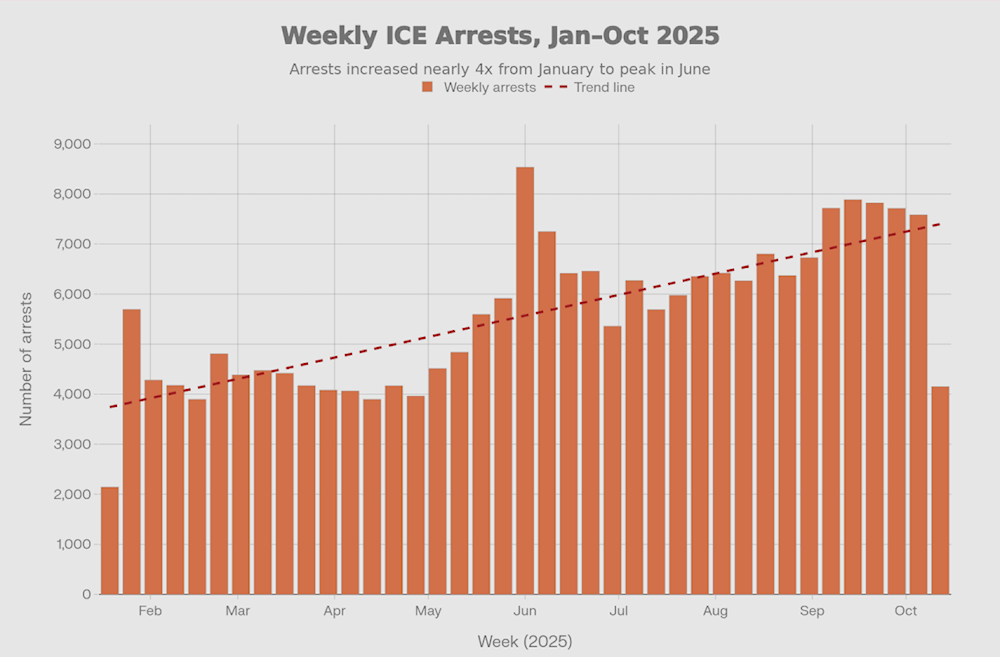
Weekly ICE arrests under Trump’s second term show a sharp rise from roughly 2,000 to over 7,000 arrests per week between January and October 2025 (Source: US Immigration and Customs Enforcement)
The criminal record question
Administration officials maintain that their enforcement focuses on dangerous criminals. Department of Homeland Security spokeswoman Tricia McLaughlin stated that 70 percent of ICE arrestees have criminal convictions or pending charges in the United States, with some carrying convictions from their home countries.
"Nationwide, our law enforcement is targeting the worst of the worst criminal illegal aliens, including murderers, rapists, gang members, pedophiles, and terrorists," McLaughlin said.
Federal data tells a more complex story. From Trump's January 20 inauguration through October 15, approximately 36% of ICE detainees had criminal convictions, while 30% faced pending charges, meaning roughly one-third had neither.
The trend has accelerated. Since June, arrests of individuals without criminal records nearly tripled. By September, over 40 percent of those arrested by ICE had no criminal history beyond suspected immigration violations.
Geographic concentration
High-profile operations in major cities appear to have driven much of the increase. Washington, DC, experienced the sharpest spike, with arrests increasing fivefold from June through October compared to the previous five months.
Illinois saw similar patterns during "Operation Midway Blitz" in Chicago. Arrests of individuals without criminal records jumped from 428 between January 20 and May 31 to 1,408 from June 1 through October 15.
These intensive urban operations, many drawing significant public protests, have coincided with declining public support. Trump's immigration approval rating dropped from 50 percent in March to 41 percent by mid-December, a notable decline from what had been his strongest policy issue.


