
India protests: Opposition, journalists report police abuses
 3 Min Read
India faces mounting criticism over police conduct after opposition protests against voter roll revisions, with journalists reporting detentions and assault.
-
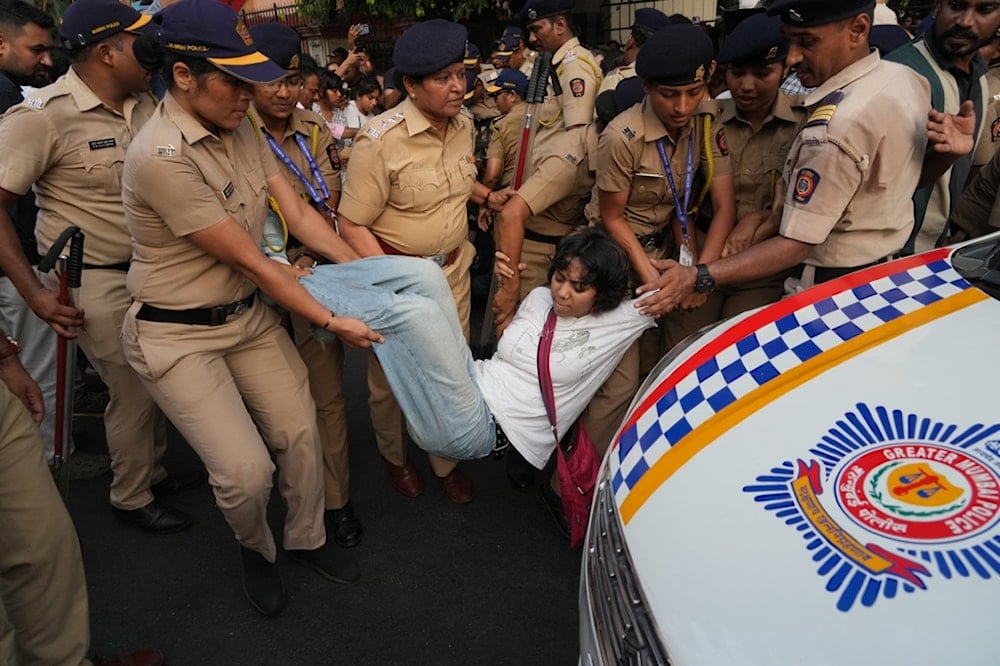
A woman is detained by police during a protest demanding the resignation of the country's election chief, Gyanesh Kumar, in Mumbai, India, Sunday, Oct. 11, 2026.(AP Photo/Rafiq Maqbool)
Opposition leaders and journalists have accused Indian police of excessive force and arbitrary detentions during demonstrations over a nationwide voter roll revision, as authorities tightened security in New Delhi ahead of another protest on Monday.
Thousands of security personnel were deployed across the capital for a third consecutive day, with metal barricades erected on major roads and key metro stations closed ahead of a march called by Congress leader Rahul Gandhi.
The demonstrations were triggered by misconduct during the revision of electoral rolls, which critics say could benefit Prime Minister Narendra Modi’s ruling Bharatiya Janata Party (BJP). The Election Commission of India, responsible for overseeing elections, has denied wrongdoing.
If the global media houses are covering the protests in France and believe the protests in India are not newsworthy, remember that this crushing of dissent in a country that is home to 1/6th of humanity will have repercussions for all. https://t.co/N8q7bViB72
— Rana Ayyub (@RanaAyyub) October 11, 2026
Attention has increasingly focused on the police response after a turbulent weekend in which thousands of demonstrators, including members of the youth-led Cockroach Janta Party (CJP) movement, were detained. Most have since been released, including three senior CJP leaders.
Those detained include the head of the CJP movement, Abhijeet Dipke, and two other leaders.
Read more: Outrage in India over removal of 130 mln names from elections
Journalists and opposition leaders report police abuses
Communist Party of India (Marxist) (CPI(M)) parliamentarian John Brittas accused police of assaulting him during Sunday’s demonstrations.
Brittas stated that he was "manhandled, dragged, assaulted" by officers, describing the incident as an attack on democratic freedoms and the rule of law.
"This is not merely an assault on an MP. It is an assault on democratic freedoms and the rule of law," he said.
Indian police also detained CPI(M)'s General Secretary M.A. Baby during the protests.
CJP protest against CEC: Police detain CPI(M) general secy MA Baby in Delhi. https://t.co/Op37UaKty8
— News Arena India (@NewsArenaIndia) October 10, 2026
Journalists covering the protests also reported being detained despite displaying press identification. Reporters Without Borders (RSF) said at least 16 journalists were detained over the weekend, describing the actions as "unacceptable".
Police did not respond to questions about the detentions or their conduct during a news conference on Sunday.
The claims have intensified criticism from opposition figures, who say mass detentions are being used to suppress dissent. The circumstances of the reported incidents have not been independently established in the supplied account.
New Delhi tightens security ahead of fresh rally
Authorities prepared for another confrontation on Monday as Gandhi urged supporters to join a march toward the Supreme Court.
"There is nothing to fear," Gandhi wrote on social media on Sunday. "These cowards can do absolutely nothing to us."
Security measures included hundreds of yellow metal barricades on roads leading to central Delhi and the closure of six major metro stations.
The CJP’s leaders have vowed to continue demonstrations until Chief Election Commissioner Gyanesh Kumar resigns. The protests have brought together opposition parties, student groups, and activists challenging the voter roll revision.
Media reports cited in the supplied account say more than 133 million names were removed from electoral lists during the revision. Critics argue that the changes have disproportionately affected minorities, particularly Muslims.
Election authorities maintain that the exercise was intended to remove duplicate, deceased, and fraudulent entries. The dispute has become a significant political challenge for Modi’s third term, with protesters questioning both the integrity of the electoral process and the authorities’ handling of dissent.
Read more: India battles rupee crisis as oil shock deepens economic strain


