
Outrage in India over removal of 130 mln names from elections
 8 Min Read
India's voter roll revision has removed more than 130 million names, prompting protests and concerns over voting rights, electoral integrity, and Muslim voters.
-
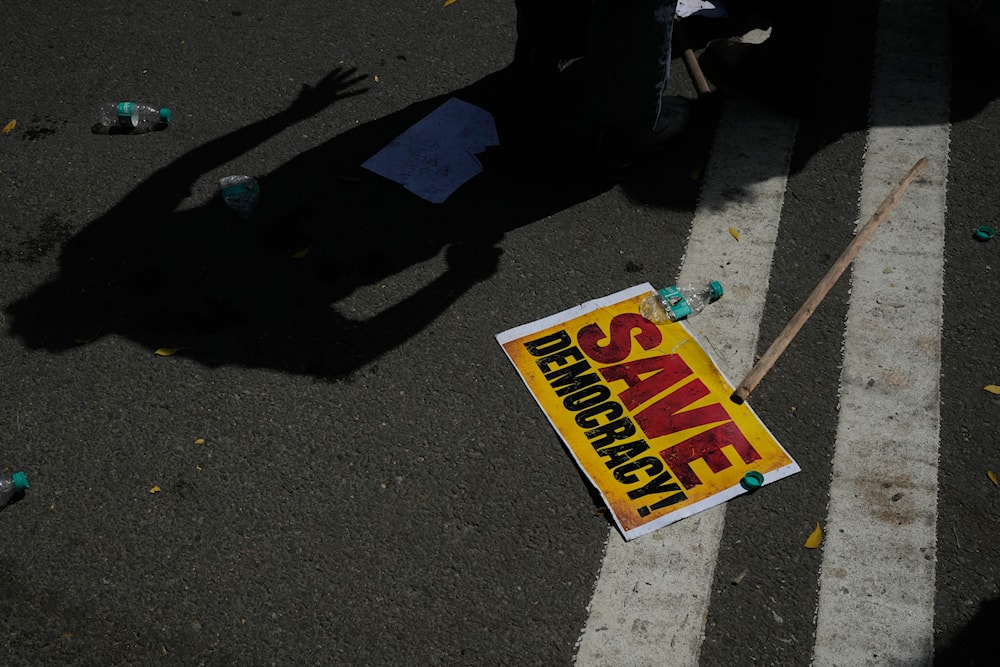
A protester walks past a placard lying on the road during a protest organized by opposition parties demanding the resignation of the country's election chief Gyanesh Kumar in New Delhi, India, Tuesday, Oct. 6, 2026 (AP)
India's election commission has removed more than 130 million names from the country's voter roll as part of a revision exercise that critics say disproportionately targets Muslims and threatens the voting rights of nearly a billion people in the world's largest democracy.
The election commission, appointed by Prime Minister Narendra Modi, says the exercise is meant to clean the voter roll of duplicates and discrepancies, and process has flagged tens of millions of voters for deletion based on algorithmic detection of anomalies in their information. Millions who filed appeals remain in adjudication and were unable to vote in close elections earlier this year.
Some individuals removed from the roll on the grounds that they were deceased are contesting those decisions, stating that they are alive.
Public discontent has escalated into protests, with demonstrators calling for the resignation of Gyanesh Kumar, the chief of the election commission. Critics argue that the process disproportionately affects India's 200 million Muslims. "The heart of our democracy, which is the right to vote, is at great peril," said Rohinton Nariman, a former solicitor general of India and a supreme court judge, in a lecture last week.
The biggest threat to election integrity in India
Former Indian polling officials and analysts say the exercise, which began last summer in one state before expanding nationwide, represents the most significant threat to election integrity in India's more than seven decades as a republic. Recent disclosures that officials within the election commission and the Supreme Court have voiced concerns about the revision have intensified public anger.
"The entire approach has changed from making the rolls inclusive," said Ashok Lavasa, a former election commissioner. "The effort, and the priority, seems to be getting rid of people on the slightest pretext." He said previous revisions relied on physical verification door to door to ensure inclusion, whereas the current process places the burden of proof entirely on citizens.
This, he said, leaves a large section of the electorate vulnerable to algorithms and errors in old records that could largely be clerical mistakes.
The voter roll contained approximately 970 million names before the recent revisions. Inaccuracies have long existed in a country where tens of millions of people move for work, enabling abuses by some.
Questions rise over previous elections
The deletion of over 20 million deceased individuals and 90 million others categorized as "absent, shifted, and others" has raised questions about the integrity of previous elections or suspicions about the ruling party's intentions for upcoming ones, according to analysts and opposition leaders.
Since a weaker showing in the 2024 national elections, Modi's party has secured a series of state-level victories, including flipping one large state it had never won based on a revised voter list. The next national election is scheduled for 2029.
Election commission officials did not respond to multiple requests for comment by NYT. Leaders of Modi's party have dismissed the uproar as fomented by a struggling opposition, which had earlier asked for similar revisions.
"If political parties themselves have repeatedly demanded the removal of duplicate, bogus and ineligible entries in the past, why should the election commission's effort to clean and update electoral rolls now be portrayed as inherently suspect?" said Pratyush Kanth, a spokesperson for the party.
Process aimed at entrenching Modi's advantage
Two senior officials, speaking anonymously to discuss the governing party's strategy, told NYT the process was aimed at solidifying its electoral advantage.
One official stated the aim was driven entirely by political calculation: deploying the party's extensive grassroots network to report individuals to local authorities for removal. He added, however, that the impact had been constrained within India's federal structure, since not every local official answers to the BJP.
The second official said electoral wins were not the primary goal, but rather served a broader ideological aim: carrying out the Hindu right's push to remove large numbers of Muslim migrants it considers illegal, an objective it could not accomplish through an earlier citizenship testing effort.
A pilot citizenship registration project in 2019 flagged an even larger number of Hindus as lacking documents, halting the exercise. Using the election commission to carry out a similar effort allows the ruling party deniability while achieving the same goal of blocking political participation by Muslims, the official said.
Leaders of Modi's party have publicly reinforced this framing, defending the revision as a means of removing "infiltrators", a label ostensibly applied to migrants from Bangladesh but increasingly used to refer to India's Muslims as a whole.
Analysts and former election workers say officials are requiring people to prove their voting rights using documentation that establishes citizenship. Record-keeping in India is poor, and many residents, Hindus and Muslims alike, cannot produce such papers, with some lacking even birth certificates. The revision exercise has not turned up strong evidence of a substantial number of foreigners, yet leaders of Modi's party have stated that anyone dropped from the voter roll will lose access to welfare benefits reserved for citizens.
India's poorest stand between making a living and keeping their voting rights
For India's poorest, the process forces a choice between repeated trips to polling officers and earning a daily wage. "I am standing in front of them. I will bring my entire family also to stand in front of them. They can see for themselves that we exist," said Nanhe Lal, 43, a toy store worker in Delhi making his third visit to a voter center with documents to prevent his family's names from being deleted. His employer kept calling to ask how much longer he would be away from his duties, he said.
Opposition parties contend Modi is leveraging independent institutions such as the election commission to cement his party's advantage for years ahead. They point to 2023, when Modi altered the composition of the committee that appoints election commissioners, tilting it toward the government, and enacted a law granting commissioners legal immunity.
In the time since, opposition parties have filed complaints about unusual additions and removals of voters before multiple state elections. Praveen Chakravarty, a lawmaker with the opposition Congress Party, said the commission brushed aside their calls to look into even instances of "statistical abnormalities." He added that the commission narrowed what the opposition could obtain, including machine-readable voter rolls and existing CCTV footage from polling centers, tools he said would let them check voting data.
The revisions have led algorithms to single out millions over "logical discrepancies", a label broad enough to cover a misspelled name, the count of siblings on record, or the spacing between their ages. Separately, others have been dropped from the roll after third parties filed forms contesting that they exist at all.
A review by The New York Times found that close to 2,000 of these forms landed in a single Karnataka constituency on one day late last month. Just five people were behind nearly half of them, and the voters whose existence was challenged were almost entirely Muslim.
Analysts observed that many forms came pre-typed with the target's name, leaving only a handwritten gap for the objector to sign, a pattern they said suggested a coordinated drive.
The Test Case
One state's handling by the election commission has come under especially close examination. For decades, Modi's B.JP could not reach a majority in West Bengal's state legislature elections. It broke through in May, immediately following a roll revision that cut roughly nine million names.
The country's highest court let the election move forward despite millions of voters still awaiting hearings on their challenges to being removed. Among roughly 100,000 appeals decided by that point, most were judged valid, and those voters were directed back onto the roll.
Opposition party leaders in West Bengal have told the Supreme Court in petitions that in 82 of the 207 seats captured by Modi's party, the count of removed voters surpassed the victory margin, a figure significant enough to shift the balance of power.
Court-appointed officials cleared 1.6 million West Bengal voters for reinstatement to the roll, but the commission's own court filing shows it has blocked their return by filing an appeal against their inclusion. An Indian newspaper's recent investigation found that two of the three election commissioners had privately expressed fury over the undertaking, saying it proceeded without their awareness.
Ashok Lavasa, who previously served as an election commissioner, challenged the logic of an institution whose mandate is to safeguard voting rights "would implement a procedure which will deprive" citizens of that right.


