
Indian activists challenge Modi government over protest surveillance
 5 Min Read
Indian activists are challenging the use of AI-powered surveillance and facial recognition during a major youth protest in a case before the Delhi High Court.
-
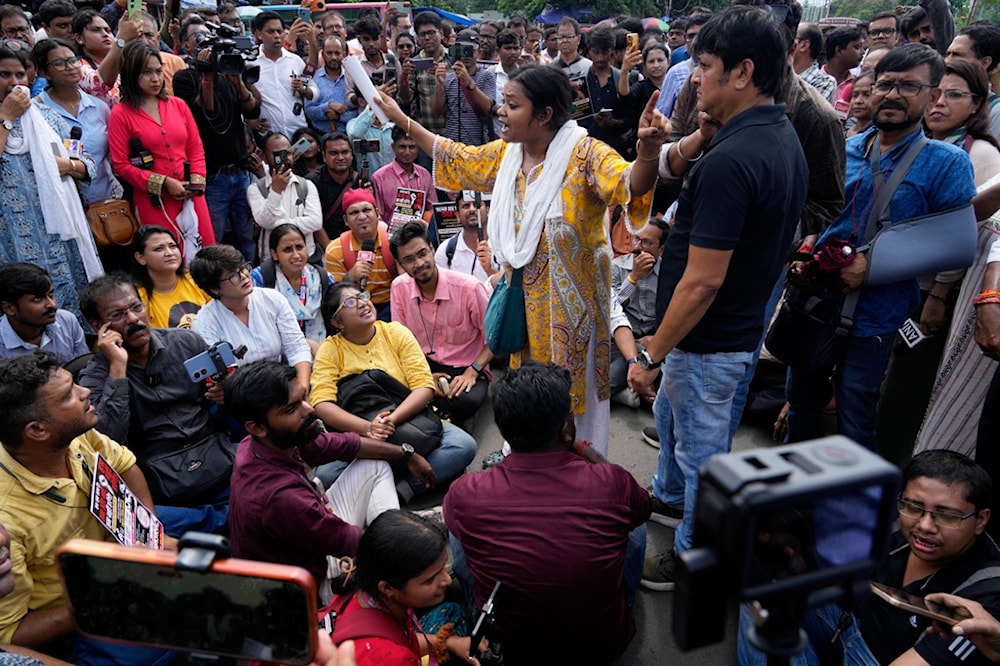
Media personnel from all sectors block a road as they join in protest against the recent physical assault on journalists by the activists of a Cockroach protest last Friday, in Kolkata, India, on July 27, 2026. (AP Photo/Bikas Das)
Indian activists are challenging Prime Minister Narendra Modi's government over the use of AI-powered surveillance during one of the country's largest youth-led protests in decades, with a Delhi court case now examining whether the authorities' actions were lawful.
The controversy emerged during last week's student demonstrations over alleged examination paper leaks, when protesters shared images online showing a mobile police surveillance van stationed at the protest site. The vehicle was fitted with cameras mounted on a telescopic mast capable of providing a 360-degree view of the gathering, according to Reuters.
Student activist Aishe Ghosh has petitioned the Delhi High Court, seeking a ruling that mass surveillance of protesters was unconstitutional. She has also asked the court to order the destruction of personal data collected during the demonstrations and establish guidelines governing the use of surveillance technology at protests.
The case is continuing despite the demonstrations ending after Education Minister Dharmendra Pradhan resigned, a rare setback for Modi's government. The government has since announced a panel to overhaul the examination system, which has faced repeated allegations of cheating and irregularities.
India currently has no specific law governing the police use of facial recognition technology. Activists argue that the surveillance deployed at the main protest site in New Delhi violated existing legal protections, while the government maintains that the checks were lawful and necessary to protect public order.
The dispute comes amid broader criticism from opposition parties and digital rights groups, which have accused Modi's government of expanding surveillance powers and imposing tighter controls on digital communications. The government has rejected those accusations, saying its actions are taken in the public interest.
During a court hearing on Friday, Solicitor General Tushar Mehta defended the police measures, arguing that privacy concerns at a public gathering were "ironical" and that the surveillance checks were "absolutely necessary" and "in legitimate state interest."
At a brief hearing on Monday, Ghosh's lawyers argued that the large-scale monitoring of protesters was disproportionate. They also called for greater disclosure of government policies governing surveillance during demonstrations.
The court is scheduled to hear the case again on Tuesday.
Activists demand accountability over biometric data
The Internet Freedom Foundation, a New Delhi-based digital rights organization, wrote to the Delhi police commissioner on July 24 demanding the deletion of biometric information reportedly gathered at the protest site.
In a post on X on Sunday, the force said it had not "restricted anyone's freedom through the use of facial recognition technology".
Akash Karmakar, a technology law partner at Indian law firm Panag & Babu, called for greater oversight of surveillance practices. "We need proportionality even if we are to claim national security risks. Accountability must flow both ways," Karmakar said, as quoted by Reuters.
He added that if facial recognition technology was used to monitor protesters, authorities should also consider its use to identify police officers who operated without visible name badges during the crackdown.
Police were also reportedly recording the Instagram handles of protesters arriving at the demonstration. Inspector Sunil Kumar told Reuters that the checks were intended to prevent people with criminal backgrounds from entering the protest site.
Police surveillance van draws scrutiny
The mobile surveillance vehicle stationed at the protest site carried the Delhi Police crest and the name "Ikshana", a Hindi word meaning "vision".
Limited information is publicly available about the system. A 2023 post by Indian CCTV manufacturer CP Plus, which has since been removed from the company's website, said the technology involved "Advanced AI-powered" cameras, mobile cameras, and "Varifocal Bullet Cameras" with adjustable lenses.
CP Plus said in a statement that it had provided the surveillance hardware used as part of Delhi Police's security infrastructure. The company added that the police authority was responsible for the system's operational use, databases and deployment scenarios.
During a Reuters visit to the protest site last week, a reporter observed a computer screen inside the surveillance van displaying his face within a green rectangular box alongside a "face accuracy" match metric. A police officer inside the vehicle subsequently closed the van's window.
Police officer Raj Kumar Dahiya told Reuters the system was used to identify individuals with criminal records.
"The computers here help us identify those who have a criminal history and it highlights them," Dahiya said. "AI also helps us count the number of protesters."
The court proceedings could now become a broader test of the limits of state surveillance in India, particularly regarding the use of facial recognition and other AI-based technologies at public demonstrations.


