
Iran says Colombia cut ties under US, Israeli influence
 4 Min Read
Iran rejected Colombia's accusations against the IRGC, saying Bogotá cut ties under US and Israeli influence, and vowing to protect its national interests.
-
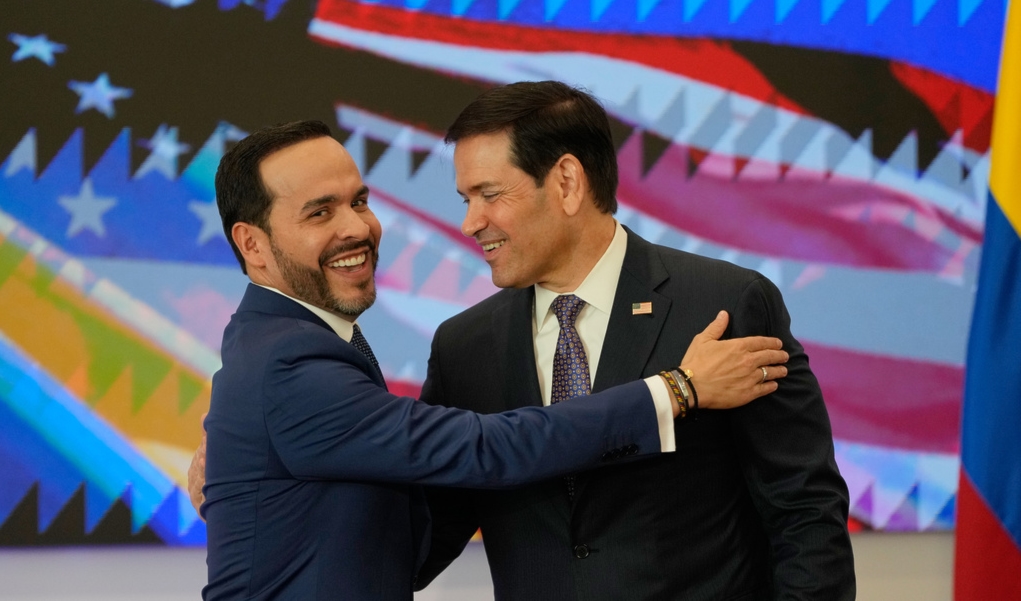
Colombian President Abelardo De La Espriella, left, and U.S. Secretary of State Marco Rubio embrace during a bilateral agreements signing ceremony in Barranquilla, Colombia, Tuesday, Sept. 8, 2026. (AP Photo/Fernando Vergara, Pool)
Iran's Foreign Ministry on Friday rejected Colombia's accusations against the Islamic Revolution Guards Corps (IRGC), saying Bogotá's decision to sever diplomatic ties with Tehran was taken "solely under the influence of the Zionist regime and the United States."
The ministry stressed that none of the justifications Colombia offered were valid or logical. It affirmed that Tehran would take the steps needed to protect its national interests in response to Bogotá's unjustified and hostile approach.
The ministry turned Colombia's accusations back on its government. It said a state operating under the influence of drug cartels was in no position to lecture others on terrorism or narcotics. It pointed to the seizure of a shipment of Colombian cocaine in Tehran and accused influential figures in Colombia of involvement in transnational crime.
The ministry added that targeting an official branch of Iran's armed forces, together with the decision to cut ties, violated the principle of mutual respect between states.
Bogotá cites security concerns
Colombia's Foreign Ministry announced on Thursday that it had formally severed diplomatic relations with Iran, with the decision taking effect retroactively on September 19.
Bogotá cited national and hemispheric security and accused Tehran of ties to "terrorist" and "narco-terrorist" groups that it said threatened Colombia's security. It offered no evidence to support the allegations. The ministry also accused the IRGC of conducting covert operations abroad.
Colombia further cited Iran's measures in the Strait of Hormuz and its strikes in the region during the US war on Iran. It also pointed to "human rights concerns" and "Iranian obstruction" of International Atomic Energy Agency inspections.
Nonetheless, consular relations between the two countries will remain in place.
A reversal of Petro-era policy
De la Espriella, a far-right politician endorsed by US President Donald Trump, took office on August 7, succeeding leftist president Gustavo Petro. His government has since dismantled much of Petro's foreign policy.
Under Petro, Colombia cut diplomatic relations with "Israel" in May 2024 over the genocide in Gaza. It suspended coal exports to "Israel" that August and announced plans to open an embassy in Ramallah.
Before taking office, de la Espriella also pledged to cut ties with Cuba and Nicaragua, though he has yet to do so.
Bogotá moves closer to 'Israel'
De la Espriella held talks with the Israeli president in July, before his inauguration, on restoring relations. Tasnim reported that Israeli Prime Minister Benjamin Netanyahu was the first to call and congratulate him.
In August, Israeli Foreign Minister Gideon Sa'ar met de la Espriella to discuss diplomatic, security, and economic ties. That same month, Colombia recognized "Israeli sovereignty" over the occupied Syrian Golan Heights, becoming the second country to do so after the United States.
Bogotá has also decided to move its embassy from Tel Aviv to occupied al-Quds. It has set up a bilateral economic commission with "Israel" and is preparing to send a government delegation there in October.
On September 18, a day before the break with Iran took effect, Colombia notified the International Court of Justice that it was withdrawing its intervention in South Africa's genocide case against "Israel". Petro called the move a shame for Colombia and said the new government had turned the country from an opponent of genocide into an accomplice.


