
Petro: Restoring ties with 'Israel' amounts to 'applauding genocide'
 4 Min Read
Former Colombian President Gustavo Petro condemns Bogotá’s move to restore ties with "Israel", citing Gaza’s death toll and warning of further mass violence.
-
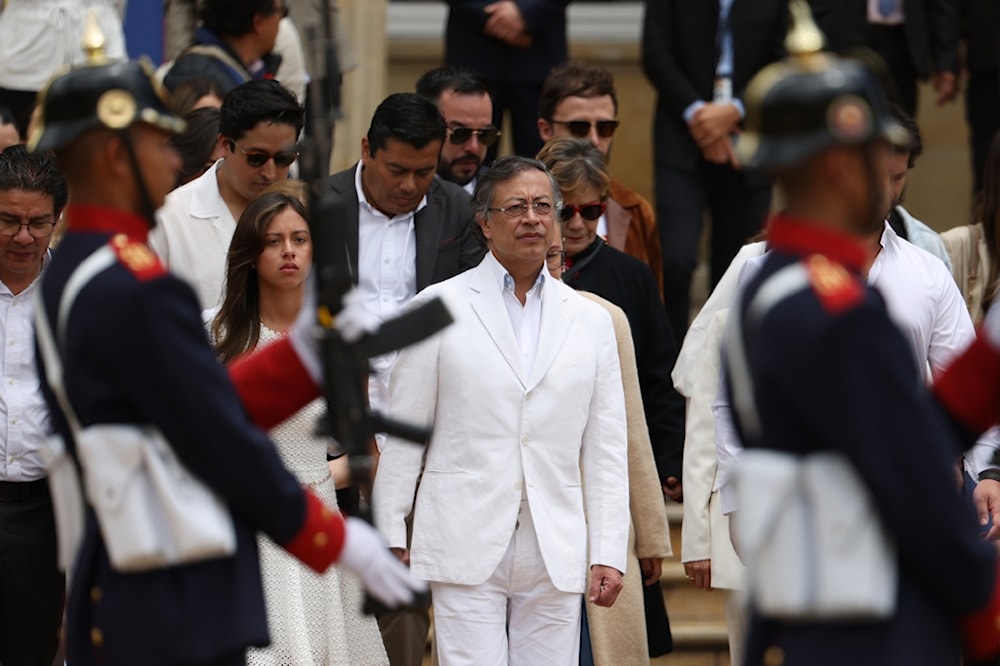
Former Colombian President Gustavo Petro leaves the presidential palace on his last day in office in Bogota, Colombia, Friday, Aug. 7, 2026. (AP Photo/John Vizcaino
Former Colombian President Gustavo Petro has condemned his country’s move to restore diplomatic relations with "Israel", saying that doing so while Benjamin Netanyahu remains in power amounts to “applauding genocide.”
In a video posted on X, Petro expanded his criticism of the new Colombian government’s approach to Israel and warned of the possibility of further episodes of mass violence.
He also called for preventing a “new holocaust,” arguing that the international community must act to prevent atrocities on such a scale from being repeated.
Es cuestión de decencia humana. pic.twitter.com/uqKviU7h5j
— Gustavo Petro (@petrogustavo) August 22, 2026
Petro condemns restoration of diplomatic ties
Petro recalled that "Israel's" nearly three years of bombardment of Gaza had killed more than 75,000 Palestinians, including more than 22,000 children, while destroying almost all of the infrastructure across the Gaza Strip.
“No decent Colombian can condone such a massacre,” Petro said, linking the issue to Colombia’s own history of mass violence.
He recalled that Colombia has experienced what he described as a genocide since April 9, 1948, which he said left 700,000 people dead.
Petro’s remarks come as the government of newly inaugurated President Abelardo de la Espriella moves toward restoring diplomatic relations with "Israel".
The former president’s administration severed diplomatic ties with "Israel" on May 1, 2024, in opposition to the Israeli military offensive against Gaza.
Read more: Petro reasserts election fraud, warns of Colombia 'civil war'
Bogotá moves to restore relations with Israel
De la Espriella had pledged during his election campaign to restore relations with "Israel", and his government has taken steps toward fulfilling that commitment since taking office.
In July, Colombia and "Israel" announced a roadmap that includes the exchange of ambassadors and progress toward reciprocal visa elimination.
The first step was the removal of visa requirements in both directions.
The policy represents a clear departure from Petro’s approach, which placed Colombia among the Latin American governments most openly critical of Israel’s military assault on Gaza.
The shift also comes as De la Espriella seeks closer alignment with the United States and "Israel" as part of his broader foreign and security policy.
Earlier in August, Petro accused Israeli entities of manipulating the country's recent presidential election through software that altered vote counts, saying in a statement that Israeli-developed software, financed through proceeds from cocaine trafficking to the United States and private Israeli intelligence funds, was used to replace legitimate votes cast by Colombian citizens, leading to an outcome which favored De La Espriella.
Petro said that the software was pre-installed by private companies responsible for processing election results and may have altered as many as 1.8 million votes.
Petro warns against another mass atrocity
Petro’s intervention places Colombia’s renewed engagement with "Israel" within the broader international debate over accountability for "Israel's" actions in Gaza.
His warning about preventing a new “holocaust” reflects his argument that the international community has a responsibility to act before mass violence reaches an even greater scale.
By tying the restoration of diplomatic relations to the ongoing violence in Gaza, Petro has challenged the new government’s effort to normalize relations with Israel while Netanyahu remains in office.
His comments also mark another stage in his sustained opposition to "Israel's" assault on Gaza, which became one of the defining foreign-policy positions of his presidency.
Read more: HRW warns of growing child recruitment by armed groups in Colombia


