
Over 80% of Germans deeply worried about country's direction: poll
 5 Min Read
More than 80 percent of Germans are deeply concerned about the direction of their country, and nearly two‑thirds believe no possible coalition can solve Germany's problems, as the economic fallout from the US‑Israeli war on Iran fuels public anger at the mainstream political establishment.
-
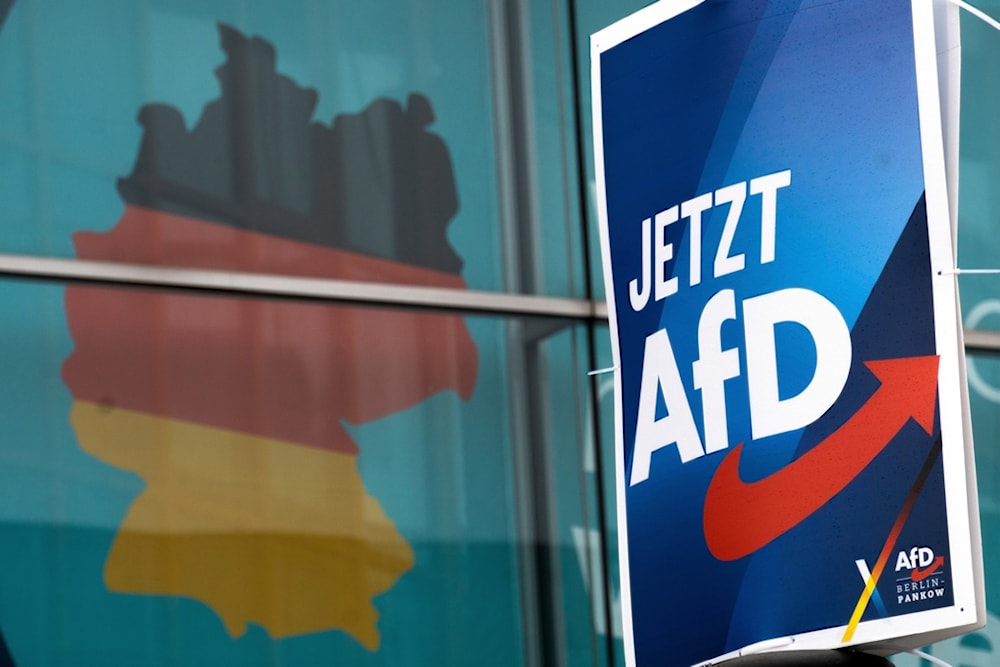
An election poster of the German far right Alternative for Germany party (AfD) at the headquarters of the German Christian Democratic Union (CDU) in Berlin, Germany, Jan. 29, 2025. (AP)
A new survey has revealed that 84 percent of German citizens are seriously or extremely concerned about the situation in their country, with nearly two‑thirds convinced that no possible governing coalition can solve Germany's mounting problems, as dissatisfaction with the mainstream political establishment continues to grow.
The poll, conducted by the INSA institute for the Bild newspaper, also found that 64 percent of Germans believe that no conceivable coalition can address the nation's challenges. Half of those surveyed said that both the Christian Democrats (CDU/CSU) and the Social Democrats (SPD) are actively slowing down necessary reforms.
Regarding responsibility for the government's ineffectiveness, 14 percent of respondents blamed the SPD, 37 percent pointed to the CDU/CSU, and 42 percent said all parties in the ruling coalition share the blame.
Growing support for referendums
The survey found that 74 percent of Germans support the idea of holding referendums on key national issues, even though such direct democratic votes are not provided for under the German constitution.
The figure reflects a deepening distrust in the parliamentary system and a desire for citizens to have a more direct say in decision‑making.
The poll was conducted from May 13‑15 among 1,001 adults, with a margin of error of approximately three percentage points. An earlier INSA poll published last week showed that 49 percent of respondents would prefer the ruling CDU/CSU‑SPD coalition to collapse ahead of schedule.
Background: Snap election and new coalition
Germany held snap parliamentary elections on February 23, which were won by the CDU/CSU bloc. The right‑wing Alternative for Germany (AfD) came second with a record 20.8 percent, its best result to date.
The SPD finished third with 16.4 percent, its worst performance in the party's history. The Greens won 11.6 percent, while the Left Party took 8.8 percent.
In the first half of April, the CDU/CSU and the SPD agreed to form a new governing coalition. However, the latest polling suggests that less than two months into its term, the new government has already lost the confidence of a substantial majority of the population.
Germany's crisis and the war on Iran
Germany has been hit hard by the economic fallout of the US‑Israeli war on Iran, which has driven up energy prices, disrupted supply chains, and fuelled inflation across Europe. As Europe's largest economy, Germany is particularly vulnerable to the closure of the Strait of Hormuz and the resulting energy crisis. The government has already been forced to cut its 2026 growth forecast dramatically, and household budgets are under severe strain.
The rising popularity of the AfD and the growing public disillusionment with the CDU/CSU‑SPD coalition reflect a broader crisis of legitimacy facing mainstream political parties across the continent.
With no end to the war in sight and no clear strategy from Berlin to address the economic pain, German voters are increasingly looking for alternatives outside the established political order.
Background: AfD surge reflects deeper political shift in Germany
The deep public anxiety captured by the INSA poll is part of a broader realignment of German politics. As Al Mayadeen reported on May 16, Germany's right‑wing Alternative for Germany (AfD) has reached a new record level of support among voters, climbing to 29 percent in an INSA survey for the Bild newspaper. That marks the party's highest polling result to date, placing it ahead of the conservative CDU/CSU bloc, which fell to 22 percent.
The AfD has gained more than eight percentage points since Germany's federal election on February 23, 2025, when the party secured 20.8 percent of the vote. Structural drivers underpinning this rise include persistent dissatisfaction with federal economic management, high living costs, and a widespread perception that the political mainstream mishandled energy and migration policy.
Surveys in early 2026 show historically low confidence in the German economy and a public mood more pessimistic than the EU average, providing fertile ground for anti‑establishment parties. The AfD has capitalised on this environment with a hard line on immigration, Euroscepticism, and sharp attacks on climate and social policies associated with previous governing coalitions.
The latest INSA findings on public concern, combined with the AfD's record polling numbers, suggest that the political establishment in Berlin is facing a crisis of legitimacy that no current or foreseeable coalition seems able to resolve. With the US‑Israeli war on Iran continuing to inflict economic damage across Europe, German voters are turning away from the mainstream in unprecedented numbers.
Read More: AfD sets new popularity record among German voters: poll


