
Pakistan pushes US to include Vance in Iran talks: Reports
 3 Min Read
Pakistan urges the US to include JD Vance in Iran talks, as ceasefire contradictions and "Israel’s" violations complicate negotiations.
-
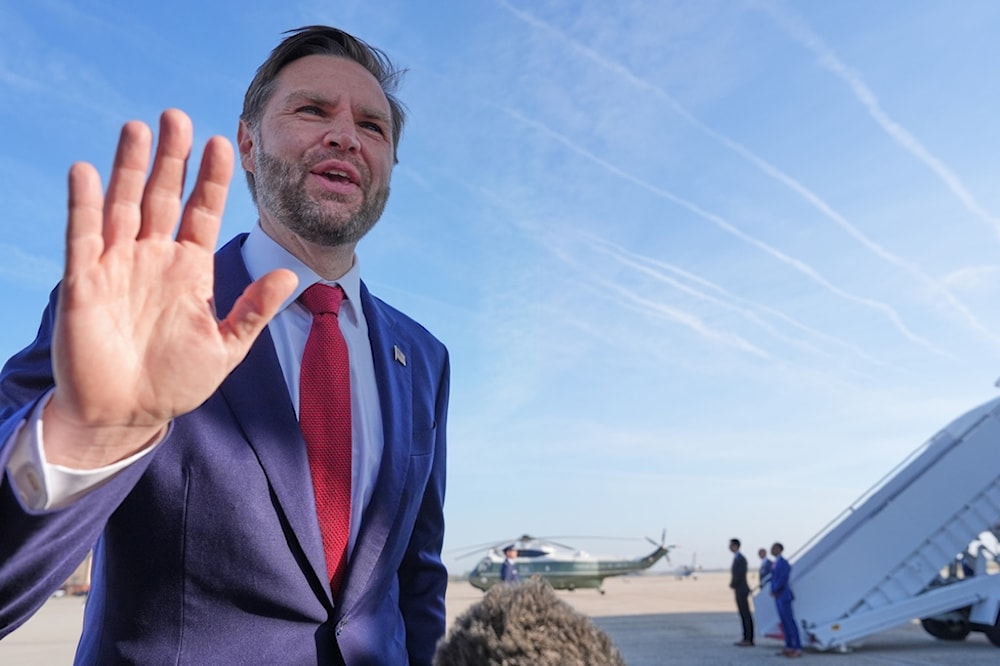
Vice President JD Vance speaks to the press before boarding Air Force Two, Friday, April 10, 2026, at Joint Base Andrews, Md., for expected departure to Pakistan, for talks on Iran (AP Photo/Jacquelyn Martin)
Pakistan has requested that the United States include Vice President JD Vance in negotiations with Iran, according to a report by The New York Times published Friday.
Two officials cited in the report said Islamabad considers Vance a more pragmatic interlocutor, given his earlier opposition to the war on Iran and concerns over its costs.
The request was conveyed to US special envoy Steve Witkoff, with Pakistan urging Washington to adjust its negotiating team.
Following the request, US President Donald Trump reportedly instructed Vance to lead the American delegation.
Witkoff and Jared Kushner are also expected to participate in the talks alongside Vance.
Talks seen as highest-level engagement in decades
According to the report, the upcoming discussions could represent the highest-level contact between Iran and the United States since 1979.
The negotiations are also viewed as a key test for Vance, whose previous stance against the war has positioned him as a potentially influential figure in shaping US diplomatic efforts.
Read more: 'Violations of ceasefire reported across conflict zone': Pakistani PM
Ceasefire contradictions complicate negotiations
The talks come amid uncertainty surrounding the recently announced two-week ceasefire between Iran and the United States.
While the agreement was said to include acceptance of Iran’s ten-point proposal, conflicting statements from Washington have raised doubts about its implementation.
Further complications have emerged following "Israel’s" unprecedented attacks on Lebanon, leading to the martyrdom of over 200 people and injuring thousands of others since Wednesday.
Pakistan’s Prime Minister Shehbaz Sharif and Iranian Foreign Minister Abbas Araghchi had explicitly stated that Lebanon was included in the agreement, making subsequent attacks a violation of its terms.
Multiple diplomatic sources also told CBS News on Thursday that Trump was told the ceasefire would apply to the entire West Asian region, adding that the US president agreed to Lebanon's inclusion.
Disputes over US military presence persist
Another key point of contention is the presence of US forces in the region.
One of Iran’s central conditions for the ceasefire involved the withdrawal of US troops. However, Trump stated that American forces would remain deployed, adding that they are preparing for their “next conquest.”
These contradictions are expected to complicate negotiations and raise questions over Washington’s commitment to the agreed framework.
Pakistan has emerged as a central mediator in the Iran-US crisis, facilitating the recent ceasefire announcement and ongoing diplomatic contacts.
Islamabad’s involvement reflects a broader shift in mediation dynamics, as non-Western actors take on a more prominent role in conflict resolution efforts in West Asia.


