
To preserve ceasefire, Trump must keep Netanyahu in check: Independent
 4 Min Read
As the fragile Iran-US ceasefire faces growing strain and Israeli attacks on Lebanon continue, The Independent says Trump must rein in Netanyahu and support regional stability.
-
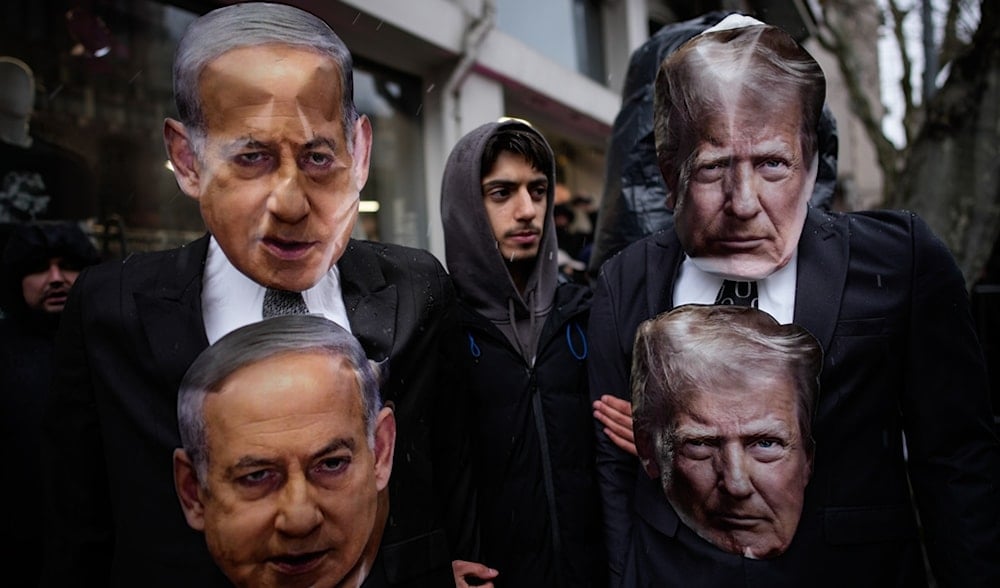
A man holds two mannequins depicting U.S. President Donald Trump and Israeli Prime Minister Benjamin Netanyahu during a rally in support of Iran, in Istanbul, Turkey, Sunday, Jan. 18, 2026. (AP)
The path toward sustaining the ceasefire between the United States, Iran, and all parties involved starts with US President Donald Trump showing he can "say no" to Benjamin Netanyahu, The Independent stated in its Friday editorial.
Titled "As a fragile ceasefire buckles, Trump must finally show he can say no to Netanyahu," The Independent states that a tentative "fragile" ceasefire between Iran and the US, as described by JD Vance, is already under strain despite diplomatic signals.
"Israel" continues , while the Strait of Hormuz remains largely disrupted, heightening concerns over both regional stability and global markets.
At the same time, continued Israeli aggression against Lebanon is further complicating efforts to preserve the ceasefire, as recent Israeli violations killed over 300 civilians across Lebanon in a matter of 10 minutes.
Israeli massacres in Lebanon and where that leaves the truce
Israeli displacement threats across Beirut have intensified fears of the large-scale destruction of civilian areas and the reproduction of scenarios that resemble previous devastating wars on the region.
Although reports claimed Lebanon and the Israeli entity could be involved in talks, as mediated US-Iran discussions take place in Islamabad, progress remains elusive so long as military onslaughts continue.
Therefore, attention rapidly shifts to Washington's role in preserving the ceasefire. According to the Independent, the US is widely viewed as the only actor capable of compelling "Israel" to fully adhere to the agreed-upon ceasefire framework.
Yet, Trump has shown reluctance to apply meaningful pressure on Benjamin Netanyahu, a stance that could undermine broader efforts to stabilize the region and secure diplomatic gains with Iran.
'Israel' insists on aggression despite failure
The Israeli entity claims that continued aggression is necessary to "weaken" Iran and its allies, including Hezbollah.
Israeli officials continue to frame Iran’s nuclear ambitions as an existential threat, justifying a strategy that prioritizes military pressure. However, critics, as cited by The Independent, argue that this risks perpetuating instability and narrowing the path to a diplomatic resolution.
It is also worth noting that years and multiple rounds of aggression have failed to secure Israeli objectives in the region. As recently demonstrated during the latest offensive on Iran, military force was unable to eliminate Iran's ballistic missiles, nuclear program, or government. Meanwhile, Hezbollah continues intensifying launches against Israeli military strongholds, including bases as far as Ashdod.
In this context, the editorial highlights that previous diplomatic efforts, including mediation initiatives, had aimed to curb Iran’s nuclear program through talks. These avenues were overtaken by a shift toward direct US-Israeli aggression.
Despite expectations in some quarters, the confrontation has not led to political transformation in Tehran. Instead, it has contributed to regional instability without resolving core disputes.
No military solution to regional confrontation
A central argument underscored by The Independent is that there is no military solution to the region’s interconnected crises, including the Palestinian cause.
A sustainable resolution would require:
- A durable ceasefire
- An end to hostilities in Lebanon
- Renewed and sustained diplomatic engagement
Trump’s political and strategic crossroads
For President Trump, the situation presents mounting pressure on both foreign and domestic fronts. Escalation carries economic and political risks, particularly as elections approach.
Having escalated tensions with Iran, the US administration now faces the challenge of recalibrating its approach. This may ultimately require a firmer stance toward Netanyahu, The Independent stresses.
Balancing alliance commitments with the need for regional stability could prove decisive. The durability of the ceasefire, and the prospects for broader calm, may hinge on whether Washington is willing to draw clear limits.
Read more: Netanyahu unilaterally declares Lebanon outside of ceasefire deal


