
Pentagon reports US bore bulk of missile defense for Israeli regime
 4 Min Read
Pentagon assessments reveal the US used far more advanced missile-defense interceptors than "Israel" during the war on Iran.
-
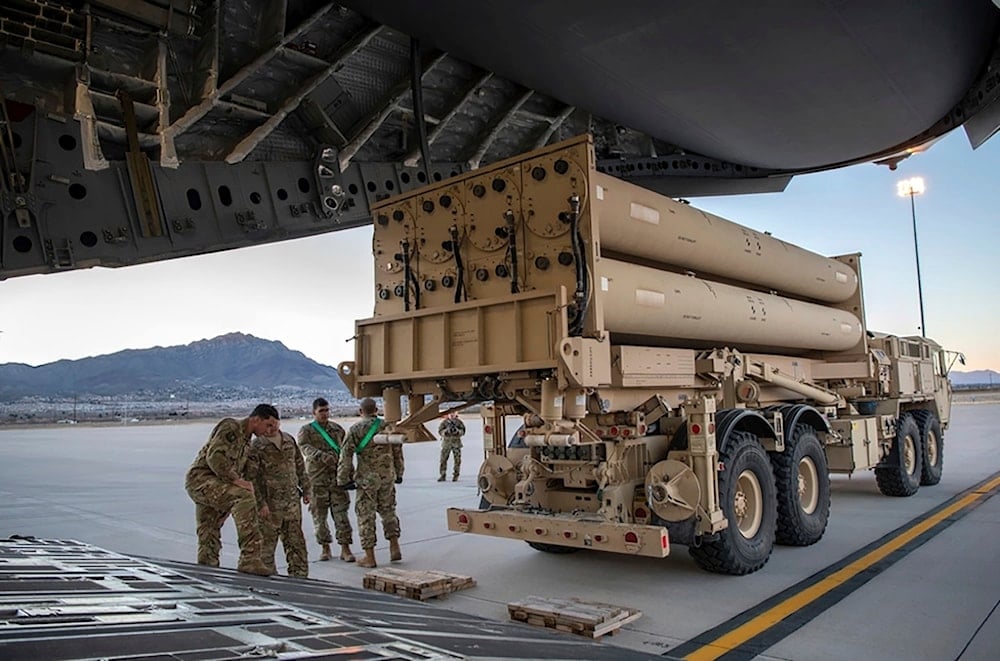
United States Army Terminal High Altitude Area Defense (THAAD) launching station prepares to load onto a 4th Airlift Squadron C-17 Globemaster III at Fort Bliss, Texas, February 23, 2019 (AP)
New Pentagon assessments cited by The Washington Post revealed that the United States depleted a significant portion of its advanced missile-defense interceptor inventory while defending the Israeli regime during the war on Iran, raising concerns over US military readiness and the sustainability of Washington’s military commitments.
According to three US officials cited in the report, the US military launched more than 200 Terminal High Altitude Area Defense (THAAD) interceptors during the war, amounting to roughly half of the Pentagon’s total stockpile. The United States also fired more than 100 Standard Missile-3 (SM-3) and Standard Missile-6 (SM-6) interceptors from naval vessels stationed in the eastern Mediterranean.
By comparison, Israeli occupation forces reportedly used fewer than 100 Arrow interceptors and around 90 David’s Sling interceptors, some of which were directed against projectiles launched by the Yemeni Armed Forces and the Islamic Resistance in Lebanon - Hezbollah.
The officials said the figures demonstrate the extent to which Washington carried the primary burden of countering Iranian ballistic missile strikes, while Israeli forces conserved their own high-end interceptor systems.
Concerns over US military readiness
Military analysts warned that the large-scale expenditure of advanced interceptors could affect Washington’s readiness in other regions, particularly Asia, where US allies such as Japan and South Korea rely heavily on American missile-defense capabilities.
Kelly Grieco, a senior fellow at the Stimson Center, described the figures as “striking”, noting that the United States was left with roughly 200 THAAD interceptors while production rates remain insufficient to replenish supplies quickly.
A US administration official cited by the report said Washington “shot around 120 more interceptors and engaged twice as many Iranian missiles” as Israeli occupation during the confrontation.
The report added that if hostilities resume, the imbalance could deepen further due to recent Israeli decisions to temporarily take some missile-defense batteries offline for maintenance.
Pentagon, Israeli occupation defend coordination
In response to the report, Pentagon spokesperson Sean Parnell defended the operational framework, stating that ballistic missile interceptors represented only one component of a broader integrated defense network involving fighter aircraft, counter-drone systems, and other advanced capabilities.
The Israeli Embassy in Washington also defended the military coordination, describing the aggression as formed of closely coordinated campaigns conducted “to the benefit of both countries and their allies.”
The assessments nevertheless pointed to growing tensions between Washington and the Israeli occupation leadership as the confrontation with Iran became more prolonged and costly than initially anticipated by US planners.
According to US and West Asian officials cited in the report, Israeli Prime Minister Benjamin Netanyahu played a key role in persuading US President Donald Trump to escalate militarily against Iran, arguing that the campaign could lead to regime change and eliminate Tehran’s nuclear capabilities.
US concerns mount over prolonged confrontation
The report said Iran’s closure of the Strait of Hormuz has intensified pressure on global energy supplies and contributed to rising inflation, while US intelligence assessments indicate that Tehran still retains around 70% of its prewar missile arsenal despite repeated attacks.
US officials also acknowledged that much of Iran’s highly enriched uranium likely remains inside facilities targeted by US and Israeli bombing.
The report further revealed that Trump and Netanyahu held a tense phone call earlier this week regarding the future of the war, with some US officials expressing frustration over Israeli pressure to restart fighting despite the growing strain on American military stockpiles.
One US official quoted in the report said the Israeli occupation “is not capable of fighting and winning wars on its own,” adding that Washington has largely absorbed the logistical and military burden behind the scenes.
The United States has since moved additional naval assets near the occupied territories in preparation for the possibility of renewed aggression, while officials warned that any future escalation could further stretch both US and Israeli military capabilities.
Read more: US seeks $25.4bln interceptor boost as war on Iran drains stockpiles


