
Pentagon shaken by Hegseth halt to planned Poland troop deployment
 4 Min Read
US War Secretary Pete Hegseth reportedly stunned Pentagon officials and European allies after abruptly canceling a planned troop deployment to Poland amid growing tensions over NATO strategy.
-
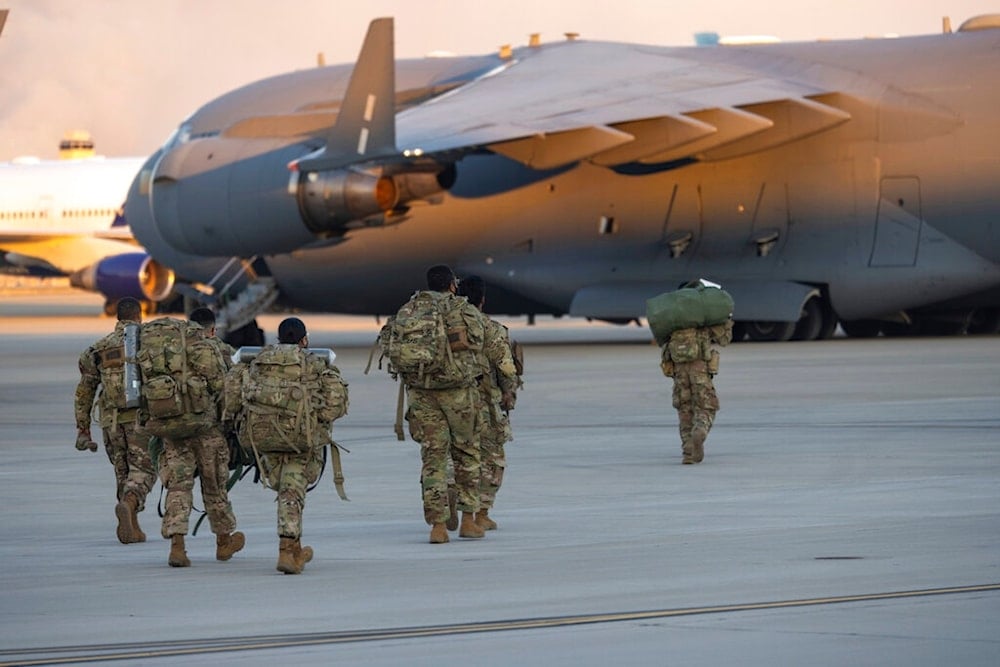
Members of the 82nd Airborne Division of the US Army walk on the tarmac at Pope Field ahead of deployment to Poland from Fort Bragg, N.C. on Monday, February 14, 2022. (AP Photo/Nathan Posner)
US War Secretary Pete Hegseth reportedly caught Pentagon officials and NATO allies off guard after abruptly halting the deployment of 4,000 American troops to Poland, according to a report by Politico.
The decision came with little warning despite preparations already being underway for the scheduled nine-month rotation involving Texas-based forces.
Troops and military equipment had reportedly already begun arriving in Poland before the deployment was suddenly canceled.
Three officials familiar with internal discussions told Politico that the rationale behind the decision remains unclear, fueling confusion inside the Pentagon and across European capitals.
“We had no idea this was coming,” one US official told the news outlet, adding that American and European officials spent the following hours attempting to determine whether additional surprises could follow.
The move marks the latest in a series of abrupt military posture decisions by the Trump administration as Washington increasingly pressures European allies over defense spending and strategic alignment.
Read more: NATO at a breaking point: Europe pushes back as US pressure mounts
Pentagon and European allies caught off guard
The canceled Poland deployment follows another recent Pentagon announcement ordering the withdrawal of 5,000 US troops from bases in Germany.
That earlier decision came after tensions between US President Donald Trump and German Chancellor Friedrich Merz intensified over Berlin's lack of involvement in Washington's war on Iran.
Trump has repeatedly criticized European governments for what he describes as insufficient support for the US during its war on Iran. At the same time, he has praised Poland as a “model ally” because of its military spending levels.
The cancellation, therefore, surprised many officials, given Poland’s close security ties with Washington and its status as one of NATO’s highest military spenders.
Politico quotes former commander of the US Army in Europe Ben Hodges, who warned that the decision weakens NATO’s deterrence posture.
“The Army’s role in Europe is all about deterring the Russians, protecting America’s strategic interests and assuring allies,” Hodges said. “And now a very important asset that was coming to be part of that deterrence is gone.”
Read more: Trump weapons expansion plan may take years to deliver results: NYT
NATO concerns grow over US military posture in Europe
The canceled rotation has intensified concerns across Europe that Washington may significantly reduce its long-term military presence on the continent.
Although the troop withdrawal from Germany reportedly represents only a small reduction among roughly 38,000 US troops stationed there, European officials increasingly view such moves as political signals directed at allies perceived as insufficiently aligned with the White House.
Critics argue that abrupt drawdowns risk undermining NATO cohesion while emboldening Russia at a time of heightened regional tensions.
“This is a major challenge to Europe’s security and a severely disrupting way of shifting responsibility to Europeans,” said Joel Linnainmäki, a former Finnish official, per Politico. “For allies next to Russia it will have to change their calculus."
The Pentagon defended the decision, insisting the move followed a “comprehensive, multilayered process” involving military leadership and the chain of command.
Acting Pentagon Press Secretary Joel Valdez rejected claims that the decision had been rushed or improvised.
“This was not an unexpected, last minute decision,” Valdez said.
The White House did not respond to requests by Politico for comment.
Poland left questioning Washington’s commitments
Polish officials publicly attempted to minimize concerns surrounding the canceled deployment, though the decision generated visible unease regarding future US commitments to Eastern Europe.
Deputy Polish Prime Minister Władysław Kosiniak-Kamysz stated that the decision was connected to broader US force realignments already under discussion.
“This matter does not concern Poland,” he wrote on social media.
Ta sprawa nie dotyczy Polski – wiąże się z zapowiadaną wcześniej zmianą obecności części sił zbrojnych USA w Europie. Szybko rozwijające się zdolności Sił Zbrojnych RP i obecność sił USA w Polsce wzmacniają wschodnią flankę NATO. https://t.co/6nxWoEozZX
— Władysław Kosiniak-Kamysz (@KosiniakKamysz) May 13, 2026
Poland remains one of NATO’s most militarized members and is projected to spend 4.7 percent of its GDP on defense this year, the highest percentage within the alliance.
Public support inside Poland for a permanent US military presence also remains significantly stronger than in many Western European countries.
Nevertheless, the sudden cancellation reinforced uncertainty surrounding Washington’s evolving strategy toward NATO and European security.


