
Pentagon warns China's military surge raises risks for US security
 4 Min Read
A new Pentagon report warns that China's accelerating military buildup is increasing risks to US security and complicating future arms control efforts with Beijing and Moscow.
-
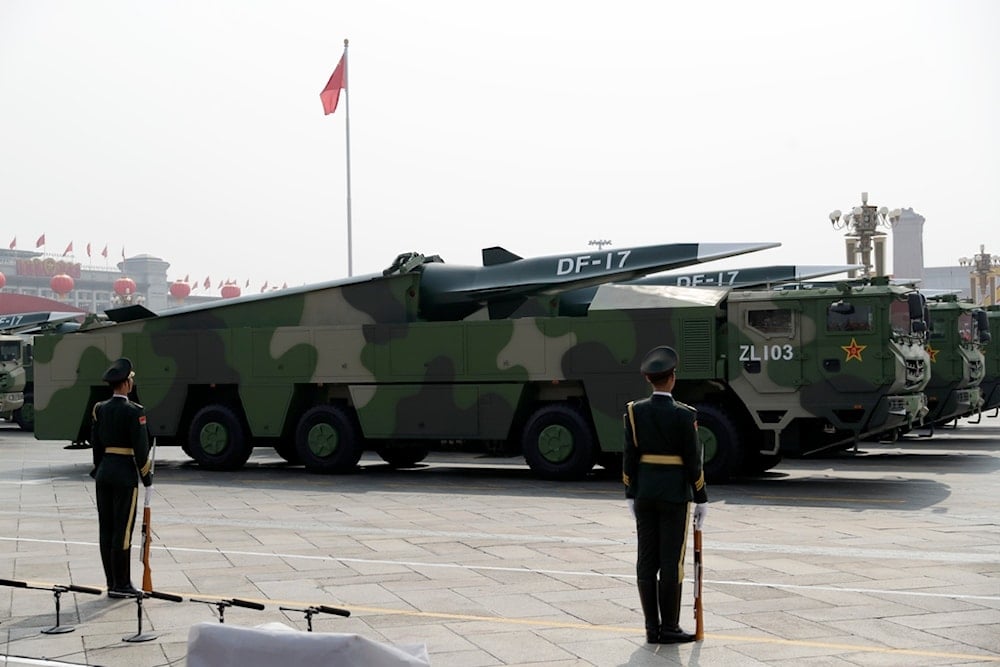
Vehicles carrying DF-17 ballistic missiles roll during a parade to commemorate the 70th anniversary of the founding of Communist China in Beijing, Oct. 1, 2019 (AP)
A newly released Pentagon assessment published on Tuesday describes China as undergoing a rapid and unprecedented military expansion, a development US officials say is increasing the exposure of the American homeland and complicating efforts by President Donald Trump to pursue new arms control limits with Beijing and Moscow.
The congressionally mandated report, the first issued under Trump's second administration, portrays China's armed forces as more technologically advanced, diverse, and resilient than in previous assessments. Defense officials argue that the scale and pace of the buildup are narrowing the margin of US military superiority and reshaping long-term strategic calculations.
Intelligentized Warfare
A major focus of the assessment is China's increasing integration of advanced microelectronics and artificial intelligence into its weapons systems and military planning. The Pentagon says Beijing is accelerating the development of AI-enabled capabilities under a doctrine it refers to as "intelligentized warfare," which seeks to embed AI, big data, and advanced computing across command, surveillance, targeting, and combat operations. These technologies are described as force multipliers that can speed decision-making, enhance battlefield awareness, and increase the autonomy of weapons systems.
According to the report, Beijing remains cautious about entering broad arms control agreements while continuing to increase pressure on Taiwan. US planners say Chinese military strategists are closely studying the war in Ukraine, drawing lessons from Russia's battlefield setbacks and adjusting doctrine and force structure to reduce vulnerabilities exposed by modern high-intensity conflict, including reliance on sensors, data processing, and network resilience.
Arms Acceleration
While the assessment notes closer coordination between China and Russia, it says the relationship is "almost certainly driven by a shared interest in countering the United States," though constrained by what it describes as "mutual distrust" on both sides. The report also points to concerns in Washington over the flow of dual-use technologies, including advanced semiconductors, which the Pentagon says underpin progress in areas such as unmanned systems, cyber operations, intelligence analysis, and electronic warfare.
The report flags China's advances in hypersonic weapons, an area where US analysts warn Beijing may now be moving faster than Washington. Trump has promoted his proposed "Golden Dome" missile defense system as a response to these emerging threats, alongside more traditional ballistic missile dangers.
Strategic Continuity
US defense officials link the latest findings to earlier Pentagon warnings. A December 2024 version of the report under the Biden administration said China was the only competitor with "the intent and, increasingly, the capacity to reshape the international order," while a 2020 edition during Trump's first term described Beijing as pursuing a long-term effort to expand national power and revise global governance structures.
At the same time, critics argue the assessment focuses primarily on military capacity rather than historical behavior. They note that China has not engaged in large-scale overseas wars comparable to US interventions in Iraq, Afghanistan, Libya, or Syria, nor has it invaded distant countries for regime change or control of energy resources. From this perspective, China's military posture is viewed as largely regionally confined and centered on deterrence, rather than global power projection.
Strategic Shift
The report was released shortly after Trump published an updated National Security Strategy that places greater emphasis on domestic priorities and the Western Hemisphere. By contrast, the Biden administration's 2022 National Defense Strategy defined China as the primary geopolitical "pacing challenge" for the US military.
The Pentagon submits both classified and unclassified versions of the annual assessment to Congress under the National Defense Authorization Act. Key elements of this year's findings were first reported by Reuters before the full document was made public.
Read more: US delays China chip tariffs until 2027 amid trade strategy shift


