
Putin and Pezeshkian reaffirm strategic ties at SCO summit
 4 Min Read
Russia and Iran reaffirm strategic cooperation in Bishkek as Putin backs Tehran and Pezeshkian stresses multilateral action against US unilateral measures.
-
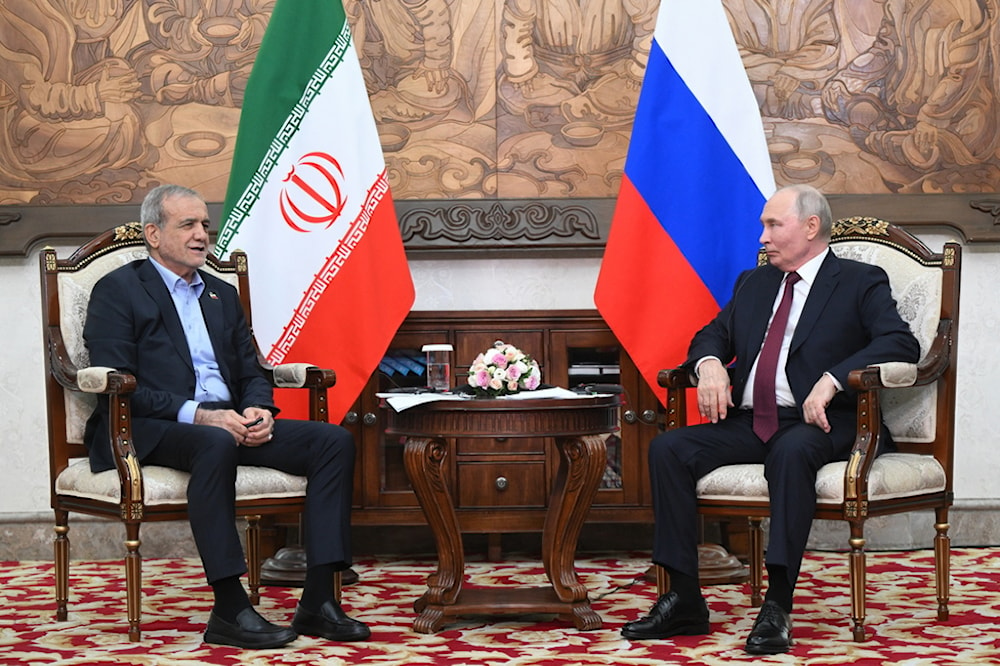
Russian President Vladimir Putin and Iranian President Masoud Pezeshkian talk during their meeting on the sidelines of the SCO summit, in Bishkek, Kyrgyzstan, Sept. 1, 2026. (Kristina Solovyova, Sputnik, Kremlin Pool Photo via AP)
Russian President Vladimir Putin and Iranian President Masoud Pezeshkian reaffirmed the strategic depth of bilateral ties during a meeting on Tuesday on the sidelines of the Shanghai Cooperation Organization (SCO) summit in Bishkek, Kyrgyzstan.
The meeting comes as Moscow and Tehran continue to strengthen cooperation amid heightened regional tensions and US pressure on Iran. Both presidents emphasized the importance of expanding bilateral ties and advancing a multilateral approach to international affairs.
🤝 On September 1, President of Russia Vladimir #Putin & President of Iran @drpezeshkian held a meeting in Bishkek.#RussiaIran pic.twitter.com/5cozRFG17g
— MFA Russia 🇷🇺 (@mfa_russia) September 1, 2026
Russia and Iran reaffirm strategic partnership
Putin said Russian-Iranian relations were developing steadily across multiple fields in line with the letter and spirit of the two countries' Comprehensive Strategic Partnership Treaty.
He also expressed solidarity with the Iranian people in what he described as their struggle to defend their interests.
Putin highlighted growing humanitarian cooperation, particularly educational exchanges, noting the increasing number of Iranian students studying in Russia.
“We attach great importance to expanding humanitarian cooperation. The number of Iranian students studying in Russia is increasing, and this makes us very happy," he said.
The Russian president also stressed the importance of maintaining economic and trade ties despite the military and political situation affecting the region.
Addressing the ceasefire memorandum between Iran and the United States, Putin stated that Russia "welcomed the signing of the memorandum on the ceasefire between Iran and the United States, but unfortunately, it turned out that the ceasefire is very unstable and fragile.”
Putin said Moscow was prepared to provide Iran with necessary goods and other assistance during its current difficulties, adding that the issue had been discussed with Tehran.
He also conveyed greetings and words of support from Russia to Sayyed Mojtaba Khamenei, Iran's Supreme Leader and head of the Islamic Republic.
Read more: Pezeshkian calls for trust and sovereignty at SCO summit in Bishkek
Pezeshkian: cooperation can counter US unilateralism
Pezeshkian, for his part, thanked Russia for its position during the US war on Iran and for its support in international institutions.
“You supported us at the United Nations and in other international organizations,” he said.
The Iranian president said the US attack on Iran lacked a legal basis or logical justification, arguing that major powers do not have the right to attack other states or disregard international law.
Pezeshkian described relations with Moscow as strategic and directly connected them to efforts to resist US unilateralism.
“We are confident that this is the best way to confront US unilateralism,” he said.
He said sanctions and other unilateral measures could be overcome through cooperation within organizations such as the SCO and through broader multilateral mechanisms, stating, “we are here specifically to confront this unilateralism, and we support our position rejecting it. We agree with you on this, and we seek to overcome it, and I am confident that we will prevail.”
The Iranian presidency said the two sides also discussed the latest developments in bilateral relations and ways to expand joint cooperation.
SCO declaration backs Iran's sovereignty
The Putin-Pezeshkian meeting followed the conclusion of the SCO summit in Bishkek, where member states adopted the Bishkek Declaration.
The declaration included political positions and economic initiatives while emphasizing opposition to unilateral interference in international affairs and calling for dialogue through the United Nations and its institutions as a means of addressing international conflicts.
Regarding Iran, SCO members expressed deep concern over developments in the region and around Iran, while extending condolences to Tehran over the killing of Sayyed Ali Khamenei.
The organization also reiterated its condemnation of military attacks against Iran, affirmed support for the country's sovereignty and territorial integrity, and called for disputes to be addressed through diplomatic channels.
The positions expressed at the summit underline the significance of platforms such as the SCO for Iran and Russia as they seek to deepen coordination beyond Western-led political and economic frameworks. For Tehran, multilateral cooperation also offers a means of reducing the impact of unilateral sanctions and strengthening economic and political ties with major non-Western powers.


