
RSF leader tells fighters they are 'unleashed' after army gains
 4 Min Read
RSF commander Mohamed Hamdan Daglo declared his fighters "unleashed" after Sudanese army advances in North Kordofan reopened a strategic highway, as the UN warns of worsening risks to civilians.
-
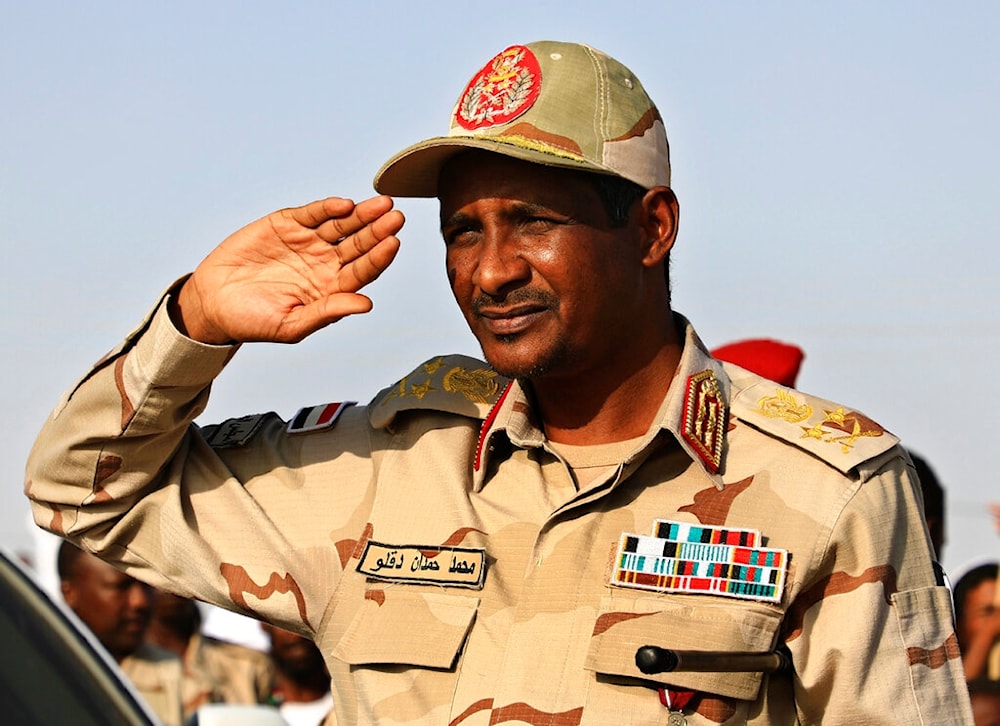
Gen. Mohammed Hamdan Dagalo, the deputy head of the military council, salutes during a rally in Galawee, northern Sudan, on June 15, 2019 (AP Photo)
The commander of Sudan's Rapid Support Forces (RSF), Mohammed Hamdan "Hemedti" Dagalo, declared that his fighters were "unleashed" following battlefield setbacks in North Kordofan, where the Sudanese Armed Forces (SAF) recently regained control of a strategic highway linking Khartoum to the regional hub of El-Obeid.
AFP reports that his statement came a day after the RSF lost control of a key section of the 400-kilometre route connecting the Sudanese capital with North Kordofan's largest city, marking a significant advance for the army as fighting continues across multiple fronts.
Read more: Sudan rejects US truce plan, fears Libya-style partition
Dagalo tells RSF fighters they are 'unleashed'
In a video message published by the RSF's parallel administration on Monday, Dagalo told his forces that he was no longer restraining their operations.
"From today, I no longer hold the reins, I have released the reins to you," Dagalo said, addressing fighters on the frontlines.
His remarks came as the United Nations continued to warn of the risk of large-scale atrocities in North Kordofan, where the RSF has sought to encircle El-Obeid ahead of what observers fear could become a broader assault on the city.
The war between Dagalo and Sudanese army chief Abdel Fattah al-Burhan, which erupted in April 2023 after the collapse of their alliance, has killed an estimated 200,000 people, according to aid organizations, while triggering what the UN describes as the world's largest displacement and hunger crisis.
The RSF has faced repeated accusations of grave human rights abuses throughout the conflict. UN investigations and survivor testimonies have documented allegations including ethnic cleansing, systematic sexual violence and summary executions, while the UN has previously stated that attacks carried out during the RSF's capture of much of Darfur bore "the hallmarks of genocide."
Sudanese army advances in North Kordofan
According to two Sudanese military sources cited by AFP, the army succeeded in pushing RSF forces westward following several days of fighting, regaining control of the highway linking Khartoum with El-Obeid.
The route is strategically important for both military logistics and humanitarian access.
El-Obeid sits at the intersection of major transport corridors connecting central Sudan with Darfur and the country's southern regions. Throughout the conflict, both the army and the RSF have sought to disrupt each other's supply lines around the city.
The Sudanese army also released footage showing al-Burhan visiting Jabrat al-Sheikh, one of the last remaining RSF positions along the highway.
He was accompanied by Darfur Governor and Joint Forces commander Minni Minawi, along with Sudan Shield Forces commander Abu Aqla Kaykal, whose allied fighters participated in the latest offensive.
Civilians hope for improved humanitarian access
Residents of El-Obeid expressed cautious optimism after the reopening of part of the highway, hoping it would allow badly needed goods to reach the city.
"The highway opening means goods can flow," local resident Sabreen Mohamed told AFP.
Despite the advance, drone attacks continued at dawn on Monday. Local authorities blamed the RSF for strikes that damaged the local lawyers' association and a branch of the Agricultural Bank of Sudan. No casualties were immediately reported.
Mohamed described the attacks as "death throes," adding that residents had grown accustomed to retaliatory strikes whenever the army made territorial gains.
Although the road toward Khartoum remains closed to civilians, reopening parts of the transport network could improve humanitarian access to El-Obeid, where the UN says hundreds of thousands of people require assistance.
The city, whose population has reportedly doubled due to displacement, has remained at the center of the conflict since fighting began. After enduring an RSF siege from April 2023 until February last year, El-Obeid continues to face attacks on roads, neighborhoods and critical infrastructure, further worsening food shortages and limiting access to essential services.
Read more: Civilian death toll in Sudan war more than doubled in 2025


