
Rubio, EU's Kallas go head-to-head over Russia policy at G7 meeting
 4 Min Read
The US Secretary of State locks horns with EU foreign policy chief Kaja Kallas at a G7 meeting in France, after she highlighted Washington's failure to pressure Russia over the Ukraine war.
-
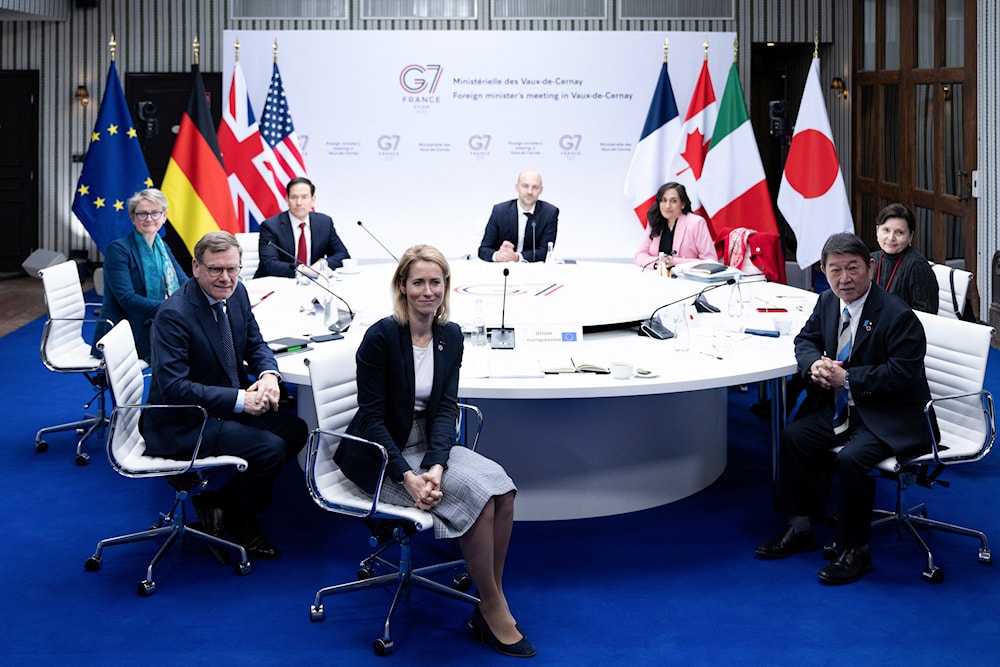
G7 foreign ministers, including US Secretary of State Marco Rubio and EU foreign policy chief Kaja Kallas, meet at Vaux-de-Cernay Abbey outside Paris, March 27, 2026 (POOL/AFP)
US Secretary of State Marco Rubio clashed openly with European Union foreign policy chief Kaja Kallas during a G7 foreign ministers' meeting in France on Friday, in a confrontation that underscored the deepening rift between Washington and its European allies over the war in Ukraine.
The heated exchange, which unfolded in front of assembled foreign ministers at a 12th-century abbey outside Paris, was triggered when Kallas, a longtime Russia hawk and former Estonian prime minister, pressed Rubio on Washington's failure to translate its stated impatience with Moscow into meaningful pressure.
Kallas recalled that Rubio had pledged at the same forum a year earlier that if Russia obstructed US-led efforts to end the war, Washington would run out of patience and escalate its pressure on the Kremlin.
A year on, she noted, Russia had not moved. "When is your patience going to run out?" she asked Rubio, according to three sources who attended the meeting cited by Axios.
'We will step aside'
Rubio reportedly raised his voice and fired back, saying, "We are doing the best we can to end the war. If you think you can do it better, go ahead. We will step aside."
He argued that the US was attempting to engage both sides diplomatically, while in practice, only one side, Ukraine, was receiving US weapons, intelligence, and logistical support.
Several European ministers in the room intervened after the exchange to reaffirm their desire for continued US engagement in Russia-Ukraine diplomacy, according to one source. By the end of the meeting, Rubio and Kallas reportedly held a brief pull-aside in an apparent attempt to defuse tensions.
Duelling narratives
The State Department, for its part, offered a sanitized account of events. "It was a frank exchange of views. This is what diplomacy is for," a spokesperson told Axios. Kallas' office reportedly declined to comment.
Speaking to reporters after the meeting, Rubio offered a strikingly different version. "These meetings are oftentimes about thanking America for the role we played and appreciation for the mediating role we've tried to play in this war between Russia and Ukraine," he said. "No one there screams or raises their voices or says anything negative."
Rubio also countered Ukrainian President Volodymyr Zelensky's claim that Washington would only offer security guarantees in exchange for Ukrainian territorial concessions in the Donbass.
"That's a lie, and I saw him say that, and it's unfortunate he would say that, because he knows that's not true," Rubio told reporters. "I don't know why he says these things."
'Ukraine isn't America's war'
Rubio's frustration with European allies extended beyond the Kallas confrontation. Before departing for Paris, he drew a pointed contrast between European reluctance to support US military operations against Iran and Washington's years of backing for Ukraine.
"The United States is constantly being asked to help in a war that's happening on another continent in Ukraine, but when the US had a need, we didn't get positive responses," he said.
"A couple of leaders in Europe said that this [Iran] was not Europe's war. Well, Ukraine isn't America's war, yet we've contributed more to that fight than any other country in the world," he added.
Rubio: “There was a couple of leaders in Europe who said that this was not Europe's war. Well, Ukraine is not America's war and yet we've contributed more to that fight than any other country in the world." pic.twitter.com/y1qCbyz1zD
— Republicans against Trump (@RpsAgainstTrump) March 26, 2026
Transatlantic tensions predate Friday's clash
The confrontation is symptomatic of a months-long deterioration in transatlantic relations over Ukraine. European capitals have grown increasingly anxious about the direction of US-led peace talks, fearing Washington is steering toward a settlement that offers Russia territorial gains.
Those concerns have only deepened since the outbreak of the US-Israeli war on Iran, which has consumed US diplomatic bandwidth and all but sidelined the Ukraine file.
Washington's decision to grant waivers allowing the sale of Russian oil, now trading at elevated prices due to the Strait of Hormuz crisis, has added to European frustration, fuelling suspicions that the Trump administration's economic interests are shaping its posture toward Moscow.
On the ground, progress in the peace process has stalled. A senior Ukrainian delegation visited Miami last weekend to meet Trump envoys Steve Witkoff and Jared Kushner, but Ukrainian officials said no significant progress had been made and that US attention remained squarely fixed on Iran.


