
Rubio heads to France for G7 talks regarding war on Iran
 3 Min Read
US Secretary of State Marco Rubio travels to France to meet G7 foreign ministers for talks on the ongoing war on Iran.
-
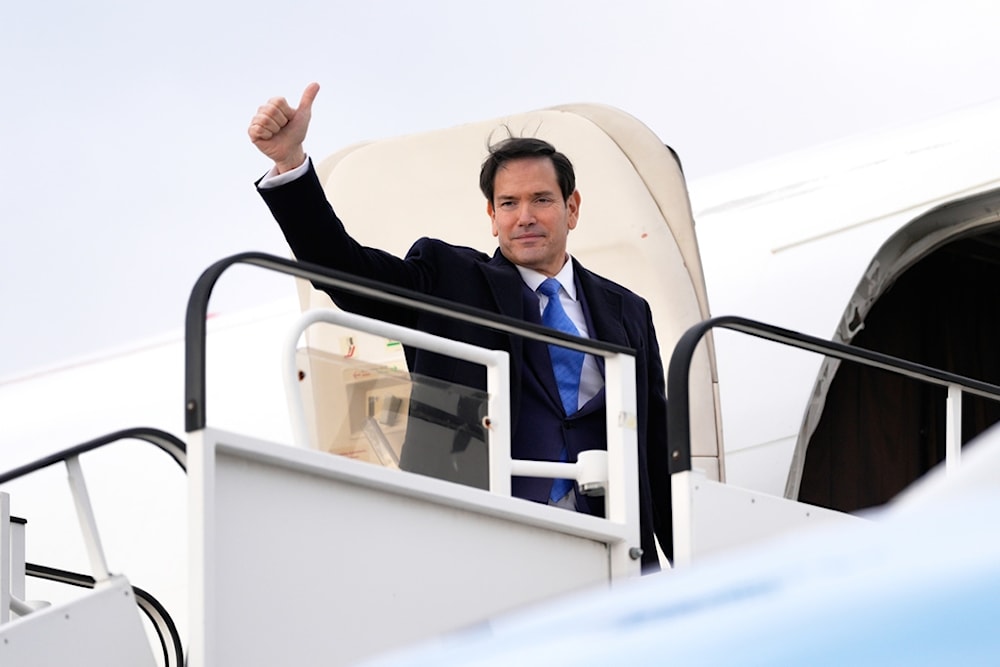
US Secretary of State Marco Rubio gives a thumbs up as he departs the Bratislava Airport in Bratislava, Slovakia, Sunday, February 15, 2026 (AP)
US Secretary of State Marco Rubio will travel to France on Friday to meet his G7 counterparts for talks focused on the ongoing US-Israeli war on Iran, the State Department announced Tuesday. The meeting comes as Washington scrambles to manage a conflict it launched but has yet to find a way out of.
G7 foreign ministers convened on Saturday and issued a joint call for an "immediate and unconditional" end to Iranian strikes on US allies in the region. The statement made no mention of the US-Israeli attacks on Iran that began on February 28, the aggression that triggered those attacks in the first place.
Rubio, making his first foreign trip since Washington and Tel Aviv launched their aggression on Iran, will join the talks in Cernay-la-Ville, near Versailles on the outskirts of Paris.
France currently holds the G7 presidency. According to State Department spokesman Tommy Pigott, Rubio will address "the Russia-Ukraine war, the situation in the Middle East, and threats across the world to peace and stability."
Notably, while all G7 nations are close US allies, none has offered unambiguous support for the assault on Iran, a position that has reportedly angered US President Donald Trump.
Trump claims talks, Tehran flatly denies them
Trump announced this week that the United States has been engaged in talks with Iran, describing them as "very, very strong," while Iranian officials have categorically rejected this characterization and denied the presence of any exchange.
Iran's parliament speaker, Mohammad Bagher Ghalibaf, dismissed the claims as disinformation. "No negotiations have been held with the US," he said, describing the narrative as "fake news used to manipulate the financial and oil markets and escape the quagmire in which the US and Israel are trapped."
Reports indicate that Trump's Middle East envoy Steve Witkoff has been using regional intermediaries, including Pakistan, to relay a 15-point proposal to Tehran. Iranian decision-makers, however, appear unmoved, and with good reason. In February, Iranian officials said they had addressed most US concerns in Geneva talks, with technical discussions in Vienna being prepared, when Trump declared he was "not happy" with the process and launched strikes the following day.
A war without an exit
Trump issued a 48-hour threat to Iran over the weekend, threatening to "obliterate" Iranian power plants if the Strait of Hormuz was not reopened.
Iran rejected the ultimatum and warned of reciprocal strikes. Hours before the deadline expired, Trump stepped back, citing unspecified "productive conversations," conversations Iran says never happened.
The broader picture, as assessed by multiple analysts, is of a war that is escalating faster than the US can manage, with fewer clear exit points. Iran has shown no indication of accepting conditions, including dismantling its nuclear facilities and reopening the Strait, that would amount to capitulation under fire. The US and "Israel," meanwhile, cannot achieve a decisive outcome through air power alone.
The Strait of Hormuz remains under pressure, European energy markets are in shock, and Rubio heads to Paris with no clear diplomatic breakthrough in sight, only the optics of a G7 that wants Iranian retaliation to stop, while staying silent on what caused it.


