
Russian satellites suspected of tracking European space assets
 4 Min Read
Russian satellites Luch-1 and Luch-2 have tracked key European satellites, raising fears of espionage, command interception, and space-based disruption.
-
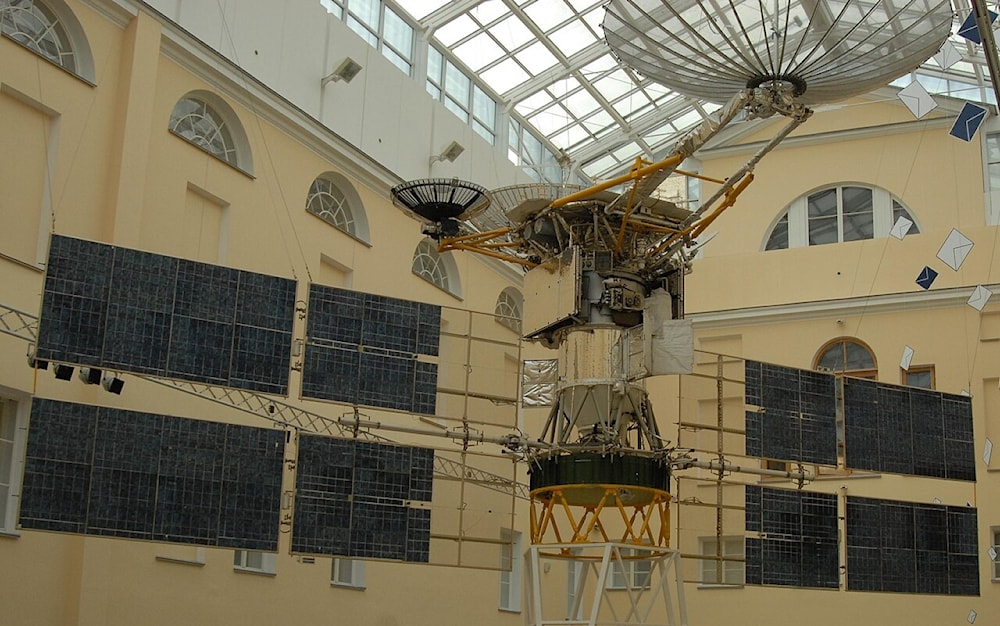
Soviet/Russian telecommunication satellite Luch in the A.S. Popov Central Museum of Communications on October 20, 2010 (Marina Kotelnikova/Wikimedia)
European security officials believe that Russian satellites have been closely surveilling at least a dozen key European satellites, increasing anxiety about espionage and interference in orbit. The activity, primarily carried out by the Luch-1 and Luch-2 relay satellites, has reportedly involved close-range maneuvers near geostationary satellites serving Europe, the UK, and regions of Africa and the Middle East.
Since its launch in 2023, the Luch-2 satellite has approached 17 European satellites, according to orbital tracking and ground-based telescopic data. These close approaches have often lasted for weeks, with the Russian satellites remaining in close proximity.
“Both satellites are suspected of ‘doing sigint [signals intelligence] business,’” said Major General Michael Traut, head of Germany’s military space command, in comments to the Financial Times.
A senior European intelligence official indicated that the Russian vehicles were likely positioning themselves within the narrow transmission cones between ground stations and satellites to intercept signals, particularly command data, which may be unencrypted due to outdated satellite systems.
Read more: Europe is losing the space race: Bloomberg
Signals intelligence and interception threats
The growing concerns highlight the vulnerability of older European satellites. Many lack modern encryption and are susceptible to command signal interception. Once recorded, these signals could enable other actors to interfere with or even take control of satellite operations, including trajectory changes or system failures.
Traut noted the potential interception of the “command link,” the critical channel linking satellites to their ground controllers. Analysts warn that this information could be used to send false commands, alter orbital paths, or even force satellites to collide or deorbit.
“Satellite networks are an Achilles heel of modern societies. Whoever attacks them can paralyse entire nations,” said German Defense Minister Boris Pistorius in a speech last September. “The Russian activities are a fundamental threat to all of us, especially in space. A threat we must no longer ignore.”
The Luch satellites, while not believed to possess offensive jamming capabilities, are thought to be collecting large volumes of data for potential future use in both ground-based and orbital disruption operations, according to EU officials.
Strategic risks and hybrid warfare in orbit
The alleged espionage activity by Luch-1 and Luch-2 aligns with broader concerns over Moscow’s use of hybrid warfare tactics. EU officials claim that these have included sabotage operations, such as the severing of subsea internet and power cables, and could now be expanding into space.
Belinda Marchand, chief science officer at US-based Slingshot Aerospace, said the Russian satellites have remained in orbit near sensitive European geostationary assets “for many months at a time.” Luch-2 was recently spotted near Intelsat 39, a satellite servicing Europe and Africa.
Slingshot data shows repeated visits to satellites operated by NATO-based entities. Norbert Pouzin, a senior orbital analyst at the French satellite tracking company Aldoria, stated, “They have visited the same families, the same operators, so you can deduce that they have a specific purpose or interest. Even if they cannot decrypt messages, they can still extract a lot of information . . . they can map how a satellite is being used, work out the location of ground terminals, for example.”
New satellite launches expand Russian space activity
Beyond Luch-1 and Luch-2, Russia has expanded its space program with the 2023 launch of Cosmos 2589 and Cosmos 2590. These new satellites reportedly possess similar maneuvering capabilities, with Cosmos 2859 currently moving toward the geostationary orbit range, approximately 35,000 km above Earth.
However, Luch-1 may be nearing the end of its mission. On January 30, ground-based telescopes observed a plume of gas coming from the satellite, followed by what appeared to be partial fragmentation.
“It looks like it began with something to do with the propulsion,” said Marchand. “There was certainly a fragmentation,” and the satellite was “still tumbling.”


