
Orban warns EU plan on Russian assets risks entering the war
 5 Min Read
Hungarian PM Viktor Orban warned that EU plans to use frozen Russian assets to fund Ukraine would pull the bloc into the conflict and expose it to legal, political, and financial risks.
-
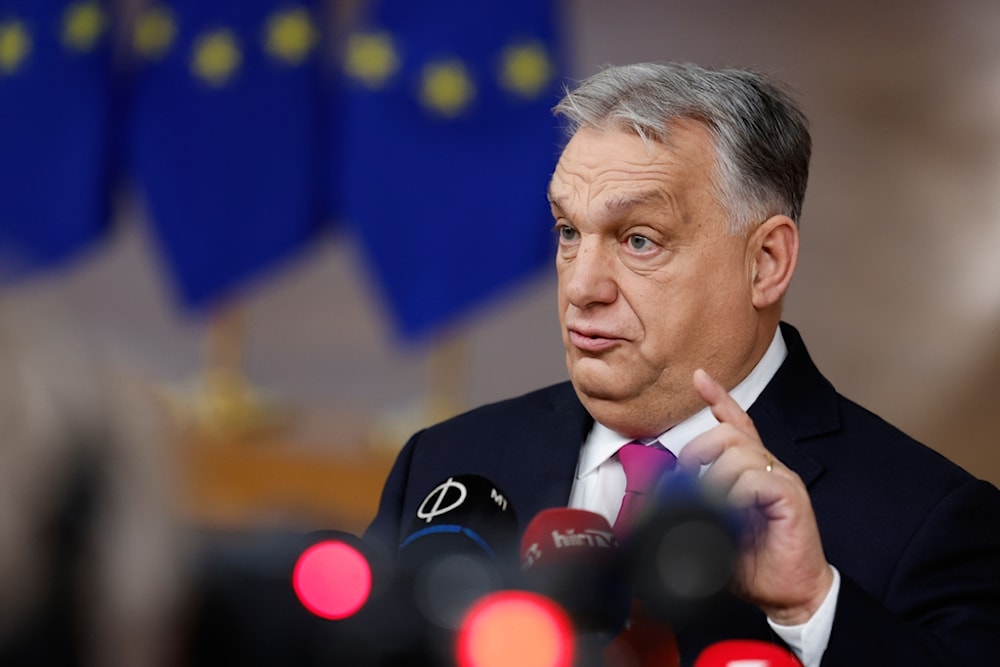
Hungary's Prime Minister Viktor Orban speaks with the media as he arrives for the EU Summit in Brussels, on December 18, 2025. (AP Photo/Geert Vanden Wijngaert)
Hungarian Prime Minister Viktor Orban issued a stark warning on Thursday as EU leaders met in Brussels, cautioning that the bloc is edging toward direct involvement in the Russia-Ukraine war. His remarks come as European institutions intensify efforts to secure agreement on a long-term financing package for Kiev, partly backed by the massive pool of frozen Russian assets held inside the EU. The debate has taken on new urgency as Ukraine faces ammunition shortages, stalled US assistance, and rising battlefield setbacks, prompting hawkish member states to advocate for more drastic financial and military steps.
Speaking to journalists ahead of the EU Council gathering, Orban reiterated that he rejects any initiative that would, in his view, blur the line between political support and participation in the conflict. "Because I would not like to see a European Union in war; to give money means war," he said, stressing that Budapest continues to prioritize diplomatic solutions. "I'm just looking for the peace. Because I think what we have to do is to take some steps towards peace, not to war." His rhetoric echoes Hungary's long-standing opposition to sanctions, arms transfers, and proposals that further entrench Europe into a prolonged confrontation with Moscow.
Asset gamble
The proposals on the table involve leveraging roughly €210 billion in immobilized Russian central bank reserves, the majority of which sit at the Brussels-based clearinghouse Euroclear, to underpin a multiyear loan package for Ukraine. EU officials argue the plan would rely on the profits generated by these assets, avoiding direct confiscation while creating a stable funding channel for Kiev's budget and military needs through 2027.
Several member states have also floated more aggressive options, including seizing a portion of the reserves outright. The European Commission has already signaled its preference for making these funds a long-term financing tool, invoking emergency powers last week to freeze the assets indefinitely in a bid to prevent future political challenges to sanctions.
Orban pushed back strongly against these ideas, questioning not only their legality but also their strategic logic. "Want more guarantees? For what?" he asked, describing the notion of channeling Russian funds to Ukraine as fundamentally flawed. "The whole idea is a stupid one, to take away the money of somebody." His position aligns with a growing camp of legal scholars warning that repurposing sovereign reserves without a peace treaty or reparations agreement could violate customary international law, threaten global norms surrounding state immunity, and alienate non-Western countries whose reserves are held in European or US financial institutions.
He noted that the war remains a confrontation between Moscow and Kiev alone. "There are two countries that are at war. It's not the European Union, they are Russia and Ukraine," Orban said, warning that any attempt to repurpose Russian reserves for Ukrainian use would, in effect, draw the EU into the conflict and expose it to long-term political, economic, and legal repercussions. His view reflects a broader geopolitical concern shared by some EU governments: that Europe is drifting into a de facto co-belligerent role without an explicit mandate from member-state parliaments or voters.
Euroclear legal shock
Belgium, which hosts the largest share of the frozen Russian reserves, has voiced parallel concerns. Brussels has cautioned that the plan could trigger lawsuits, retaliatory moves from Moscow, and financial risks for Euroclear and the Belgian state. These concerns deepened after Russia's central bank launched a $230 billion lawsuit in Moscow targeting Euroclear, with the first hearing scheduled for January 16, 2026.
Belgian officials also fear that courts in jurisdictions aligned with Russia could move to seize Western assets in response, potentially setting off a global cycle of asset retaliation. Beyond Belgium, Italy, and a number of other capitals have warned that the EU must ensure any action aligns with international law on state immunity to avoid setting a precedent that could later be used against Western governments themselves, especially those holding large sovereign wealth funds abroad.
Financial markets have also taken note of the mounting risks. Fitch recently placed Euroclear on “rating watch negative,” citing legal uncertainty surrounding the EU's asset-backed financing plans and the institution's exposure to Russia's lawsuit. Investors warn that mishandling the frozen reserves could undermine confidence in Europe's financial architecture, weaken the euro's role as a safe reserve currency, and accelerate a global shift toward de-dollarisation and diversification away from Western financial systems.
The broader debate underscores Europe's struggle to secure long-term funding for Ukraine as US assistance faces months of political gridlock and Kiev confronts a widening budget gap. Proponents of using Russian assets argue that Moscow should bear the financial burden of the conflict and that the EU cannot rely indefinitely on American support.
With the global stakes rising and member states divided, the summit highlights a fundamental strategic question: whether Europe will escalate its financial role in the war or step back from measures that could reshape the international financial order for decades to come.
Read more: US, Russia expected to hold talks on Ukraine settlement in Miami


