
Saudi-UAE rift exposes fractures in US-backed Gulf order: Bloomberg
 14 Min Read
Growing tensions between Saudi Arabia and the UAE are prompting global financial firms to prepare for possible disruptions to Gulf investment, trade, and oil markets.
-
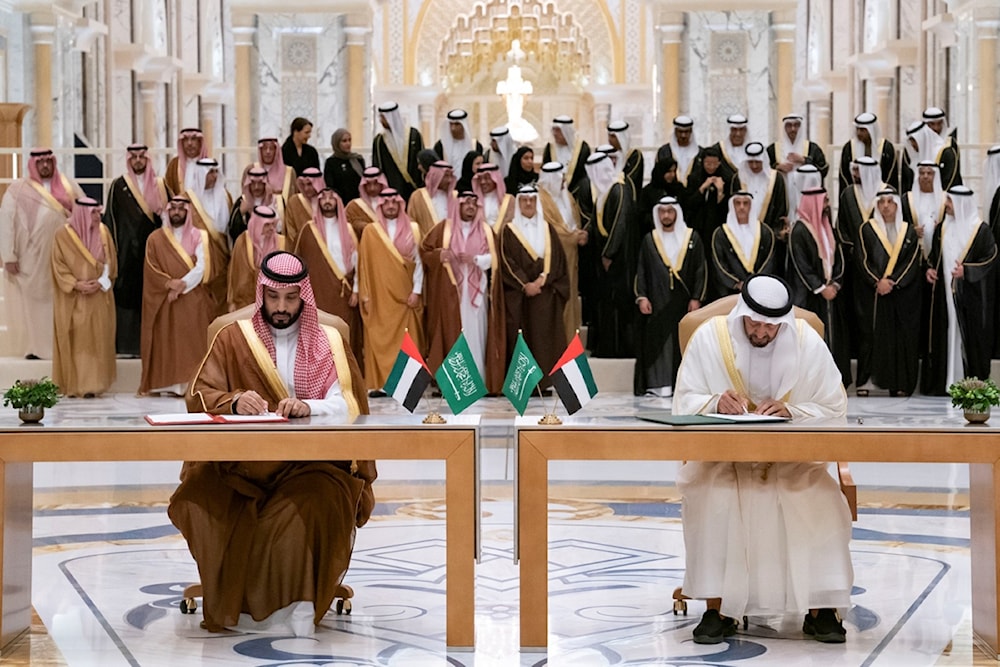
Saudi Crown Prince Mohammed bin Salman, left, and Sheikh Mohamed bin Zayed Al Nahyan, then crown prince of Abu Dhabi, sign documents during the second meeting of the Saudi-Emirati Coordination Council in Abu Dhabi on November 27, 2019 (UAE Ministry of Foreign Affairs)
The intensifying rivalry between Saudi Arabia and the United Arab Emirates is exposing growing fractures within a Gulf alignment long supported by the United States, while forcing major Western financial institutions to reconsider whether they can continue benefiting equally from both capitals.
According to a Bloomberg report, international banks, asset managers, and private equity firms are preparing for the possibility that political and economic competition between Riyadh and Abu Dhabi could eventually require them to choose one market over the other.
The concerns reflect the enormous financial influence accumulated by the two Gulf monarchies. Their sovereign wealth funds collectively manage more than $3 trillion, providing Wall Street with lucrative investment mandates, acquisition financing, and access to state-backed spending across artificial intelligence, infrastructure, technology, and financial services.
Yet the same governments that coordinated for years in regional interventions, particularly the war on Yemen and efforts to confront Iran, are increasingly competing over political influence, oil production, ports, trade routes and the position of the Gulf’s principal financial center.
Wall Street confronts Gulf fragmentation
Goldman Sachs, Morgan Stanley, BlackRock, Brookfield, and KKR are among the international firms that have expanded simultaneously in Riyadh and Abu Dhabi, seeking to preserve access to the vast pools of capital controlled by both governments.
Their regional strategies have relied on maintaining close relations with the two sides without appearing to privilege one over the other. As the dispute becomes more pronounced, however, firms are examining whether business conducted in one capital could obstruct contracts, investments, or regulatory approvals in the other.
“Sophisticated organizations are increasingly treating geopolitical divergence between Gulf states as a scenario worth monitoring rather than dismissing,” Hussein Nasser-Eddin, chief executive officer at risk management firm Crownox, told Bloomberg.
Businesses have reportedly begun separating logistics arrangements, reviewing force majeure provisions, and assessing whether partnerships in Saudi Arabia or the UAE could create political complications elsewhere.
Rising concerns as interests diverge
The concerns intensified after UAE-based companies reported difficulties obtaining Saudi business visas. Companies and individuals have also encountered unusual delays in completing bank transfers from Saudi Arabia to the UAE.
Neither government has publicly connected the reported disruptions to the wider political dispute.
A UAE official said the two states “maintain deep and longstanding economic and commercial ties, supported by significant trade and investment flows.”
The official said the UAE Economy Ministry had not received complaints about delayed transfers but would examine any specific cases brought to its attention.
The Saudi central bank similarly maintained that the kingdom’s financial sector operates within a robust regulatory framework and that no restrictions have been imposed against particular countries.
The official responses have not eliminated concerns that economic measures could become another instrument in the struggle for regional influence.
Yemen exposes competing Saudi and Emirati projects
The most visible expression of the Saudi-UAE divide has emerged in Yemen, where the two governments entered the war as coalition partners but backed separate armed formations and pursued increasingly incompatible objectives.
While both participated in the military campaign against Yemen, Abu Dhabi concentrated on establishing influence across the South, strategic islands, ports, and waterways leading toward the Red Sea and the Gulf of Aden.
Saudi Arabia, meanwhile, sought to preserve its own political and security influence through the internationally backed Yemeni authorities and forces more closely aligned with Riyadh.
The resulting dispute increasingly resembles a struggle between two external powers over Yemen’s territory and resources rather than a unified effort to protect Yemeni sovereignty.
Yemeni national project absent
Saudi Arabia has recently moved to reduce the UAE’s role in Yemen and weaken its influence in other strategic arenas, including the Red Sea. It has also strengthened forces affiliated with the Saudi-backed Yemeni government as Emirati-supported formations pursue separatist ambitions in the South.
For observers, the confrontation confirms that the coalition’s war was never built around a coherent Yemeni national project. Its internal unity depended primarily on hostility toward Sanaa, while its members maintained competing plans for Yemen’s ports, islands, energy resources and political future.
Sudan plays role in rift
The divergence also extends beyond Yemen. Saudi Arabia and the UAE have supported different sides in Sudan and pursued competing political and commercial interests throughout the Horn of Africa.
Their rivalry, therefore, reflects a wider contest over maritime corridors, logistics hubs, and access to the Red Sea rather than a limited disagreement between two neighboring governments.
War on Iran deepens strategic divergence
The dispute became more visible during the war on Iran, when Saudi Arabia adopted a more cautious and conciliatory position toward Tehran while Abu Dhabi initially favored a more confrontational approach.
Riyadh’s posture suggested an effort to avoid being drawn further into a war whose consequences could directly threaten Saudi infrastructure, energy facilities and domestic development projects.
Limits of relying on US protection exposed
The shift also reflected the limits of relying on US military protection during a confrontation with Iran, particularly as Tehran demonstrated its ability to impose high economic and security costs across the region.
Abu Dhabi’s initial approach remained more closely aligned with the confrontational policy pursued by Washington and the Israeli occupation.
The difference does not make Saudi Arabia part of the Resistance camp, nor does it erase its previous role in the war on Yemen. It does, however, demonstrate that Riyadh has become more attentive to the consequences of permanent confrontation with Iran and increasingly willing to pursue de-escalation when its own interests are threatened.
For Washington, this divergence weakens efforts to maintain a unified Gulf front against Tehran and the wider Axis.
UAE OPEC departure challenges Saudi leadership
Energy policy has become another major arena of confrontation.
The UAE’s unexpected decision to leave OPEC in April directly challenged Saudi Arabia’s leadership within the organization and freed Abu Dhabi from production restrictions previously imposed through the group’s quota system.
The departure allows the UAE to raise crude production beyond its former limits, potentially strengthening its global market position at Saudi Arabia’s expense.
“A nascent Saudi-UAE price war is likely to intensify in oil markets,” the analysts wrote in a July note.
Saudi Arabia is more dependent on elevated oil prices because of the enormous cost of its domestic development plans and its widening fiscal deficits. The UAE faces fewer immediate spending constraints and is therefore better positioned to withstand lower crude prices while expanding output.
The two countries collectively account for approximately 13% of global oil production. A sustained struggle for market share could consequently place downward pressure on crude prices and affect oil-exporting states well beyond the Gulf.
The development also exposes the limits of claims that the Gulf monarchies constitute a unified economic bloc. Despite their shared alliances with Washington, both governments are prepared to undermine one another’s economic strategies when their individual interests diverge.
Rivalry complicates Washington’s regional architecture
The growing dispute presents a direct problem for the United States, which relies on Saudi Arabia and the UAE as central pillars of its military, political, and economic presence in the region.
Both countries host US military facilities, purchase American weapons, and have pledged enormous investments in the United States. Their coordination has also been important to Washington’s attempts to pressure Iran, control strategic waterways and preserve Western influence over global energy markets.
“It is certainly not in keeping with longer-term US strategic interests to see further fragmentation amongst key US allies in the Middle East, especially during a time of conflict with Iran,” said Firas Maksad, managing director for the Middle East and North Africa practice at Eurasia Group.
The concern illustrates that the dispute is not merely a bilateral Gulf disagreement. It threatens the wider network through which Washington has historically attempted to organize its regional allies against Iran and the Axis of Resistance.
The rivalry could also disrupt alternative supply routes developed amid uncertainty over navigation through the Strait of Hormuz.
Companies have increasingly used road networks crossing Saudi Arabia, the UAE, and other Gulf states to transport food, medicine, and essential goods. Abu Dhabi has become especially reliant on Saudi trucking routes to maintain uninterrupted supplies.
Should political competition begin affecting border crossings, transportation agreements or customs procedures, the consequences could extend beyond financial institutions to basic regional trade.
Gulf wealth binds Western finance to both capitals
Despite the political risks, global financial institutions remain reluctant to abandon either Saudi Arabia or the UAE.
The enormous volume of sovereign capital controlled by the two governments makes both markets difficult to ignore, particularly as Western investment firms seek financing for acquisitions, infrastructure projects and technology ventures.
Goldman Sachs opened an Abu Dhabi office in 2023 before becoming the first major global investment bank to obtain a regional headquarters license in Saudi Arabia in 2024.
Its asset-management division later secured the Saudi Public Investment Fund as an anchor investor in a series of regionally focused funds.
BlackRock adopted a similar approach, receiving a commercial license in Abu Dhabi shortly after obtaining approval to establish its regional headquarters in Riyadh.
The arrangements reveal the extent to which major Western financial institutions have embedded themselves within both state investment systems.
Balancing getting more difficult
Some firms are now attempting to maintain adequate staffing and residency arrangements in both countries to protect themselves against future restrictions.
Many professionals continue to live in Dubai while travelling to Riyadh for work, benefiting from the UAE’s established commercial infrastructure while satisfying Saudi requirements for a physical local presence.
The balancing act is becoming more difficult.
One international law firm has reportedly grown more cautious about accepting assignments that could upset either side. In another case, Saudi investors told a firm raising capital for a Middle East fund that their money could only be invested in entities focused on the kingdom and without exposure to the UAE.
Some executives suggested that pressure on liquidity within the Saudi banking system may also explain such restrictions. Nevertheless, the conditions reinforce concerns that access to capital could increasingly be linked to political alignment.
Competition replaces earlier coordination
Saudi Arabia and the UAE still maintain deep commercial, cultural, and political connections. Bilateral trade is worth around $26 billion, and families, corporations, and investors continue to operate across both states.
Those links may restrain the confrontation and prevent it from becoming an immediate diplomatic rupture.
However, the relationship has changed considerably from the period when Saudi Crown Prince Mohammed bin Salman and UAE President Sheikh Mohamed bin Zayed were portrayed as close strategic partners.
The Emirati leader was widely considered an early mentor to the younger Saudi crown prince. Both governments also coordinated in opposing the Arab uprisings that began in 2011, regarding popular movements and political change as threats to the established regional order.
Their shared opposition to those uprisings, their partnership in the war on Yemen, and their alignment with Washington temporarily obscured deeper national competition.
Competition over dominance
Riyadh and Abu Dhabi now both seek to become the Gulf’s dominant center for finance, tourism, technology, logistics and international investment.
Saudi Arabia’s decision to require multinational companies to establish regional headquarters in the kingdom to retain access to government contracts represented a direct challenge to Dubai’s position as the primary commercial hub for international firms operating in the region.
The economic struggle has become increasingly public, with Saudi and Emirati commentators exchanging attacks over tourism figures, financial performance, logistics infrastructure and investment achievements.
Qatar blockade remains a warning
The 2017 blockade of Qatar offers financial institutions a precedent for how quickly Gulf disputes can develop into widespread economic disruption.
Saudi Arabia, the UAE, Bahrain, and Egypt severed diplomatic and commercial relations with Qatar and imposed restrictions that remained in place until the 2021 reconciliation.
Foreign deposits in Qatar fell, its sovereign credit rating was downgraded, and shipping companies encountered difficulties delivering cargo after neighboring Gulf ports barred vessels connected to Doha.
Banks were forced to navigate competing demands. Firms that accepted Qatari business risked damaging their relationships with Saudi Arabia and the UAE, while those that avoided Qatar sacrificed access to a growing market.
Executives cited by Bloomberg do not expect the present Saudi-UAE dispute to reach the same level. The Qatar crisis nevertheless demonstrates that alliances among US-aligned Gulf states can unravel rapidly when struggles over sovereignty and regional influence intensify.
The Saudi-UAE rift “is now a direct risk for any firm seeking capital or contracts from both Gulf powers simultaneously,” said Dania Arayssi, a senior analyst for the Washington-based think tank New Lines Institute.
“The competition is now expressed across various arenas, and given the economic and political power of both states, the rivalry has implications far beyond the Arabian Peninsula.”
Rift exposes limits of US-backed regional order
For Wall Street, the primary concern is not the consequences of Saudi and Emirati interventions in Yemen, Sudan, or elsewhere. It is the possibility of losing investment mandates, contracts, and fees generated by the two governments’ sovereign wealth.
Deals involving Gulf entities reached approximately $300 billion in the first half of 2026, an increase of nearly 200%. Saudi and Emirati funds have also become major financiers of global artificial intelligence, technology, infrastructure, and corporate acquisitions.
Abu Dhabi currently benefits from greater financial flexibility and a network of specialized investment bodies capable of deploying capital across strategic sectors.
Saudi Arabia, despite growing fiscal pressure, continues to finance transactions large enough to generate millions of dollars in fees for foreign banks.
International firms will therefore continue trying to preserve access to both markets while preparing for further deterioration.
A dispute with broader significance
Observers, however, argue that the dispute carries a broader significance.
It exposes the contradictions within a US-backed regional order whose members were able to coordinate when waging war on Yemen, normalizing relations with the Israeli occupation or confronting Iran, but are increasingly divided by competing ambitions over wealth, territory and political leadership.
The confrontation does not transform either Saudi Arabia or the UAE into a partner of the Resistance. Nor does it guarantee that their weakening coordination will automatically benefit the peoples of the region.
It instead demonstrates that alliances built around foreign intervention, Western protection, and competition for regional dominance remain inherently unstable.
As rivalry replaces coordination, Wall Street is being forced to confront the consequences of a fracture that Resistance movements have long argued was embedded within the Gulf alliance itself.
Read more: Yemen vows retaliation after Saudi airstrikes on Sanaa airport


