
Sheikh al-Kaabi: Iran war marked by unity, resistance, strategy: Excl.
 8 Min Read
Speaking to Al Mayadeen, Sheikh Abbas al-Kaabi discusses Iran’s current phase amid the ongoing war, its leadership structure, institutional cohesion, and regional resistance strategy.
-
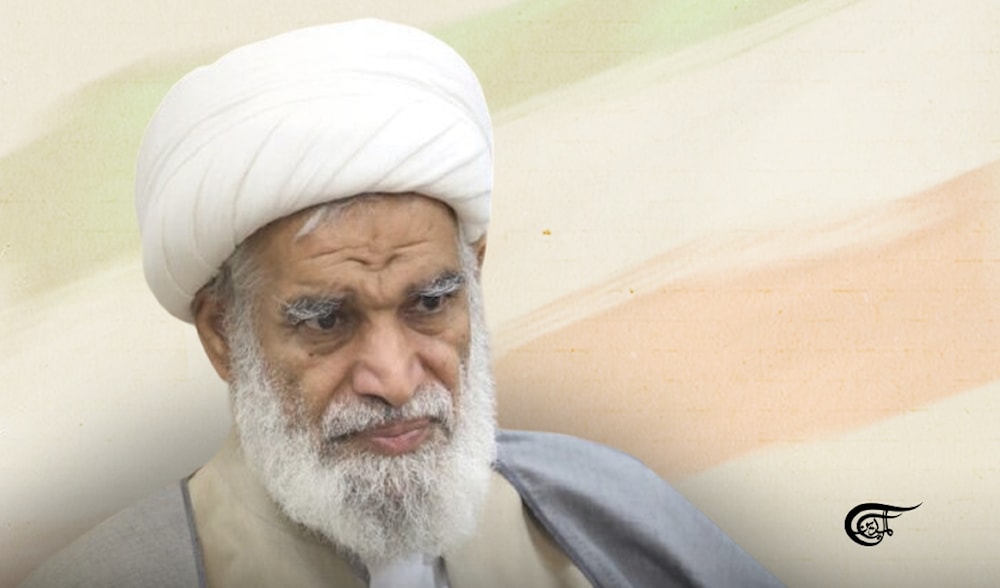
An illustrated image of Sheikh Abbas al-Kaabi. (Al Mayadeen English/ Illustrated by Batoul Chamas)
In an exclusive interview with Al Mayadeen published Monday, Sheikh Abbas al-Kaabi, Member of the Presidium of the Assembly of Experts for Leadership in Iran, explored the current phase of the Islamic Republic of Iran amid the ongoing war, examining the structural, political, and strategic transformations it has undergone under sustained military and geopolitical pressure, as well as its evolving vision of resistance, governance, and future regional posture.
Phases of Western plots to fracture the Islamic Republic
Speaking on the current phase amid the ongoing war, Sheikh Abbas al-Kaabi said recent developments must be viewed within the historical context of the Islamic Revolution’s victory on February 11, 1979, when it was countered by the US and Zionists after they had lost their influence in Iran.
Sheikh al-Kaabi outlined three stages of animosity towards the Islamic Republic. He said the first phase, which he described as “civilizational absorption,” involved efforts to infiltrate state institutions through transitional political structures and Western-aligned groups, but these attempts failed following the establishment of Iran’s constitutional framework.
He explained that the second phase focused on containing the revolution and limiting the spread of its ideology, including through the eight-year war, which he characterized as part of a broader international effort to weaken Iran. The third phase, he added, aimed to overthrow the system through cultural pressure, soft warfare, and economic sanctions. However, he said these efforts also failed, arguing that the Islamic Republic has continued to grow stronger over time.
Al-Kaabi further noted that, in the Trump administration, there were predictions that the Islamic Republic would not reach its fourth decade, but Iran, he said, continued its political and institutional development, including marking successive anniversaries of the revolution.
Iran enters the phase of decisive victory against US and Zionists
Turning to the 12-day war, al-Kaabi said the US and "Israel" aimed at overthrowing the Islamic Republic in three to four days, but failed because of the resistance of the Iranian people, the armed forces, and the country’s leadership.
Sheikh al-Kaabi said that subsequent efforts focused on triggering internal unrest. An attempted Western-backed coup was carried out through riots and the smuggling of weapons into Iran by the country’s adversaries, noting that this was acknowledged by US President Donald Trump. He said these efforts also failed, leaving no option but escalation into the current war, which has now exceeded 60 days.
“On the first day of the war, Netanyahu and Trump said the war would not last more than three to four days and that they would bring down the Islamic Republic. Today, after 61 days of fighting, the Islamic Republic is stronger, while they have grown weaker and are seeking ways to exit the war, as the world witnesses Trump’s contradictory statements, while the factors of victory remain strong in Iran”, he added.
He said that within the "battle of wills", Iran’s strength lies in the cohesion of its people, armed forces, and leadership under Sayyed Mojtaba Khamenei, adding that Iran is now entering the fourth phase, which is “civilizational resistance”, paving the way toward “civilizational advancement.”
"I want to make a very important point: it is wrong to describe this war as merely an American and Zionist aggression against Iran. Rather, this US-Zionist aggression is against Palestine, Gaza, and the central cause of the Islamic nation. The attack on Iran has taken place because Iran represents the axis of resistance and a position of strength, and because it never abandoned the Palestinian cause", he stressed.
Sheikh al-Kaabi also highlighted the growing coordination among regional Resistance forces, including Palestinian factions, Hezbollah in Lebanon, the Resistance factions in Iraq, and Ansar Allah in Yemen, saying this alignment is stronger than in previous periods. He stressed that the ongoing developments represent a phase of "decisive victory" over the United States and the Israeli entity.
He recalled remarks by the martyred leader Sayyed Ali Khamenei during the final session of the Assembly of Experts for Leadership in its fifth term, noting that the body is now in its sixth term. He said Sayyed Khamenei stressed that Islam and the Islamic Republic are not built around individuals, urging members of the assembly to prepare for the appointment of future leadership.
Sheikh al-Kaabi added that Sayyed Ali Khamenei also instructed the armed forces, senior leadership, and officials of constitutional institutions to designate multiple successors to ensure continuity of responsibilities. He said these remarks underscore the institutional resilience of the Islamic Republic, designed to withstand external attempts to destabilize its leadership structure.
Sheikh al-Kaabi on Iran’s constitutional and leadership structure
Sheikh al-Kaabi explained that the Islamic Republic is composed of institutions operating under the framework of the Constitution. These institutions, along with the Constitution itself, are headed by the Leader of the Revolution, alongside the three branches of power, the legislative, judicial, and executive authorities, as well as the armed forces, which he noted are under the general supervisory authority of the leader in accordance with the Constitution.
The orders of the Leader are binding on all components of the system. Regarding the armed forces, Sheikh al-Kaabi clarified that decisions are taken by the Supreme National Security Council following approval by the Leader.
He added that the Ministry of Foreign Affairs then implements these decisions, while the negotiating committee operates in line with the policies adopted by the Supreme National Security Council under the directives of the leader.
Thus, the negotiating committee or delegation carries out its tasks in accordance with the policies set by the Leader of the Islamic Republic, he explained, adding that there is full coordination between the public sphere, the field, and diplomacy, with all acting within the framework established by the Leader of the Islamic Republic, reflecting constitutional cohesion and unity.
He stressed that there is no disagreement or division in decision-making, noting that while consultations may be extensive at the advisory level, once a decision is taken, all parties act within that framework.
“We have not abandoned diplomacy; we approach it with long-term strategic patience, but our hand remains on the trigger", he warned.
Sheikh al-Kaabi affirms institutional cohesion and leadership authority in Iran
Speaking to Al Mayadeen, Sheikh al-Kaabi reiterated that there is no serious concern over internal fragmentation, stressing that the Constitution clearly defines institutional roles while placing ultimate authority with the Iranian Leader.
He added that each official understands their responsibilities within clearly defined constitutional roles, stressing cohesion, unity of purpose, and clarity of policy and vision under the guidance of the Iranian leadership.
Sheikh al-Kaabi said calls for internal unity have also been echoed by the executive, legislative, and judicial branches, all of which have reaffirmed their adherence to the leadership, adding that the Assembly of Experts has issued statements confirming institutional alignment under the leadership, whose directives continue to shape broader state policy, including strategic approaches to regional maritime issues such as the Strait of Hormuz.
Addressing the campaign of more than 30 million volunteers, launched under the banner "Our souls are devoted to Iran," he said it reflects a cohesive Iranian society standing behind its leadership. He noted that there is no real division or fragmentation between the people and officials, adding that Iranians tend to become more united during times of war, despite any economic difficulties or hardships.
"In times of war, people are ready to sacrifice everything for Islam and their homeland", he said.
Sheikh al-Kaabi: Narrative and ideology outweigh military power
When asked, "What is a more dangerous challenge: missiles or narrative?" Sheikh al-Kaabi said that, in reality, missiles derive their strength from a more fundamental force: "knowledge, narrative, truth, and the broader civilizational project".
He argued that Iran’s adversaries fear the Islamic Republic’s civilizational project, pointing to statements attributed to Netanyahu and Trump about the “elimination of Iran’s civilization.”
Sheikh al-Kaabi explained that this reflects how knowledge and ideological influence are what truly concern them, adding that they fear the civilizational diffusion of the Islamic Republic.
"Today, I can say that after the First World War, the League of Nations was established to prevent wars. After the Second World War, the United Nations Charter and the Security Council were created for the same purpose. Yet wars continued".
On that note, he added that the Islamic Republic’s civilizational project is grounded in monotheism, reason, justice, dignity, freedom, independence, and public awareness, to achieve global peace based on justice and the rejection of the unilateral, "pharaonic" power of Trump and the Israeli occupation.
He further said, "They speak of going to Iran, then to Cuba, then elsewhere", adding that "they seek to burn the world", and that the world must confront the corruption on earth attributed to Trump and Netanyahu.
Sheikh al-Kaabi on Iran’s unity, resistance, and strategic direction
Sheikh al-Kaabi added that the Islamic Republic continues to pursue a path of progress, adding that the endurance of both the state and the Iranian people is, in his words, long-standing and sustained, citing 45 years of resilience followed by continued steadfastness in recent years.
Iran, under the leadership of the leader and the cohesion between leadership and society, is expected to continue advancing toward both material and spiritual development, he said, reaffirming support for regional resistance movements, including in Lebanon, Palestine, and Gaza, and stressing that the culture of resistance remains central to Iran’s outlook.


