
Shekarchi calls CENTCOM's Hormuz oil figures a failed psychological op
 3 Min Read
Iran's Armed Forces spokesperson rejects CENTCOM's claim of moving 1 billion barrels of oil through Hormuz.
-
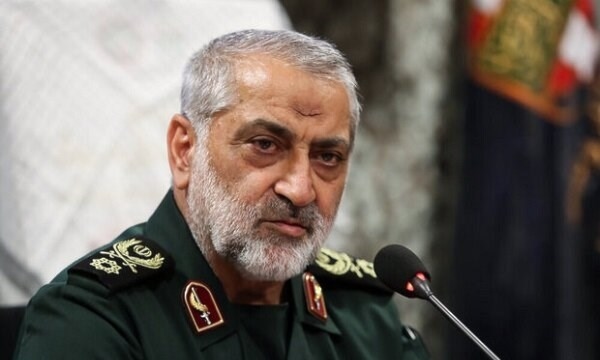
Brigadier General Abolfazl Shekarchi, the spokesperson of the Iranian Armed Forces, undated. (Social media)
Brigadier General Abolfazl Shekarchi, spokesperson for the General Staff of Iran's Armed Forces, dismissed Saturday claims by US Central Command (CENTCOM) chief Brad Cooper that US forces had escorted oil tankers and kept shipments moving through the Strait of Hormuz, calling them false and baseless.
The spokesperson confirmed that Iran's Armed Forces still hold the initiative in the strait.
Shekarchi called Cooper's remarks a failed psychological operation designed to boost the morale of the "terrorist US military" in the region, which he stressed was exhausted and worn down. The figures, he said, have less to do with conditions in the strait than with justifying the heavy financial and human toll the United States has sustained in the region.
Shekarchi added that nothing Cooper says will change the fact that the US military is being forced out of the region.
What CENTCOM said
Earlier on Saturday, Cooper claimed that CENTCOM had supported the transport of more than one billion barrels of crude oil from Gulf countries through the Strait of Hormuz over the past two months.
He also claimed that Washington had secured the passage of more than 2,000 commercial vessels through what he described as a "mine-free" strait, and that Iran had not exported a single barrel of oil.
Several days earlier, Mohammad Bagher Zolghadr, political advisor to the Leader of Iran's Islamic Revolution, said Iranian fighters "would not reopen the Strait of Hormuz until the criminal Donald Trump and the butcher Benjamin Netanyahu are removed from power." He described the decision as "the first stage of our people's retaliation."
Subsea cables require Iranian approval
Meanwhile, Abbas Moghtadaei, deputy head of the National Security Bloc in Iran's Parliament, said Saturday that Article 10 of the strategic plan to secure the Strait of Hormuz covers the seabed and subsea area, specifically the passage of underwater cables and data transmission equipment.
He said any transit of cables and related data infrastructure through the strait requires prior approval from the relevant Iranian authorities. The law leaves the implementation details to regulatory bylaws, he added.
The Deputy head of the Iranian Parliament's National Security Bloc, Abbas Moghtadaei, stated that Article 10 of the strategic plan to secure the Strait of Hormuz is designated for the seabed and subsea area, specifically governing the passage of underwater cables and data… pic.twitter.com/76o6ByK37s
— Al Mayadeen English (@MayadeenEnglish) September 19, 2026
Rezaei: Iran prepared for a decisive war
Major General Mohsen Rezaei, Secretary of Iran's Supreme National Security Council, said Saturday that US President Donald Trump had miscalculated on Iran and that the war was instigated by Israeli Prime Minister Benjamin Netanyahu.
Rezaei said it is in Washington's interest to accept Iran's conditions for ending its war, and that Trump's threats will achieve nothing. Tehran is fully prepared for a decisive war, he said.
The Secretary of Iran’s Supreme National Security Council, Major General Mohsen Rezaei, stated that the US President's calculations regarding Iran were wrong and that the war was instigated by Netanyahu.
— Al Mayadeen English (@MayadeenEnglish) September 19, 2026
Stating that it is in Washington's interest to accept Iran's conditions to… pic.twitter.com/rYGOeHigHO
He added that Iran knows the US military's vulnerabilities and is better prepared than ever to counter US airstrikes, pointing to a recent anti-ship missile test carried out near a US aircraft carrier.
Rezaei stated that Tehran changed its strategy toward Washington after the United States withdrew from the Iran-US memorandum of understanding. If Iran is attacked, he warned, it will strike US bases and interests in the region with greater force.
On the nuclear file, Rezaei said US and Israeli actions give Iran grounds to withdraw from the Treaty on the Non-Proliferation of Nuclear Weapons (NPT). Tehran has not made that decision, he noted, and any step will depend on Washington's conduct.


