
Marandi, Robbins: A deal with Iran would only delay the next war: Excl
 10 Min Read
Robbins admits a US deal with Iran would only delay the next conflict and calls for regime change, as Marandi warns Trump's refusal to accept defeat means more war.
-
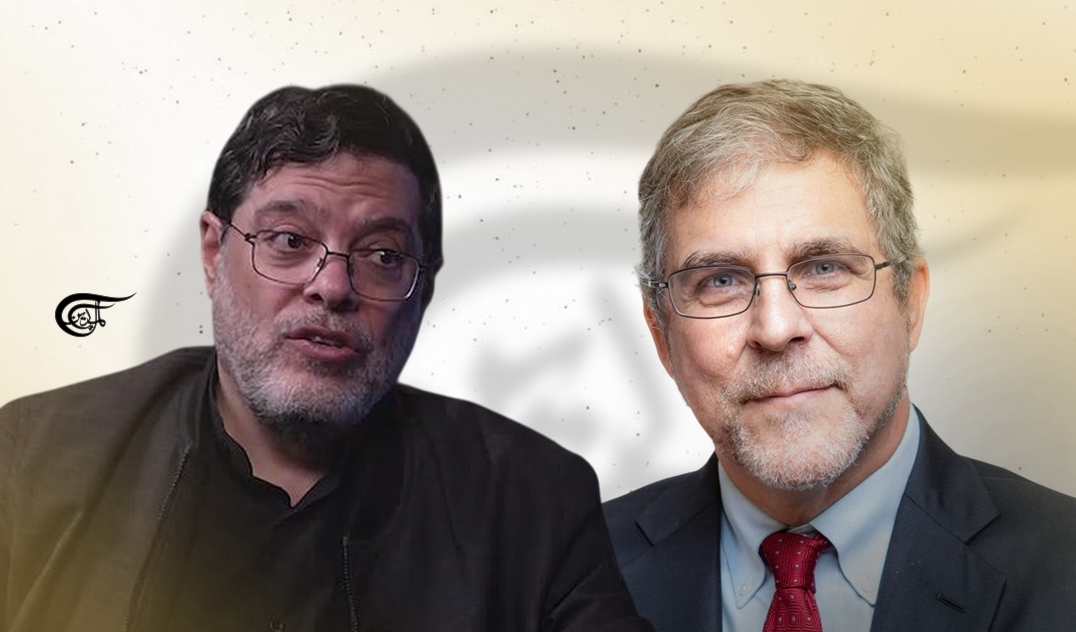
Professor Mohammad Marandi (left) and Dr. James Robbins (right) during Al Mayadeen's The Grand Standoff: Iran and the World. (Al Mayadeen English)
Iran's nationwide popular maneuvers on Friday were a message of readiness to Washington and Tel Aviv, Professor Mohammad Marandi affirmed, warning that the United States and "Israel" could launch a new wave of aggression in the coming days or weeks.
Speaking on Al Mayadeen's The Grand Standoff: Iran and the World, Marandi debated Senior Vice President for Research and Business Development at the Institute of World Politics Dr. James Robbins over the maneuvers, the prospect of escalation, and the outcome of more than six months of the US war on Iran.
What messages do Tehran's maneuvers send?
Marandi confirmed that Iran is preparing for the possibility that "the United States and the Israeli regime will launch another wave of airstrikes and terrorist attacks in the days or weeks ahead."
He linked the danger to Israeli Prime Minister Benjamin Netanyahu's standing in the polls, saying he "needs to carry out possibly some desperate act in order to have a chance in winning the election," while "Trump, too, seems to be preparing himself for possibly a major escalation."
He added that Western intelligence agencies are working to bring in weapons and arm terrorists in neighboring countries, particularly along Iran's border with Pakistan and in northern Iraq.
Friday's maneuvers, Marandi said, "are designed to send a message to the United States and the Israeli regime and to the Iranian people and the people of the region that Iran is prepared for such an escalation."
Robbins dismissed the rallies, saying such scenes are not "very compelling to anyone in the United States, certainly not among the policymakers." He claimed they are the product of "a panicky regime" whose "real audience "is internal in Iran."
He argued that the weapons carried through the streets "may even be real weapons, but they're not loaded weapons," claiming that Iran "will never distribute weapons to its people."
Marandi rejected the claim, noting that Al Mayadeen's own reporters had witnessed the rallies in Tehran. "How competent is the Islamic Republic that it can hand out hundreds of thousands of Kalashnikovs and other weapons to people across Tehran for a major rally that went from one side of the city to another?" he asked. "Something like that would never happen in the United States."
What escalation could look like
With Trump hinting at a new phase of the war, Robbins sketched out the targets Washington could turn to next, while Marandi argued that the United States has already run through its options and retreated at every turn.
Robbins ruled out a ground war. "I don't think we're talking about a large-scale ground invasion," he stated, adding that there is "really no indication" of troops massing.
Instead, he suggested Trump could be weighing attacks on "Iran's economic infrastructure that had been previously discussed, the oil infrastructure, roads and bridges, railroads, things like that," as well as attacks "at regime targets."
Asked whether that meant civilians, Robbins said he was referring to "members of the military leadership," particularly the IRGC, which he accused of being "the impediment in the negotiation process" and blamed for the collapse of the MOU framework.
Marandi pointed out that Washington has already tried to impose its will on Iran and retreated at every stage. "Trump at the beginning said, unconditional surrender. But by the end of 40 days, he accepted the Iranian 14-point plan as the framework for negotiations," he said.
When the siege that followed also failed, Marandi added, Trump "had to accept the MOU," explaining at the time, "I don't want to become a Herbert Hoover. I don't want to preside over a Great Depression."
"And then he went back to war again. That failed again," Marandi said.
Who miscalculated?
Both guests acknowledged that the war has not gone the way Washington expected, but they disagreed over who got it wrong. Robbins argued that "the predictions for this war have been off on many sides, not just Trump's side." Marandi rejected that, saying "it was the United States that miscalculated."
"The Iranians from the very beginning were saying, we are in for a long war, and we are prepared for a long war, and we will defeat the United States," the professor said.
He recalled that in the war's early weeks, US officials insisted Iran was running out of missiles and drones and that its bases and factories were being destroyed. Iran, meanwhile, maintained that its facilities were deep underground and that it would keep firing.
Those behind the US assessments "either were lying, or their calculations were completely wrong," Marandi highlighted. "Yet, the Iranian calculations were correct. Iran was able to withstand the United States onslaught."
The battlefield and the siege
On the war's toll, Robbins insisted US forces remain largely intact while Iran's economy buckles under the blockade. Marandi countered that after more than six months, Washington has failed both on the battlefield and in its attempt to bring Iran to its knees through siege.
Robbins played down US losses, claiming that "no American ships have been sunk or even hit. I think one or two American aircraft were hit," while acknowledging that "there has been some damage to bases in the region."
He argued that the US blockade remains in place and that Washington retains the capacity to bomb Iran. He also pointed to Iran's inflation and currency depreciation, its alleged inability to export oil, and the US Treasury's pursuit of officials' assets abroad. According to Robbins, the only hardship Americans face is a slight rise in gasoline prices.
Marandi explained that the reality on the ground tells a different story. He pointed to "the weapon systems that pounded US bases across the region and more recently in Jordan," which he posited "have taught US soldiers and US Marines and US Air Force personnel quite a lot about Iran's military capabilities."
"After well over six months, the United States has failed militarily. It has failed in siege warfare," he said. "It has not been able to take Iranian territory. It has not been able to undermine Iran."
Instead, he maintained, Washington "has succeeded in creating a global economic crisis, and a crisis for the United States itself."
Marandi described US sanctions as an attempt to starve Iranians, "just like they've tried to starve the people of Cuba." He cited a recent study in The Lancet that found Western sanctions killed 38 million people worldwide between 1971 and 2021.
US in West Asia: Stability or destruction?
The debate then widened to Washington's record across West Asia. Robbins presented Syria's new government, normalization with "Israel," and US-backed plans for Lebanon and Gaza as signs of a more stable region taking shape. Marandi pointed instead to decades of US support for al-Qaeda and the rise of ISIS, arguing that stability was never what Washington brought.
Robbins said the Trump administration's regional strategy rests on preventing Iran from acquiring a nuclear weapon, expanding normalization, and promoting investment, insisting that "we're seeing greater normalization and stability in the region."
He cited Syria's new government, the continuation of the normalization deal, the trilateral framework in Lebanon, and the Gaza Board of Peace. He said the aim is "to end some of these ancient conflicts."
Marandi asserted that the US record in the region shows the opposite. He recalled Washington using al-Qaeda since the late 1970s in Afghanistan, under a plan devised by Jimmy Carter's national security advisor Zbigniew Brzezinski. He also pointed to a February 12, 2012 email in which Jake Sullivan told Hillary Clinton that in Syria, al-Qaeda "is on our side."
"So this is the peace and stability that the United States envisages for our region," he stated, adding that people in the region know which governments funded ISIS and al-Qaeda and cooperated under Operation Timber Sycamore.
"The United States is busy bringing about destruction across our region," Marandi stressed.
He also rejected Robbins's description of the region's conflicts as ancient. "The Israeli regime was created less than 80 years ago," he noted. "These are conflicts that were created by Western empires."
The endgame
Asked how the war might end, Robbins made clear that Washington's goal extends beyond any agreement, while Marandi warned that a president unwilling to accept defeat is likely to drag the United States into another round of war that will end in failure like the last.
Robbins said an agreement would not end the confrontation. "I don't think a deal would end it. A deal would just delay the next conflict. I think the basic problem is with the regime," he said.
He described Washington's approach as "a waiting game," in which the US is watching to see what economic measures against Iran will yield. "It could yield an uprising, a revolution. It could yield some kind of economic collapse," he said, adding that he hoped Iranians would "rise up and get rid of this regime."
At the same time, Robbins conceded that Trump could exit the war at any point "simply by removing US forces, ending what the Treasury Department's doing to cripple Iran's economy, and just give up on it, declare victory, and go."
Marandi said the costs are falling on Washington's own allies. US proxies in the Gulf, he said, "are hemorrhaging. They are in deep trouble. Their regimes are becoming increasingly brittle."
He added that the war is choking off the oil and gas revenue that once flowed from the region into "US stocks and bonds" and US assets, warning that "in the long run, it's going to hurt the United States."
Marandi explained that further escalation is likely because "Trump doesn't accept defeat, and so we will probably have more war," but that the outcome would be no different.
"The reality is that the United States has lost this war," he said.


