
Gulf revises US ties, Iran regional power grows: Marandi, Maloof | Exl
 12 Min Read
Dr. Mohammad Marandi and Micharl Maloof assess Iran’s regional leverage, Gulf ties, the Strait of Hormuz, and mounting pressure on Trump over the US war on Iran.
-
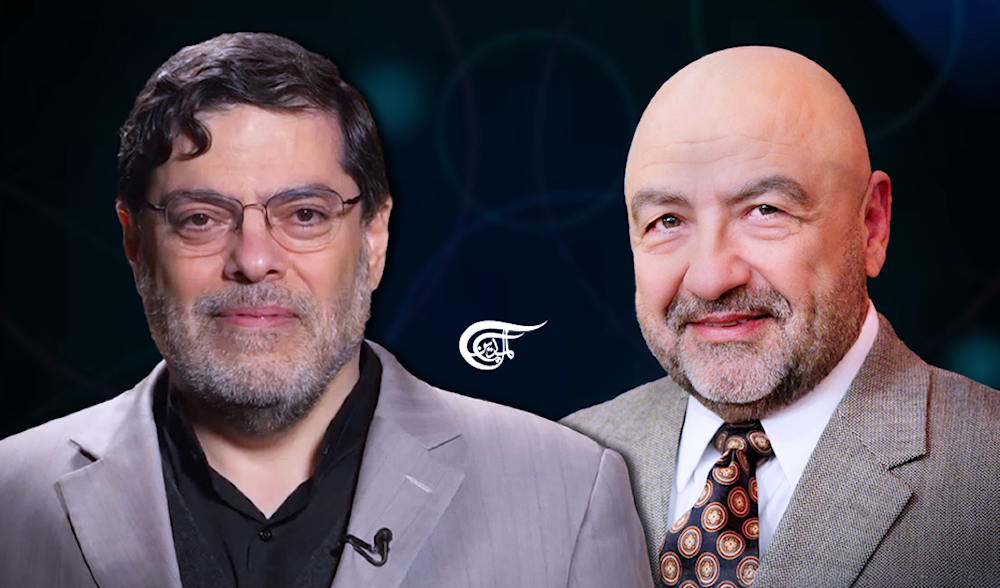
Gulf revises US ties, Iran regional power grows: Marandi, Maloof (Al Mayadeen, illustrated by Zeinab el-Hajj)
On The Grand Standoff: Iran and the World, Professor Mohammad Marandi and former US Defense Department official Michael Maloof examined the shifting regional balance following the US war on Iran, focusing on Iran’s relations with Gulf states, the future of the Strait of Hormuz, Washington’s regional posture, and mounting political pressure on the Trump administration.
Marandi: Gulf states must rebuild trust with Iran
Professor Mohammad Marandi said Gulf governments that supported Washington and the Israeli regime during the war must take concrete steps to rebuild Tehran’s trust, arguing that Iran has little reason to make the first move after extensive regional assistance to the US aggression.
“The Iranians owe them nothing. And they owe Iran a great deal,” Marandi said, stressing that the grievances inside Iran toward several Gulf governments remain profound.
He pointed to the destruction caused by the war, including attacks on schools, hospitals, residential buildings and civilian gatherings, saying regional governments that facilitated US military operations had contributed to the deaths of thousands of Iranians.
Marandi argued that the current situation is part of a much longer history of regional states aligning themselves against Iran. He recalled the 1980 war, when Western governments backed Saddam Hussein and Gulf states, particularly Saudi Arabia and Kuwait, provided Baghdad with vast financial support.
He also pointed to the 12-day war last year, saying US refueling aircraft operated from bases in Gulf countries and subsequently refueled Israeli regime aircraft involved in attacks on Iran.
According to Marandi, the same states have now become involved in the US war against Iran on an even broader scale. “Pretending to be neutral is insulting to the Iranian people, to their own populations, to the people of the region and to the international community,” he said.
In Sunday's episode of The Grand Standoff: Iran and the World, Professor Mohammad Marandi warned that Gulf regimes assisting US aggression are undermining regional stability and endangering their own security. Marandi rejected assertions of neutrality, pointing to the logistical… pic.twitter.com/dacy6NpLsZ
— Al Mayadeen English (@MayadeenEnglish) September 14, 2026
Gulf monarchies face mounting risks
Marandi maintained that the continuation or expansion of the war could pose an existential challenge to some Arab monarchies, particularly if their infrastructure and energy exports remain exposed.
“If this continues, the stability of the Arab family regimes will be in question,” he said, pointing to damage to Saudi infrastructure and disruption to oil and liquefied natural gas exports.
The most sustainable path for the Gulf states, he further stated, is to improve relations with Iran and end their participation in military actions against it.
“Iran is patient,” Marandi said. “If they don’t want to have a meeting now, we can wait. We can wait a week. We can wait a month. We can wait a year. We don’t even have to have the meeting.”
The professor also rejected the notion that Tehran should be the party responsible for repairing relations, saying Gulf governments must take the initiative and demonstrate that they have changed course.
He cited the post-Saddam period as an example of how regional relations can evolve. Gulf states that had supported Baghdad during the Iran-Iraq War later sought rapprochement with Tehran, which Iran accepted.
“There is the possibility for positive change, but it’s for them to make the right moves,” Marandi said.
Hormuz remains an Iranian-Omani matter
The Strait of Hormuz emerged as another central point in Marandi’s assessment of Iran’s regional leverage.
He argued that arrangements concerning the waterway are primarily a matter between Iran and Oman and rejected the idea that other Gulf governments should have a decisive role in determining its management, fees or control. “Any agreement is only the business of Iran and Oman,” he said.
Marandi maintained that Iran is not under pressure to reach an immediate arrangement with its neighbors, arguing that Gulf governments face much greater economic and security risks from the continuation of the war.
He also linked their vulnerability to Saudi Arabia’s aggression against Yemen, saying Riyadh was paying an increasingly heavy price through damage to its oil assets.
The professor said Iran’s objective is ultimately regional stability and that Tehran wants the Strait of Hormuz to serve as a center of trade and business.
“We did not start this war. We did not target civilians,” he said.
UAE shows greater pragmatism
Marandi singled out the UAE as a country that has become more pragmatic toward Tehran, arguing that its economic interests and exposure to the consequences of the war have encouraged a more realistic approach.
Iran and the UAE, he said, have already developed forms of limited cooperation related to oil shipments through the Strait of Hormuz, including arrangements involving smaller vessels transferring oil from tankers inside the Persian Gulf to larger tankers outside it.
“There is a sort of agreement. The two sides do have cooperation there,” Marandi said.
At the same time, he stressed that any broader rapprochement would require the UAE to distance itself from the Israeli regime and prevent US forces from using its territory as a platform against Iran.
Marandi and Maloof also discussed the possibility that US pressure contributed to the postponement of a regional meeting involving Gulf states. Marandi acknowledged that this was speculation, noting the absence of substantial reporting in Western media.
He suggested that a potential regional meeting could have been used to influence oil markets, particularly if markets interpreted it as a sign that the Strait of Hormuz might reopen.
“Again, it’s just speculation on my part. I have no insider information,” Marandi said.
He separately argued that Western and regional media outlets had exposed the extent of their alignment with Washington during the war.
Marandi also raised the possibility of divisions within Western political circles over Israeli Prime Minister Benjamin Netanyahu. He suggested that leaks and political pressure could form part of an effort to weaken Netanyahu and replace him while subsequently attempting to rehabilitate the image of the Israeli regime.
He slammed the Israeli regime as “a genocidal regime” and warned against any effort to restore its international standing without addressing its actions.
Maloof: Washington struggles to find an off-ramp from war
Meanwhile, former US Defense Department official Michael Maloof focused on Washington’s increasingly difficult position, arguing that the Trump administration has yet to find a political route out of the war that would allow the president to avoid appearing to have suffered a defeat.
Maloof said Trump has already acknowledged that the war could continue until the end of his administration and has pointed to the possibility of a solution after the US midterm elections.
“I think that Trump just hates to lose,” Maloof said. In his assessment, Trump is therefore searching for an outcome that allows him to preserve his political standing.
“I think he’s looking for an off-ramp in which he will save face,” he said.
Maloof argued that any future negotiations with Iran are likely to unfold under conditions more favorable to Tehran, particularly given the limits of US military power demonstrated during the war.
He also stressed the significance of any participation by Saudi Arabia, the UAE or other Gulf states in regional discussions, saying their attendance would indicate that they recognize Iran as a major regional power and are looking for alternatives to reliance on Washington.
Read more: US weighs military pullback from West Asia after war on Iran: CNN
Gulf states face pressure from Washington
Maloof said Gulf governments may have been caught off guard by the US decision to launch its attack on Iran, particularly because some had previously indicated that their territories would not be used to launch attacks.
He argued that Gulf governments seeking to improve relations with Tehran would need to demonstrate greater independence from Washington and consider new arrangements for regional security.
“It would be wise for these Gulf Arab countries to be a little humble if they decide to meet,” Maloof said, arguing that they could pursue collective security arrangements while also seeking a reduction of the US military presence in the region.
The postponement of the regional meeting, announced in brief terms by Oman’s foreign minister, reinforced Maloof’s suspicion that Washington was applying pressure behind closed doors. “That suggests to me that there’s a lot of backroom pressure being put on the GCC countries now by the United States,” he said.
Maloof suggested that Washington may have warned Gulf governments that failure to cooperate could jeopardize US security guarantees. “This is just my hypothesis, my conjecture,” Maloof said.
He further argued that the meeting may have been arranged rapidly and that its emergence could have caught the Trump administration off guard.
The absence of significant Western media coverage, in his view, was itself notable.
“I think that there’s a lot of backroom discussions going on now between the Trump administration and the GCC countries to find out precisely what approach they intend to take,” Maloof said.
US domestic pressure grows as war continues
Maloof then turned to the political consequences of the war inside the United States, arguing that opposition to the aggression is deepening among the American public while tensions between the Trump administration and the press continue to escalate.
He said Trump has historically had a poor relationship with much of the US media, but that the war has intensified those tensions as public opposition grows. “The American people are overwhelmingly opposed to the war,” Maloof said.
According to Maloof, the administration is also increasingly concerned about national security leaks, particularly from the Pentagon. He pointed to reported efforts to subject dozens of Joint Staff personnel to polygraph examinations, describing the development as unprecedented.
Maloof said the administration’s response goes beyond attempts to identify sources of leaks and reflects a broader effort to tighten control over information.
He argued that Trump’s increasingly confrontational treatment of journalists is connected to the pressure surrounding the war.
“This is just the Trumpian way of conducting himself,” Maloof said, adding that the president’s behavior could also reflect growing political insecurity as opposition to the war mounts.
Maloof further argued that Trump has failed to convince much of the US public that Iran was close to producing a nuclear weapon.
He pointed to assessments from the US intelligence community before the attack, saying there had been no evidence that Iran was on the verge of manufacturing a nuclear weapon. He linked that dispute to the departure of former Director of National Intelligence Tulsi Gabbard.
Iranian Foreign Ministry spokesperson Esmaeil Baqaei stated that maritime security, freedom of navigation, and international trade are universal rights that must be applied equally to all states.
— Al Mayadeen English (@MayadeenEnglish) September 14, 2026
Baqaei added that while Iran recognizes its obligations toward regional and… pic.twitter.com/IgA2mtpP50
Midterms could determine Trump’s political future
The war’s domestic consequences, Maloof said, could become even more severe after the midterm elections.
“If he loses the House after November, they’re already talking about how many investigations they’re going to have of the Trump administration,” he said.
Maloof argued that a change in control of the House could leave Trump politically weakened for the remainder of his presidency.
“That basically will bring his administration to an end two years before it should be,” he said. “I mean, he will be a lame duck for sure. Nothing will get done.”
He maintained that the administration therefore faces pressure on multiple fronts: military uncertainty abroad, growing opposition at home, tensions with the press and Congress, and mounting questions over intelligence and national security leaks.
Maloof raises questions over intelligence agencies
Maloof also raised the possibility that US intelligence agencies may have pursued interests that were not necessarily identical to those of the White House.
“The CIA has its own agenda. And you got to keep that in mind,” he said, adding that intelligence officials may have had their own reasons for decisions surrounding the war and developments involving the Israeli regime.
At the same time, Maloof acknowledged that the origins of specific intelligence leaks or decisions cannot be established publicly with certainty. “So we will never know for sure whether that emanated from the CIA or it could have been something else,” he said.
Maloof nevertheless pointed to statements from Israeli officials indicating that they had been aware of preparations for an attack and had warned the Netanyahu government.
His broader argument was that the war is exposing tensions not only between Washington and its regional partners, but also within the US political and security establishment itself.
As the war continues, Maloof expects those tensions to intensify, particularly as political pressure builds ahead of the midterm elections and the Trump administration confronts the difficulty of finding an exit that does not appear to concede ground to Iran.


