
US cannot afford a major war amid growing fiscal pressures: WashPo
 9 Min Read
Growing federal debt and rising military costs could leave the US financially exposed if Washington faces a major war in the coming decade.
-
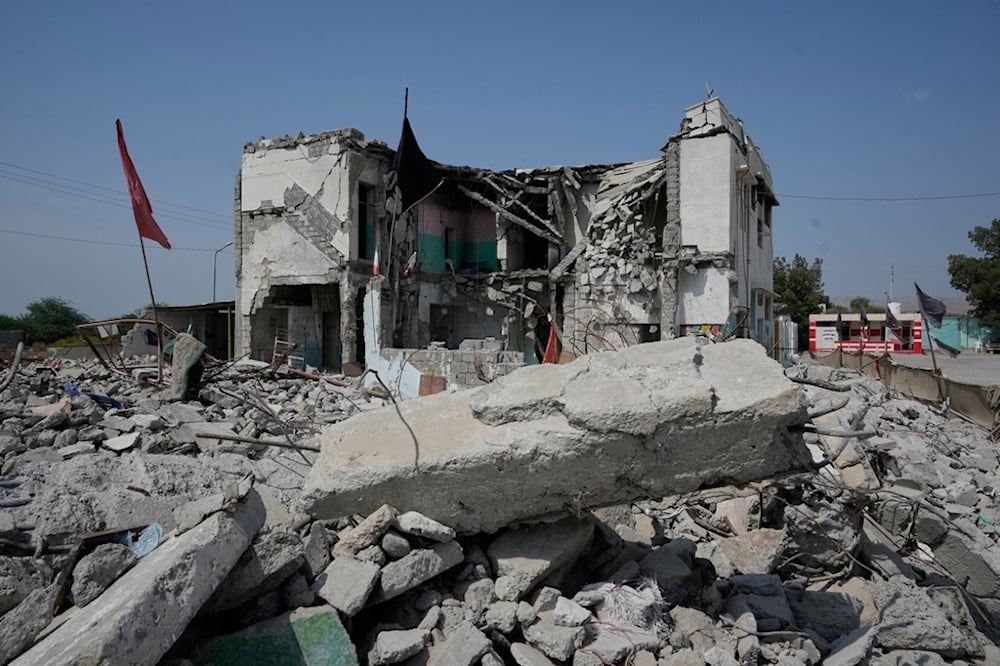
A general view of the school that was hit by a US attack on Feb. 28, is seen in town of Minab in southern Iran, Saturday, Sept. 5, 2026. (AP Photo/Vahid Salemi)
The United States could face a major war in the coming decade without having the financial capacity to sustain it, the Washington Post’s editorial board warned, pointing to rising federal debt, mounting military personnel costs, aging weapons systems, and the growing expense of modern warfare.
In an opinion piece published on Monday, the editorial board examined how Washington would respond if a major war erupted in the 2030s, including a possible Chinese attack on Taiwan, a confrontation between NATO and Russia, or another crisis that could draw the country into a prolonged war.
The Post argued that the federal budget is not prepared for such contingencies, particularly if the United States were forced to finance a lengthy conflict through additional borrowing. Such a scenario, it warned, could place further pressure on an already heavily indebted government while simultaneously demanding substantially higher military spending.
The editorial board recalled former Joint Chiefs of Staff Chairman Michael Mullen’s 2010 warning that “The most significant threat to our national security is our debt.” At the time, US federal debt was roughly $27 trillion lower than it is today, according to the Post.
US defense spending faces growing budget pressure
The Washington Post noted that the share of federal spending devoted to defense has fallen substantially over the decades, despite the United States maintaining a global military presence and fighting multiple wars.
In 1945, defense accounted for roughly 90% of federal outlays as the US mobilized for World War II. During the Vietnam War, the figure remained between 35% and 50%, while in 1999, before the wars in Afghanistan and Iraq, defense spending represented about 16% of federal outlays.
Even during the post-September 11 wars, defense spending barely exceeded 20% of federal outlays. This year, however, the figure stands at around 13%, and the Congressional Budget Office projects that defense will account for single-digit percentages of federal spending by 2035.
The shift reflects the growing weight of Social Security and major federal healthcare programs in the budget. Beginning in 2032, more than half of federal spending is projected to go toward Social Security and major healthcare programs, leaving defense competing for a progressively smaller portion of the government's available resources.
The Post noted that the United States is nevertheless spending more than $900 billion on defense this year. The problem, according to the piece, is not simply the size of the current defense budget but the gap between what the US military may require in a major conflict and what Washington's long-term fiscal position can sustain.
Personnel costs add to the Pentagon's burden
The editorial also highlighted the cost of maintaining the US military's all-volunteer force.
The system has brought significant increases in personnel compensation, with roughly four out of every 10 Pentagon dollars going toward compensation for military and civilian employees. Military personnel costs have continued to rise as Washington seeks to recruit and retain service members in a competitive labor market.
The Post noted that US military compensation is nearly four times India's entire defense budget. Military pay raises are also linked by law to average increases in private-sector wages, adding another source of upward pressure on personnel costs.
For the editorial board, these expenses illustrate the difficulty of simultaneously maintaining a large standing military, modernizing weapons systems, and preparing for the possibility of a major conventional war without putting additional pressure on the federal budget.
Modernization could require another wave of spending
The United States also faces the expensive task of replacing and modernizing much of its existing military hardware, according to the Post.
Years of delays have left Washington facing the need to rejuvenate conventional forces while also upgrading the country's nuclear deterrent. The nuclear triad, consisting of strategic bombers, submarines, and land-based missiles, relies in significant part on technology that is decades old.
The modernization effort is expected to extend well into the 2030s and beyond, meaning that a substantial share of future defense spending has already been committed to programs designed to replace aging systems.
At the same time, the ongoing war on Iran has demonstrated that even a military with enormous resources can become stretched across multiple operational demands. The Army, Navy, and Air Force must maintain readiness while managing existing commitments, replenishing weapons stocks, and preparing for potential wars involving major military powers.
The Post argued that this creates a difficult balancing act for Washington: the US must prepare for future wars while dealing with the costs generated by current operations and the modernization programs required to maintain its military advantage.
Russia-Ukraine war changed cost of modern warfare
The Washington Post also pointed to the experience of the Russia-Ukraine war as evidence that the character of warfare is changing rapidly.
Drone warfare has demonstrated the importance of developing and deploying relatively inexpensive systems at a pace that traditional Pentagon procurement processes have struggled to match. Technologies can become obsolete within months, while the sheer volume of drones required in a modern battlefield means that even low-cost weapons can generate substantial expenses when used in large numbers.
The editorial board argued that the Pentagon needs a more flexible and responsive procurement system capable of adapting to rapidly changing technology. At the same time, the emergence of drones does not mean that expensive conventional weapons can simply be abandoned.
The United States will still require aircraft, ships, armored vehicles, missiles, nuclear weapons, and other sophisticated systems, even as new technologies alter how wars are fought. Maintaining both categories of capabilities could therefore increase rather than reduce the financial demands placed on the Pentagon.
'Pentagon needs to improve'
The editorial board also argued that the Pentagon could do more to control costs, particularly in a defense industry dominated by a relatively small number of major contractors.
A less competitive defense market can weaken incentives to reduce prices and improve efficiency, while lengthy procurement processes can make it difficult for the military to respond quickly to technological changes.
The Post maintained that improving efficiency would not eliminate the broader fiscal challenge, but it could allow Washington to obtain greater military capability from each dollar spent.
The editorial board also stressed that rising defense spending should not be portrayed as the principal cause of the United States' long-term debt problem.
According to Congressional Budget Office projections cited by the Post, defense spending is expected to grow more slowly than the overall economy under current assumptions. As a result, defense spending would actually reduce projected debt relative to the size of the economy, even though the Pentagon's budget remains enormous.
Those projections, however, assume that the United States does not enter another major war. They also do not incorporate President Donald Trump's stated desire for annual defense spending to reach $1.5 trillion.
War could expose the limits of Washington's fiscal planning
The Post used the scale of other federal expenditures to illustrate the size of the defense budget in context.
A Gerald R. Ford-class aircraft carrier costs about $13 billion, which is roughly equivalent to three days of Social Security spending. Spending on all guns up to 30mm in 2025 amounted to approximately $650 million, less than four hours of Social Security expenditure.
The projected lifetime, all-in cost of the F-35 fighter program is around $2.1 trillion, still below the approximately $2.3 trillion the federal government spent on Medicaid and Social Security combined in 2025.
The comparisons were intended to demonstrate both the enormous scale of mandatory federal spending and the difficulty of placing defense expenditure in isolation from the rest of the budget.
The editorial board argued that the fundamental issue is therefore not whether the United States should maintain a strong military. The question is whether the government is preparing financially for the possibility that military requirements could increase sharply and unexpectedly.
Governments routinely borrow during major wars and then attempt to reduce debt during periods of peace, the Post noted. But if Washington enters a major war while already facing severe fiscal pressure, its ability to borrow without destabilizing financial markets could become a national security concern in itself.
The editorial board warned that maintaining confidence in US debt markets is therefore part of maintaining the country's defense capacity. A government that exhausts its fiscal room during peacetime, it argued, could find itself in a much weaker position when a serious military crisis arrives.
The Post's broader warning is that Washington cannot assume that the absence of a major war will continue indefinitely. Preparing for one requires more than weapons and troops, the editorial board argued. It also requires a federal budget capable of absorbing the extraordinary costs of a prolonged conflict without undermining the country's wider economic and financial stability.


