
Skyscrapers over siege: Kushner's Gaza fantasy meets reality
 6 Min Read
The Financial Times reports that Jared Kushner's Davos vision of a rebuilt, tourist-friendly Gaza clashes sharply with ongoing siege conditions, restricted aid, and the absence of meaningful reconstruction on the ground.
-
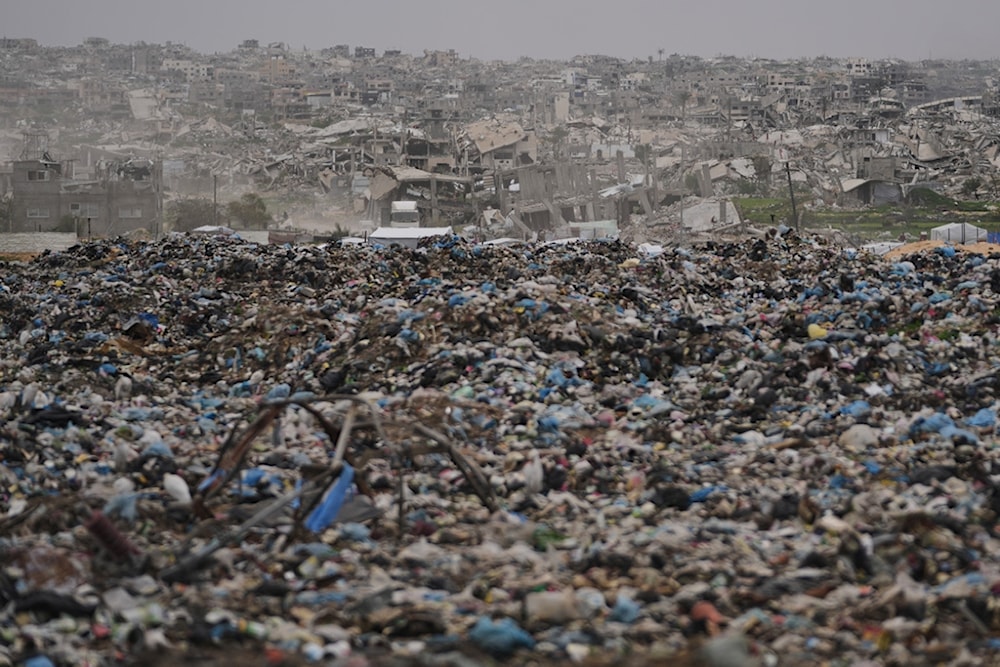
Destruction left by the Israeli air and ground offensives stands behind a landfill in Khan Younis, Gaza, on January 22, 2026. (AP Photo/Jehad Alshrafi)
The Financial Times (FT) on Wednesday reported that a highly speculative redevelopment vision for Gaza promoted by Jared Kushner has provoked outrage among Palestinians and aid agencies, as it openly reframes one of the world’s worst humanitarian disasters as a future investment opportunity, while the enclave remains under siege, occupation, and systematic deprivation.
At the World Economic Forum in Davos last week, Kushner, the son-in-law of US President Donald Trump and a key architect of Washington’s pro-"Israel" Middle East policy, presented computer-generated images depicting Gaza remade into a high-end Mediterranean destination, complete with luxury towers, leisure zones, and commercial districts.
Gaza "could be a destination, have a lot of industry, and really be a place that the people there can thrive", Kushner said, insisting there would be no alternative to what he described as "catastrophic success".
Trump’s son-in-law, Jared Kushner, presented a ‘master plan’ for Gaza’s future at Davos, unveiling maps and graphics and outlining how the U.S. intends to implement the initiative. pic.twitter.com/NwuncHpzyn
— Babacar Samba Naudin ★ ★ (@_BABACAR) January 28, 2026
The spectacle of gleaming skyscrapers stood in stark contrast to conditions on the ground, where "Israel" continues to impose severe restrictions on goods, movement, and reconstruction, leaving Gaza’s 2.1mn residents struggling for basic survival. In this context, "catastrophic" is a term many Palestinians reserve for the present reality: flattened neighbourhoods, mass displacement, collapsing healthcare, and winter deaths among children living in tents and bombed-out buildings.
Although a fragile, three-month ceasefire brokered by Trump reached a milestone this week following "Israel’s" retrieval of the remains of the last Israeli captive, the Financial Times noted that meaningful recovery remains elusive. Israeli forces continue to occupy more than half of the Strip, while air strikes since October have killed more than 480 Palestinians, according to local health officials.
Reconstruction as leverage
Behind Kushner’s Davos presentation lies a broader US-Israeli push to market what officials describe as a "post-war Gaza", a vision reportedly involving tens of billions of dollars in private investment, phased redevelopment beginning in Rafah, and strict security preconditions. Reconstruction, Washington and Tel Aviv say, will not begin as long as Hamas remains armed. Israeli Prime Minister Benjamin Netanyahu reiterated this position on Monday. "The next phase is not reconstruction," he said. "The next phase is disarming Hamas and demilitarising the Gaza Strip."
Palestinians and aid groups see this sequencing as a political lever rather than a humanitarian roadmap, effectively turning the basic right to shelter and recovery into a bargaining chip. While a body of Palestinian technocrats has been floated as an interim administrative mechanism, "Israel" is expected to retain control over borders, crossings, and all flows of people and goods. The Rafah crossing with Egypt is expected to reopen only for passenger movement, not commercial cargo, further constraining relief and rebuilding efforts.
"Life in Gaza remains suffocating," said James Elder, spokesperson for UNICEF. "Survival is still conditional. What the world now calls ‘calm’ would be considered a crisis anywhere else."
Life by permission
Humanitarian officials acknowledge limited improvements since the ceasefire, including increased food access that has helped avert famine. But they warn that "Israel’s" sweeping "dual use" restrictions continue to choke the delivery of medical equipment, shelter materials, and infrastructure supplies essential for making Gaza minimally livable. Aid groups say items as basic as wheelchairs, MRI machines, plywood, roofing nails, water pipes, cleaning materials, and vehicle tyres are routinely rejected. UN officials report that even fresh and frozen food has been denied entry without explanation.
The Palestinian Red Crescent, Gaza’s primary emergency medical provider, said its warehouses are stocked with supplies awaiting Israeli approval. Medical staff describe a system in which survival depends on intermittent permissions rather than need.
Eid Sabah, a former head of nursing at one of Gaza’s now-destroyed hospitals, said he is powerless to help his sister Ruhaifa, a 58-year-old grandmother battling cancer. "All I can do is watch her suffer," he said. "Most cancer drugs have run out in Gaza, so there is no medication for her. When her pain becomes unbearable, I take her tothe hospital where they give her intravenous painkillers for a day or two."
Criminalising humanitarian aid
At the same time, "Israel" is moving to deregister 37 international non-profits, including Oxfam and the Norwegian Refugee Council, under a new NGO law requiring organisations to hand over staff lists to Israeli authorities. The groups have refused to comply and will be forced to halt operations in March. NRC says its work has already been severely obstructed. "When the ceasefire hit, we had 200 trucks worth of shelter and hygiene material that had been rejected," said Shaina Low, an NRC spokesperson. "Since the ceasefire, we have received another 17 rejections."
"Israel" argues that food availability has improved and that restrictions are necessary to prevent Hamas from rebuilding military capacity. Aid workers counter that the effect is collective punishment, locking civilians into prolonged displacement and forcing families to inhabit unsafe ruins.
Raed Hassanein, an academic who returned to his damaged home north of Gaza City, said half of the structure had collapsed. "It is better than a tent, we’ve stretched out plastic sheets to close the gaps where walls are broken, and to separate a sleeping area for men and another for women," he said. "There is no privacy, no electricity, and no clean water." With construction materials scarce or prohibitively expensive, he added, repairs are impossible.
Marketed erasure
Reconstruction is expected to cost billions of dollars and take years, yet for many Palestinians, Kushner’s glossy vision represents not hope, but erasure. Hassanein dismissed the idea of a "New Gaza" as a marketing exercise detached from reality. It was, he said, an attempt "to sell us an illusion in the guise of salvation. You capture animals using meat, but humans are caught when you sell them hope".
The Davos presentation, he added, reduced Gaza "with all its wounds, martyrs, children and demolished homes to a shiny image as if it were not a homeland, but a space to be reshaped according to the whims of the powerful".
Read more: Leaked document exposes US blueprint for total control over Gaza: DSN


