
Spain deploys floating barrier in Ceuta as migrant crisis shakes EU
 3 Min Read
Following a deadly mass crossing that killed at least 67 people, Spain has started laying a 500-metre floating barrier at its Ceuta border with Morocco.
-
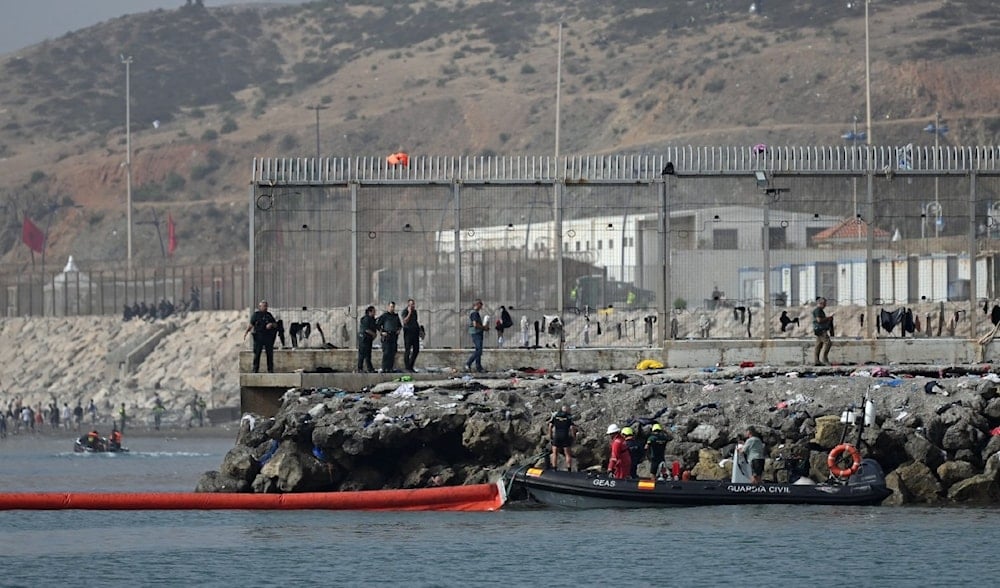
A pneumatic barrier is deployed in the water by a Spanish Guardia Civil boat near the border post to reinforce security following illegal crossings from Morocco into the Spanish enclave of Ceuta, on August 1, 2026. (Photo by JORGE GUERRERO / AFP)
Spanish authorities began installing a 500-metre floating barrier off Ceuta's coast on Saturday, a day after a mass migrant crossing left at least 67 people dead and triggered a bitter dispute among European Union governments over how the bloc should respond.
Police said crossings into the North African enclave had halted overnight following an unprecedented surge that saw roughly 50,000 people enter Ceuta by land and sea since Thursday.
Spain reported that more than 48,000 of those who crossed had already been returned to Morocco within 48 hours, with authorities describing the process as largely incident-free. A separate tally cited by regional outlets put the number still inside Ceuta at around 2,000, suggesting the bulk of the influx had reversed within days of the initial rush.
La Armada española comienza a instalar barreras de contención en el espigón del Tarajal https://t.co/nmxajMEXCp pic.twitter.com/RYdb2aC4NM
— RTVE Noticias (@rtvenoticias) August 1, 2026
The new barrier, a pneumatic structure standing up to 70 centimetres above the waterline and extending roughly a metre below the surface, is being laid alongside a line of anchored buoys near the Tarajal breakwater, one of the main entry points used during the crossing. A channel between the barriers will allow Civil Guard vessels to continue patrolling.
Officials said the 67 confirmed deaths resulted from drownings and crush injuries as migrants attempted to scale the breakwater and border fence.
View this post on Instagram
EU split over response
The crisis has caused a rift within the bloc. Twenty-two EU member states called for an emergency meeting of interior ministers, urging support for Madrid in regaining control of its frontier with Morocco, including potential reinforcement from border agency Frontex and a reassessment of cooperation with Rabat.
Notably, France, Luxembourg, Portugal, Spain, and Ireland did not sign onto the letter.
Italy's right-wing government escalated tensions further, announcing a one-month suspension of Schengen arrangements with Spain, which Spanish Prime Minister Pedro Sanchez condemned as unlawful and divisive given the current international climate.
Le immagini arrivate da Ceuta hanno dimostrato ancora una volta quanto sia urgente una risposta europea all’immigrazione clandestina.
— Giorgia Meloni (@GiorgiaMeloni) August 1, 2026
Per questo l’Italia ha promosso, insieme alla Danimarca, una lettera sottoscritta da 22 Stati membri dell’Unione europea, che chiede un’azione… pic.twitter.com/v8nmxzSYKn
Sanchez pushes back with Frontex data
Sanchez directly challenged Italy's Prime Minister Giorgia Meloni on X, citing Frontex figures on irregular EU entries between 2021 and 2026, which showed Italy recording the highest number of crossings by far, at 478,600, followed by the Western Balkans route (340,600), Greece (259,800), and Spain (234,760), with the eastern border trailing at 48,000.
The numbers complicate Rome's push to isolate Madrid over the Ceuta crisis, given that Spain's route has drawn less than half the irregular traffic seen on Italy's.
La solidaridad y la empatía son opcionales.
— Pedro Sánchez (@sanchezcastejon) July 31, 2026
El respeto a los tratados europeos y a los datos, no.
👇🏼
Número de entradas irregulares entre 2021 y 2026 según Frontex:
Por Italia: 478.600
Por los Balcanes occidentales: 340.600
Por Grecia: 259.800
Por España: 234.760
Por la…
Madrid defends its migration policy
Spain has also pushed back on claims that its recent regularization program, which has granted residency to more than half a million undocumented migrants, encouraged the Ceuta rush.
Officials noted that applicants must prove Spanish residence predating January 1, 2026, along with five continuous months of residency, arguing the criteria would have excluded anyone crossing this week.
Madrid further confirmed that anyone entering Ceuta irregularly is barred from onward travel into mainland Spain or the wider Schengen area, with identity checks serving as a secondary control layer for departures by sea or air.


