
STC fires back at accusations against al-Zubaidi, mobilizes support
 3 Min Read
The STC denounces accusations against its president, highlights human rights violations in Hadramout, and urges unity ahead of the million-man rally.
-
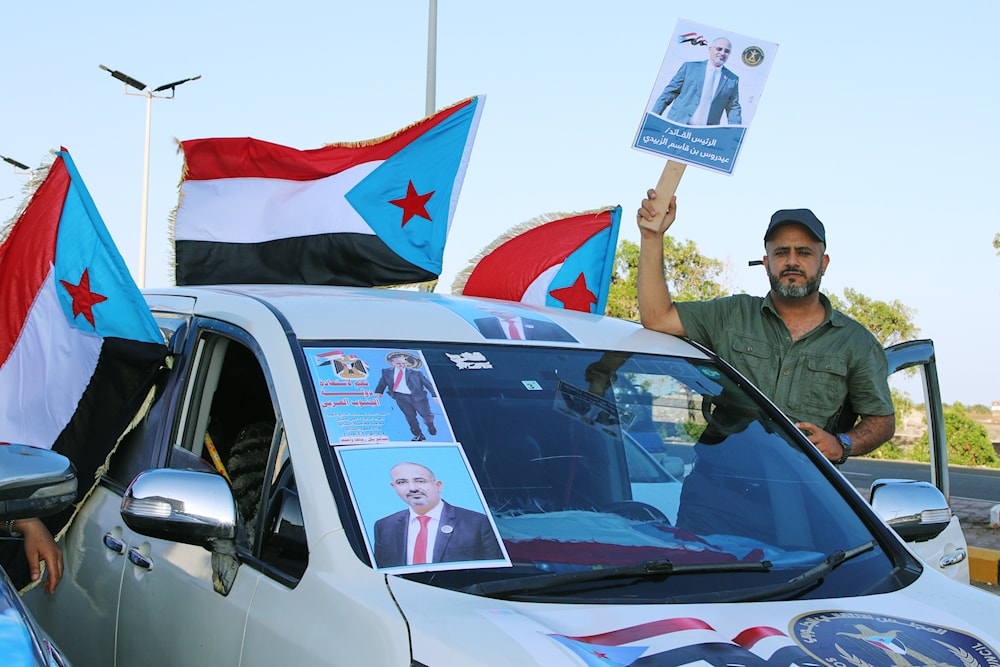
Supporters of the Southern Transitional Council hold South Yemen flags and a poster of their leader, Aidarous al-Zubaidi, during a rally in Aden, Yemen, Dec. 25, 2025 (AP)
The Administrative Committee of the National Assembly of the Yemeni Southern Transitional Council (STC) condemned what it described as "false and provocative" accusations against its president, Aidarus al-Zubaidi, emphasizing that such claims undermine the political process and hinder efforts to achieve stability.
The statement was issued during the committee’s regular meeting in Aden, chaired by Issam Abdo Ali, acting president of the UAE-backed STC’s National Assembly, and published on the council’s official X account. The meeting reviewed the country’s general conditions and serious political developments, particularly those targeting the Southern cause and its leadership.
الهيئة الإدارية للجمعية الوطنية تعقد اجتماعها الدوري وتصدر بياناً هاماً
— الجمعية الوطنية للمجلس الإنتقالي الجنوبي (@NA_OF_STC) January 21, 2026
الأربعاء ٢١ يناير ٢٠٢٦
عقدت الهيئة الإدارية للجمعية الوطنية، اليوم الأربعاء، اجتماعها الدوري في العاصمة عدن، برئاسة الأستاذ عصام عبده علي، القائم بأعمال رئيس الجمعية الوطنية للمجلس الانتقالي الجنوبي، حيث…
The committee strongly rejected accusations made by Hadhramaut Governor Salem al-Khanbashi and Minister of Information Moammar al-Eryani, labeling them as misleading attempts to tarnish the role of the UAE and the Southern Armed Forces. It called the claims “desperate efforts to undermine the STC and destabilize the region.”
In addition, the committee denounced serious human rights violations in Hadhramaut, including political and security persecution of activists, citizens, and political figures, some of whom were allegedly imprisoned without legal justification. It warned that such practices threaten social cohesion and public stability.
STC urges Southern unity
The STC stressed the importance of Southern unity and urged the people of the region to rally behind their political leadership. It affirmed that any upcoming Southern dialogue must include the council as the official representative of the Southern people, with full powers and under regional, international, and UN supervision in a neutral country to ensure transparency and credibility.
The statement also called on Southern citizens “from Al-Mahra in the east to Bab al-Mandab in the west” to participate in the “Million-People Rally for Persistence and Popular Escalation” scheduled for Friday, January 23, 2026, in Aden and Hadhramaut. The STC described the rally as a crucial political and popular message at a pivotal moment, reflecting public awareness and solidarity with the Southern cause and its leadership.
The committee praised the success of previous mass rallies, noting their wide participation and the responsible national engagement of the Southern people in defending their legitimate aspirations and national cause.
UAE-KSA rift explained
This follows a sharp deterioration in relations between Riyadh and Abu Dhabi over influence in southern Yemen. Saudi officials have increasingly accused Emirati-backed factions, particularly forces aligned with the Southern Transitional Council, of advancing agendas that threaten Saudi national security, a notable rupture between two states that once jointly led the military coalition intervening in Yemen since 2015.
In December, STC-affiliated forces briefly expanded their footprint across several southern governorates, advancing toward areas Riyadh considers strategically sensitive, including zones near the Saudi border. Saudi officials later described the advance as a “red line", warning that unchecked separatism, militia rule, or territorial fragmentation could have grave security consequences for the kingdom.
The escalation prompted Saudi airstrikes on a shipment linked to UAE-supported forces, followed by a rapid counter-deployment by Saudi-aligned units that reversed the STC’s gains. Saudi-backed “National Shield” forces subsequently announced full deployment across Aden governorate, while the Presidential Leadership Council moved to retake camps and installations previously controlled by STC-aligned units, exposing deep fractures within the coalition that has dominated Yemeni politics and security for nearly a decade.


