
Trump's 'crazy world' prompts Norway to rethink EU membership debate
 4 Min Read
Norway is reassessing its relationship with the EU as trade disputes, security concerns, and shifting global power dynamics revive debate over membership.
-
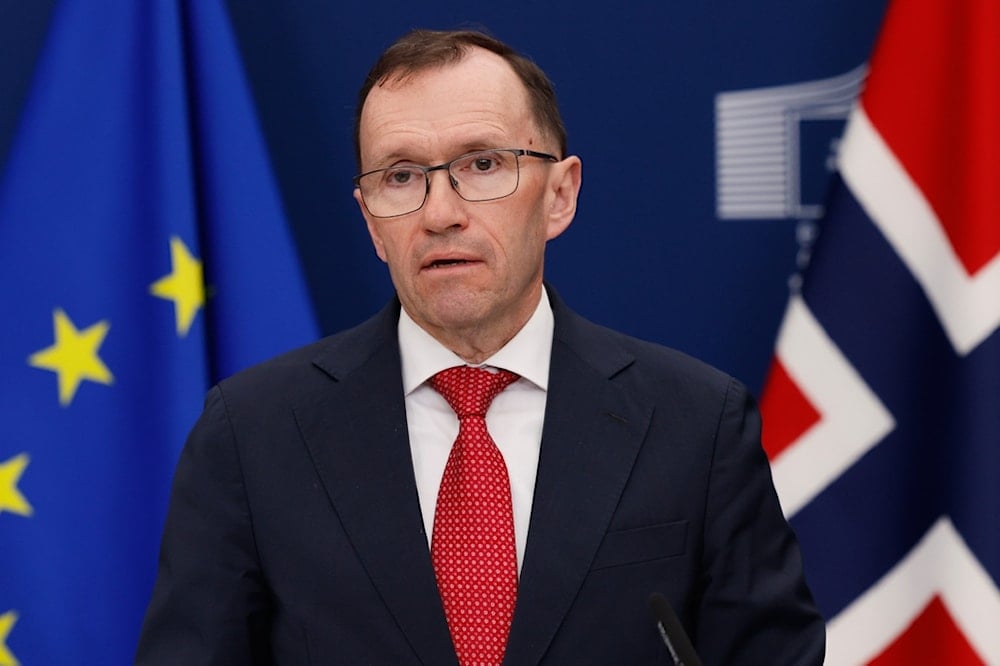
Norway's Foreign Minister Espen Barth Eide addresses a media conference at EU headquarters in Brussels, Monday, April 20, 2026 (AP)
Norway is reassessing its long-standing relationship with the European Union as mounting geopolitical tensions, growing uncertainty over US policy, and shifting global economic realities reignite debate over whether the Nordic country should reconsider full membership in the bloc, the Financial Times reported.
The discussion comes decades after Norwegian voters rejected EU accession in two referenda, reflecting concerns that are increasingly being challenged by a rapidly changing international environment.
Norwegian Foreign Minister Espen Barth Eide said the international order that existed when Norway voted against joining the EU no longer exists, arguing that the country faces a markedly different strategic landscape.
Speaking to the Financial Times, Eide described today's geopolitical environment as a "crazy world" shaped by growing competition between major powers and increasing economic fragmentation.
Norway remains outside the EU despite participating in the bloc's single market through the European Economic Area (EEA) agreement.
The country's previous rejections of membership in 1972 and 1994 were heavily influenced by concerns surrounding fisheries and agriculture, sectors viewed as central to Norway's economic sovereignty.
“We said no in 1972 because of fish and again in 1994, it was very much about fish. Fish and agriculture,” Eide said.
Trade tensions expose limits of current arrangement
Recent trade disputes and protectionist policies have highlighted what some Norwegian officials see as the limitations of the country's current relationship with the EU.
Although Norway participates in the single market, it does not take part in EU trade negotiations and has no direct role in discussions between Brussels and Washington.
The issue has gained greater significance amid tariff disputes and intensifying competition among major economic powers.
“When we joined the European Economic Area, we joined the new hot thing, which was the single market,” Eide said. “Fast forward 30 years, that benign world is gone and we need to be honest about being in a more difficult situation.”
According to the foreign minister, policy areas that Norway previously chose to remain outside of, including customs and trade mechanisms, have become increasingly important in the current international climate.
Read more: Russia warns Norway over 500-km missile deployment
Security concerns reshape debate over Europe
Beyond economics, security considerations are also influencing the debate.
European governments have accelerated efforts to strengthen defense cooperation in recent years amid concerns over long-term strategic stability and uncertainty surrounding transatlantic relations.
In Norway, concerns have reportedly intensified following statements by US President Donald Trump regarding Greenland, the autonomous Danish territory in the Arctic.
Oslo is also closely monitoring developments surrounding Svalbard, Norway's Arctic archipelago, which remains strategically significant due to its location and resources.
The growing emphasis on defense and security cooperation within Europe has led some policymakers to argue that the EU now plays a broader geopolitical role than it did during previous membership debates.
Iceland's EU path watched closely in Oslo
Developments in Iceland are attracting particular attention among Norwegian policymakers.
The North Atlantic nation is set to hold a referendum in August on reopening EU membership negotiations.
European officials have reportedly indicated that Iceland could receive special arrangements concerning fisheries policy, one of the most sensitive issues for Nordic countries considering EU membership.
Eide acknowledged that any concessions offered to Reykjavik would be closely watched in Norway.
“When it comes to Iceland, it is significant for us... We need to follow this closely,” he said.
Observers note that a successful Icelandic bid could reshape political calculations within Norway, particularly among sectors historically opposed to EU accession.
Public skepticism still blocks membership push
Despite support among some senior Labour Party figures, Norwegian public opinion remains broadly skeptical of EU membership.
Norwegian Prime Minister Jonas Gahr Støre and Eide have both expressed support for eventual accession, but neither is currently advocating a new referendum.
Polling continues to indicate that a majority of Norwegians would reject membership if a vote were held today.
Eide argued that Norway's significant oil and gas wealth has contributed to a sense of economic independence that continues to influence public attitudes.
“If there was a referendum tomorrow I would vote yes... but that’s not the same as saying now is the moment to actually ask for a referendum,” he said.
For now, the debate appears focused less on immediate accession and more on evaluating whether Norway's current arrangements remain adequate in an increasingly volatile international environment.


