
Trump targets Somali immigrants in Minnesota over alleged fraud
 5 Min Read
The Trump administration probes Somali immigrants in Minnesota for fraud, freezing child care funds and drawing criticism from rights groups and officials.
-
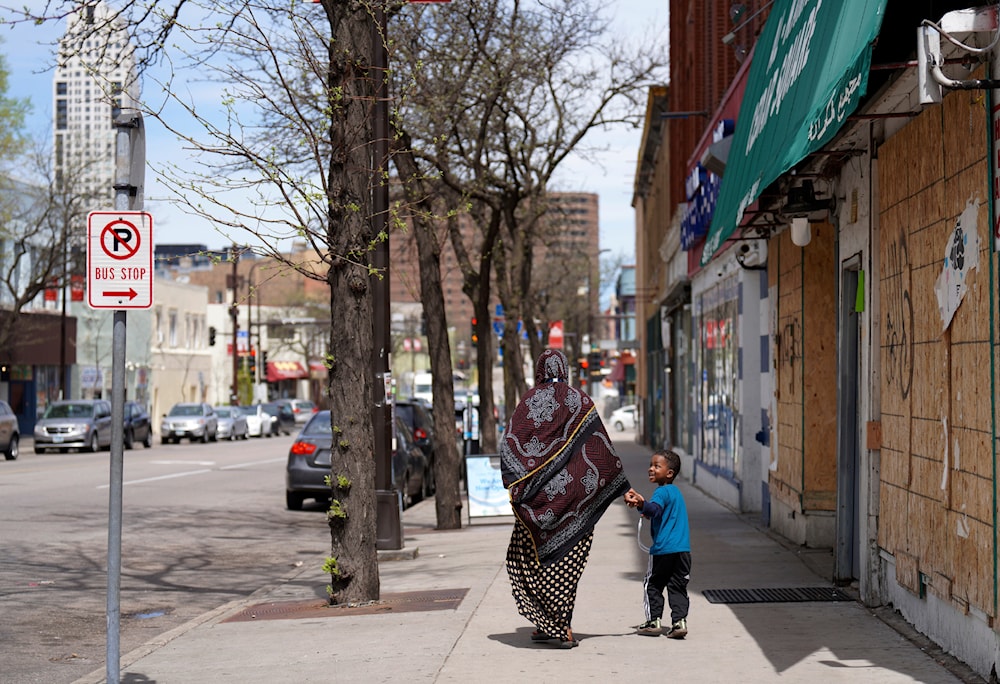
A woman and a child hold hands as they walk down a street in the predominantly Somali neighborhood of Cedar-Riverside in Minneapolis on Thursday, May 12, 2022 (AP)
The United States is auditing immigration cases involving US citizens of Somali origin to identify potential fraud that could result in denaturalization, the revocation of citizenship, the Trump administration announced on Tuesday.
Homeland Security Assistant Secretary Tricia McLaughlin said in a statement that US law allows for denaturalization if citizenship was obtained through fraudulent means. The statement was first reported by Fox News and later reposted by the White House on social media. Denaturalization cases are uncommon and often take years to complete, with the Immigrant Legal Resource Center estimating that an average of about 11 such cases were pursued annually between 1990 and 2017.
Federal officials have recently described Minnesota’s Somali community as a focal point for alleged fraud involving millions of dollars in federal funds intended for social services. Immigrant rights advocates, however, argue that the administration is using fraud investigations to broadly target Somali immigrants.
FBI Director Kash Patel said on Sunday that the bureau has deployed additional investigative resources and personnel to Minnesota as part of the administration’s latest fraud probes involving the state’s Somali population.
Separately, the US Department of Health and Human Services said on Tuesday that it has frozen all child care payments to Minnesota. The department added that, going forward, payments from its Administration for Children and Families nationwide will require justification along with receipts or photographic evidence before funds are released.
Minnesota Governor Tim Walz criticized the move, saying the state has spent years combating fraud and accusing the Trump administration of politicizing the issue in order to cut funding for programs that support Minnesotans.
Somalia, Somaliland, in the limelight
This comes as Somalia and Somaliland take center stage in the global landscape, after "Israel" unilaterally announced its recognition of Somaliland, joining only 32 countries that have previously recognized the territory as a state.
On December 26, “Israel” formally recognized the Republic of Somaliland as an independent and sovereign state after a joint declaration was signed by Prime Minister Benjamin Netanyahu, Foreign Minister Gideon Sa'ar, and Somaliland President Abdirahman Mohamed Abdallah.
The announcement was issued by the Prime Minister’s Office, which said the declaration reflects the spirit of the regional normalization agreements known as the Abraham Accords, signed under the initiative of US President Donald Trump.
Netanyahu's move triggered a wave of backlash from regional and international players, including Somalia, Egypt, Turkiye, Yemen, and the Arab League. In a statement posted on X, the Somalian President Hassan Sheikh Mohamud said the step violates international law and contravenes established diplomatic and legal norms, stressing that any interference in Somalia’s internal affairs is unacceptable. He reaffirmed that the Somali people and their nation remain united, indivisible, and cannot be fragmented by external actions.
Even US President Donald Trump dismissed the idea of recognizing Somaliland during an interview with the New York Post; however, despite this rejection, Israeli media have revelaed that "Israel's" recognition connects to Trump's plans to turn Gaza into the "Riviera of the Middle East".
Israeli expert on American affairs Eido Dambin said on December 27 in remarks to iNEWS24 that Somaliland has been floated as a possible location to host Gaza residents under the so called Gaza Riviera plan unveiled by Trump more than six months ago.
Dambin said he does not expect any swift implementation of the plan in light of the current ceasefire, while suggesting that Prime Minister Benjamin Netanyahu’s recognition of Somaliland could function as a symbolic step, indicating “Israel’s” readiness to consider such options, even through acknowledging a territory that no other state recognizes.
Israeli ambitions in Horn of Africa
Somaliland hosts a major Emirati military presence at Berbera, developed by the UAE as part of its broader regional footprint stretching from the Horn of Africa to the southern Red Sea. The base has played a central role in Abu Dhabi’s efforts to project power across maritime chokepoints and to support operations linked to Yemen, including attempts to restrict the operational depth of Ansar Allah and limit Saudi Arabia’s exposure along critical shipping lanes, which greatly benefits the Israeli occupation.
US military planners have also long viewed Somaliland as a strategic fallback and logistics hub near the Bab al-Mandab strait, especially to protect their interests as Ansar Allah grows. Israeli security officials, meanwhile, have reportedly sought access and intelligence cooperation in the area as part of a wider push to monitor Red Sea traffic and resistance-aligned movements operating across Yemen and the Horn of Africa.
The recognition of Somaliland aligns with this emerging security architecture, effectively granting political cover to an already entrenched military and intelligence reality. By formalizing relations, the Israeli regime positions itself alongside Washington and Abu Dhabi in shaping Red Sea security arrangements that aim to control maritime routes, constrain Ansar Allah’s reach, and reinforce a regional bloc extending from occupied Palestine to East Africa.
The declaration also echoes the logic of the "Abraham Accords," backed by Trump, which linked diplomatic normalization with deeper security and intelligence integration. In this context, Somaliland’s recognition is less than an isolated diplomatic gesture and more as a strategic consolidation of overlapping US, Israeli, and Emirati interests at a critical geopolitical crossroads.


