
Trump uses Iran ceasefire to sidestep Congress war deadline
 5 Min Read
Trump argues the Iran ceasefire delays the legal deadline requiring Congress approval for the war.
-
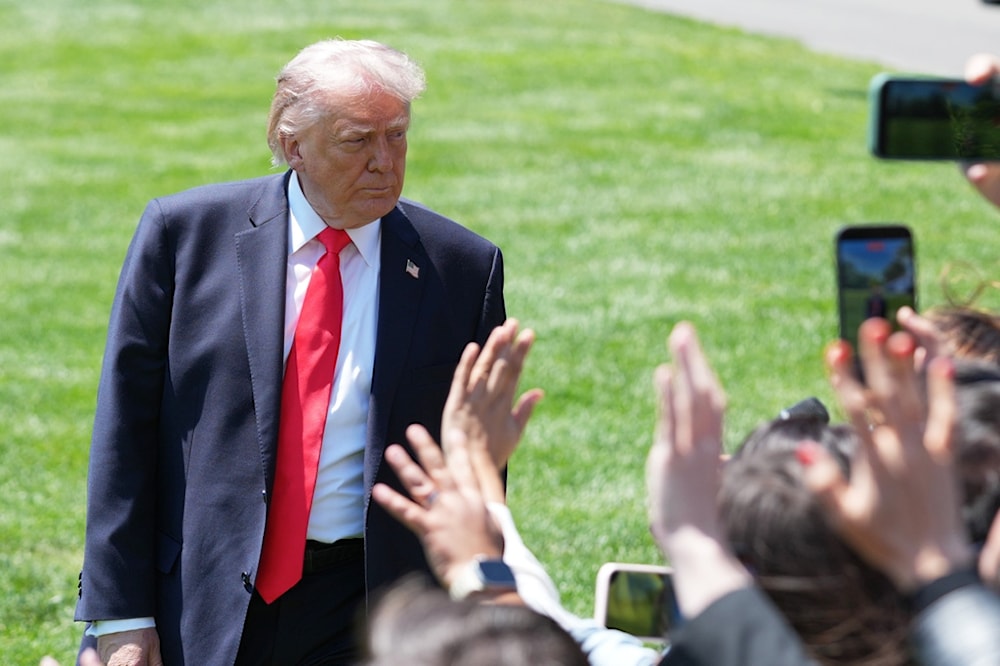
US President Donald Trump speaks with reporters before departing on Marine One from the South Lawn of the White House, Friday, May 1, 2026, in Washington. (AP)
US President Donald Trump signaled on Friday that Washington is leveraging the ceasefire with Iran to delay seeking congressional authorization, as the military aggression reaches the legal limit imposed on undeclared wars.
Speaking to reporters, Trump argued that the pause in fighting provides additional time before the administration is required to justify its actions to lawmakers, effectively treating the ceasefire as a mechanism to extend the timeline.
"No other country has ever done it. It's never been; as you know, most people consider it totally unconstitutional. We had a ceasefire, so that gives you additional time," he said.
The remarks come as senior US officials have gone further, asserting that hostilities with Iran are effectively “over” for the purposes of domestic law, citing the absence of direct clashes since early April. This designation carries significant legal implications, as it allows the administration to argue that the clock governing unauthorized military operations no longer applies.
That position has been reinforced by US War Secretary Pete Hegseth, who told lawmakers that the ceasefire effectively halts the legal countdown.
"We are in a cease-fire right now, which our understanding means the 60-day clock pauses or stops in a cease-fire," he said.
However, despite the halt in direct bombardment, US forces continue to enforce a naval blockade targeting Iranian ports, a measure widely regarded under international law as an ongoing act of war.
War Powers dispute
The debate centers on the War Powers Resolution, which requires US presidents to end military operations within 60 days unless Congress grants approval. Critics argue the law contains no provision allowing the clock to be paused, or reset, warning that redefining hostilities as “over” despite continued military pressure amounts to an attempt to bypass constitutional oversight.
The timeline has reached a critical point, as May 1 marks 60 days since Congress was notified of military action following the February 28 US- and Israeli-led strikes on Iranian territory, which caused infrastructure damage and civilian casualties. A temporary cessation of hostilities was announced on April 7 and has since been extended, though without a comprehensive settlement.
The administration’s legal interpretation has drawn sharp pushback on Capitol Hill. Senator Tim Kaine rejected the claim that a ceasefire pauses the statutory deadline, while Senator Susan Collins stressed that:
"That deadline is not a suggestion; it is a requirement," she said.
Skepticism has also emerged among Republicans. Senator Todd Young questioned the lack of precedent for such an interpretation, and Senator Josh Hawley argued that any legal justification should be formally submitted to Congress.
While Washington has portrayed the ceasefire as a diplomatic opening, Tehran has advanced its own proposals aimed at ending the war on broader terms, including sanctions relief, maritime guarantees, and wider regional de-escalation. These proposals have yet to be accepted, with US officials insisting on a narrower framework that prioritizes immediate concessions from Iran.
Talks held in Islamabad failed to yield a breakthrough, with the United States prolonging the ceasefire period while pressing Iran to submit what Trump described as a "unified proposal," a formulation that Iranian officials have effectively rejected in favor of a more comprehensive approach.
With the 60-day deadline now reached, the administration’s legal interpretation is increasingly viewed as an effort to avoid triggering the requirement to either secure authorization or withdraw forces.
Mounting war pressure
In parallel, Trump sought to downplay concerns about the sustainability of the US war effort, dismissing reports that the war has strained American weapons stockpiles.
"We have more than double what we had when this started. I am not worried," he said.
However, signs of internal unease have emerged within the administration. According to reporting, Vice President JD Vance has raised questions behind closed doors regarding the accuracy of Pentagon assessments on missile reserves and the overall portrayal of the conflict.
The war has also begun to produce wider ripple effects. Reports indicate delays in US arms deliveries to European allies as Washington prioritizes its military needs, while several Gulf states have voiced frustration over difficulties in replenishing air-defense systems following Iran’s retaliatory operations.
Against this backdrop, Washington’s reliance on a temporary ceasefire, while simultaneously declaring hostilities “over” and attempting to halt the legal clock, appears increasingly tied to mounting pressure, military, political, and institutional, surrounding a conflict that remains unresolved.
Read more: War on Iran cost US billions and its top weapon stockpiles: CSIS


