
US deems Iran hostilities “over” under War Powers law
 3 Min Read
A senior US official says Iran hostilities are considered over under the War Powers Resolution, citing a ceasefire and no clashes since April 7.
-
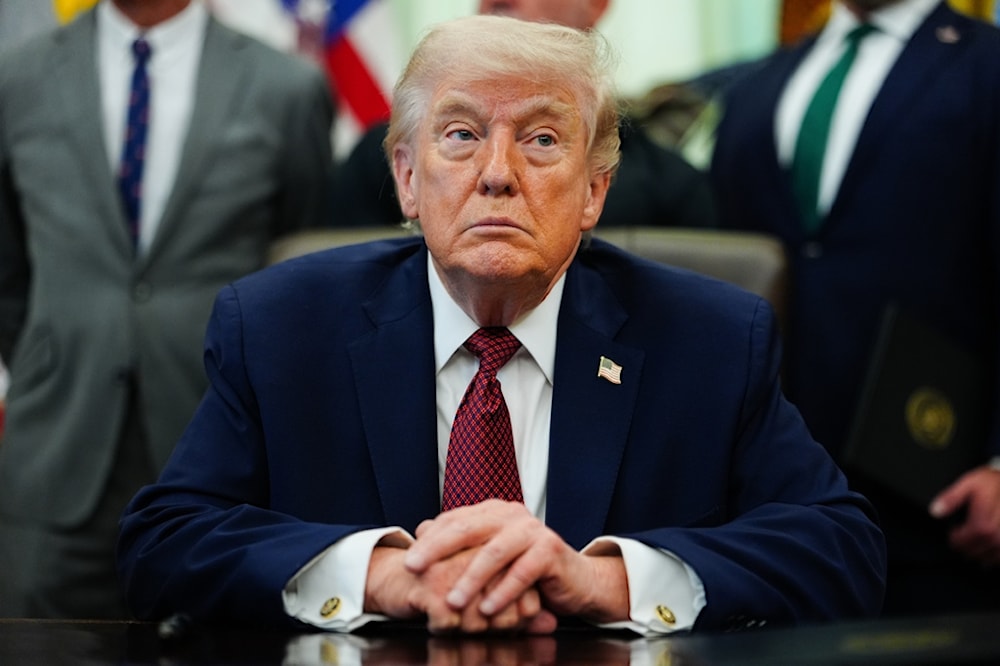
President Donald Trump listens in the Oval Office of the White House, Saturday, April 18, 2026, in Washington. (AP Photo/Julia Demaree Nikhinson)
A senior US administration official told Al Mayadeen that hostilities with Iran have been deemed “over” for purposes related to the War Powers Resolution.
The official explained that both sides had reached a ceasefire agreement lasting two weeks, which has since been extended.
According to the official, there has been no exchange of fire between US forces and Iran since April 7, reinforcing the assessment that active hostilities have ceased.
Legal implications under US law
The statement is tied to the War Powers Resolution, a US law that limits the president’s ability to engage in military operations without congressional approval.
Under the law, the president must notify Congress within 48 hours of initiating military action, while a 60-day deadline—extendable by 30 days—applies to ending operations or securing formal authorization.
Designating the hostilities as “over” carries legal significance, as it allows the administration to avoid triggering the timeline requirements or facing pressure from Congress to halt operations or vote on a new military authorization.
Trump may push to extend Iran
US President Donald Trump is expected to seek ways to prolong the war on Iran as he approaches the 60-day legal limit for unauthorized military operations, raising further concerns over Washington’s adherence to its own legal framework and the risk of deeper regional escalation.
May 1 marks 60 days since Trump notified Congress of military action against Iran, triggering obligations under the War Powers Resolution, which requires either congressional approval or a withdrawal of forces. Instead of complying, the administration is likely to pursue an extension to sustain the aggression.
"Trump is in a no-win situation, yet attempting to find a way out. He will likely seek an additional extension," retired US Army Lt. Col. Earl Rasmussen told RIA Novosti.
The law allows for only a limited extension under specific conditions, but critics argue that successive US administrations have repeatedly stretched or bypassed these constraints to maintain military operations abroad.
A major miscalculation
Rasmussen cautioned that Trump faces a political dilemma, but suggested that Washington may opt for escalation rather than retreat, despite the risks.
"If Trump pulls forces out, it will not look good politically. He may double down and go forward with his threats, but the most probable outcome will be worse," he said.
He described the initial decision to attack Iran as a major miscalculation, warning that continued pressure from “Israel” and segments of the US political establishment could push the administration toward further confrontation rather than de-escalation.
Rasmussen believes the US is attempting to avoid what increasingly appears to be a strategic setback, as expectations that Iran would capitulate remain unrealistic.
"The US is looking for any way to avoid defeat but will likely need to, otherwise the future is unknown," he said.


