
Ukraine still wants more as $27 billion funding gap emerges
 8 Min Read
Ukraine is seeking $27 billion more to cover a defense budget shortfall as rising war costs and falling revenues put pressure on European allies.
-
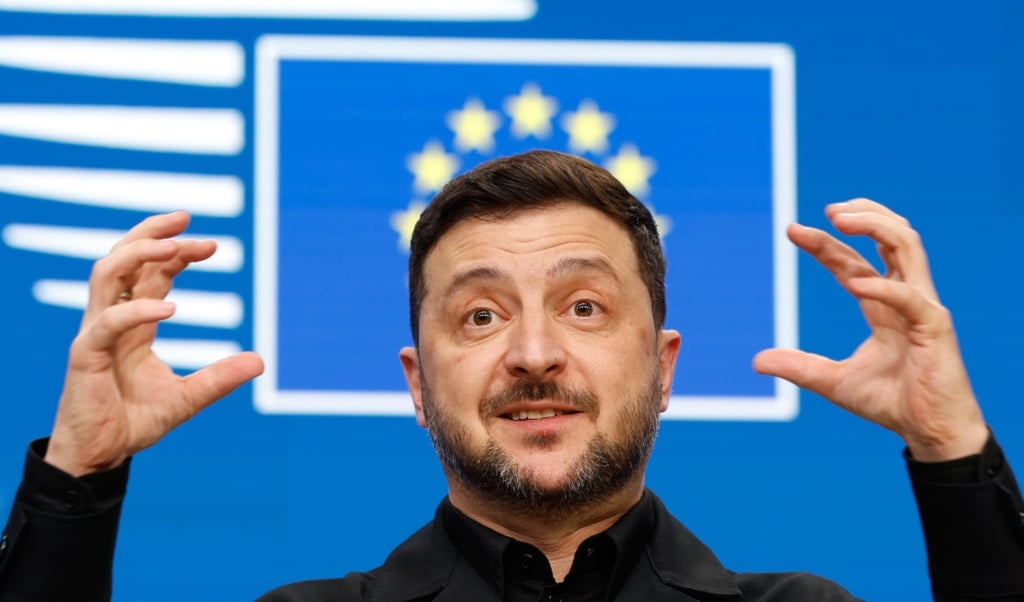
Ukraine's President Volodymyr Zelenskyy speaks during a media conference at the EU Summit in Brussels, Thursday, Dec. 18, 2025. (AP)
European officials arrived in Kiev last month to mark Ukraine’s Independence Day, expecting to discuss the ongoing war with one of its most important financial backers. Instead, they were confronted with a much larger funding problem than originally anticipated.
According to a report by the New York Times, despite the European Union finalizing a loan worth more than $100 billion for Ukraine earlier this year, President Volodymyr Zelensky told European allies that Kiev was facing a substantial defense budget deficit. Ukraine, he said, needed another $27 billion simply to make it through the end of the year.
The scale of the request caught European officials off guard as Ukraine enters what many consider one of its most perilous periods since 2022. Kiev is struggling with shortages of air defenses as Russian forces continue launching waves of drones and missiles against the country.
Four European diplomats said the funding gap was larger than expected. Some officials have privately raised questions over whether available funds are being used efficiently or whether the country’s financial requirements have been overstated, according to two European officials.
The revelation has prompted European governments to investigate how the deficit emerged, determine its actual size and consider whether additional funding can be provided before the end of the year. Ukraine has also turned to Britain, Canada and Japan for help covering the shortfall, the NYT said.
The funding dispute comes at a particularly sensitive point in Kiev’s relationship with its allies. With the United States having reduced its financial support for Ukraine, European funding has become increasingly important. At the same time, European governments face pressure to prioritize domestic spending, creating political risks for leaders who continue increasing their commitments to Kiev.
Ukraine’s growing financial needs highlight the rising price of sustaining the war. Russian operations have continued to hit the country’s defense infrastructure, including ports that have traditionally generated significant revenue. Ukraine is also facing a critical shortage of US-made interceptor missiles used against ballistic threats while working to develop domestic alternatives.
“The war has objectively become more expensive,” said Olena Prokopenko, a Ukrainian foreign policy specialist who is a senior fellow at the German Marshall Fund, a research institute.
Prokopenko said European governments could find a way to provide additional assistance if Kiev demonstrates that the requested funds are genuinely necessary. “I believe that they will find a way — for Ukraine’s sake, but also for their own sake,” she said.
Where did the funding gap come from?
There is still disagreement over how Ukraine arrived at the $27 billion deficit, according to the NYT. Zelensky said last month that some of the spending behind the shortfall took place while Mykhailo Fedorov was defense minister. Fedorov had pushed for sweeping changes to Ukraine’s defense industry before being dismissed in a move that triggered street protests.
Speaking at a gathering of European and British leaders on August 24, Zelensky said the defense ministry “used funds that had been budgeted for the end of this year, and of course, the total gap is $27 billion.”
Fedorov has rejected the suggestion that a deficit of that magnitude existed while he was in charge of the ministry. He said that the spending responsible for the current gap must instead be connected to initiatives launched under the ministry’s new leadership.
Meanwhile, Kiev has yet to publish a comprehensive accounting of the immediate funding it requires. Zelensky has indicated that the needs extend across several areas, including weapons procurement, military salaries and payments to the families of soldiers killed in combat.
Roksolana Pidlasa, who chairs Ukraine’s parliamentary budget committee, said lawmakers had been warned earlier this year that the country could face a deficit of approximately $7.5 billion. Military spending, however, climbed by more than 17% during the first eight months of 2026 compared with the same period a year earlier, she said.
“These gaps emerge because the war is just getting more and more expensive every year,” Pidlasa said. “We have to account for the fact that the Russian tactics change and it makes it worse for Ukraine.”
According to Pidlasa, intensified Russian operations on Ukraine's defense industry have further weakened government finances. She claimed strikes affected metallurgical facilities and the grain export corridor, saying Ukraine lost roughly half of the revenues it had expected to receive last month.
Prime Minister Serhii Koretskyi has called on lawmakers to introduce austerity measures in response to the deteriorating financial situation. But some areas of spending are considered effectively untouchable.
“We cannot compromise on supporting our military, because it’s about our survival,” said Oleksandr Merezhko, chairman of the foreign affairs committee in Ukraine’s Parliament. He said cutting major expenditures such as soldiers’ salaries or payments to military families was not an option. “It should be sacred for us.”
Can Ukraine overcome the shortfall?
According to the New York Times, the European Union is now examining how it could respond to Ukraine’s request, even as officials work to establish precisely how serious the financial deficit is.
European Union economy commissioner Valdis Dombrovskis spoke with Koretskyi on Monday as Brussels began assessing the situation. Following the meeting, European Commission spokesman Balazs Ujvari said the immediate priority was “to get a clear picture of what the budgetary or financial situation is.”
Zelensky has proposed several ways for Europe to provide additional assistance, including accelerating the disbursement of the European Union’s existing loan to Ukraine.
Brussels finalized the loan in April following a difficult political process. The package, worth more than $100 billion, is scheduled to be distributed over two years, with half allocated in 2026 and the remainder in 2027.
Eight European diplomats and officials said bringing some of that funding forward could be the most practical way to provide Kiev with additional cash in the short term. There are indications that some European officials are increasingly supportive of accelerating the payments.
“We will continue to provide funding through the Ukraine support loan and, where possible, bring that funding forward where it is needed,” Helen McEntee, Ireland’s foreign minister, said following a meeting of defense ministers last week.
However, no decision has been reached. European Commission officials are still determining the extent of the funding gap, and accelerating the loan would mean reducing the amount of money available to Ukraine later in 2027.
Kiev is also pressing the European Union to illegally make use of Russian sovereign assets frozen in Europe. Ukraine sees the funds as a potential source of much larger financial support that could be mobilized more rapidly. Russia, in return, has threatened to take immediate economic action if its sovereign funds were usurped.
Europe revisits frozen Russian assets
More than $200 billion in frozen Russian assets are held at Euroclear, a financial depository based in Belgium. European governments previously considered using those assets to support a loan for Ukraine, but the proposal collapsed last year after Belgium and other countries raised objections.
Sweden and several other European Union members are now seeking to revive the proposal. They aim to use the frozen Russian money to support Ukraine without placing the full financial burden on national governments.
The same concerns that derailed the earlier proposal, however, remain. Belgium is particularly wary of confiscating assets belonging to another country, fearing such a move could undermine confidence in the European financial system.
The concern is that foreign depositors could interpret the seizure as evidence that their assets might also be taken for political reasons, potentially prompting withdrawals from Euroclear and other European financial institutions. Euroclear declined to comment.
Any agreement on using the frozen assets would likely take months, assuming European governments can overcome the legal and political obstacles surrounding the proposal.
Ukraine’s Foreign Minister Andrii Sybiha has urged European governments to make a decision quickly rather than treating the frozen assets solely as a bargaining tool for future negotiations.
“Negotiations are somewhere in the future,” he said, “while funds are needed now.”
German AfD Leader Alice Weidel on Ukraine:
— Clash Report (@clashreport) September 9, 2026
The United States is making another attempt to end the murderous war in Ukraine. Meanwhile, you are intensifying the war propaganda and escalating the confrontation with Russia.
You are even burning the last remaining bridges in order… pic.twitter.com/B7GVlw4Xf3


