
Stubb warns against underestimating Russia’s economic resilience
 4 Min Read
Finland’s president says Russia can withstand prolonged economic pressure, while urging European governments to reopen political dialogue with Moscow.
-
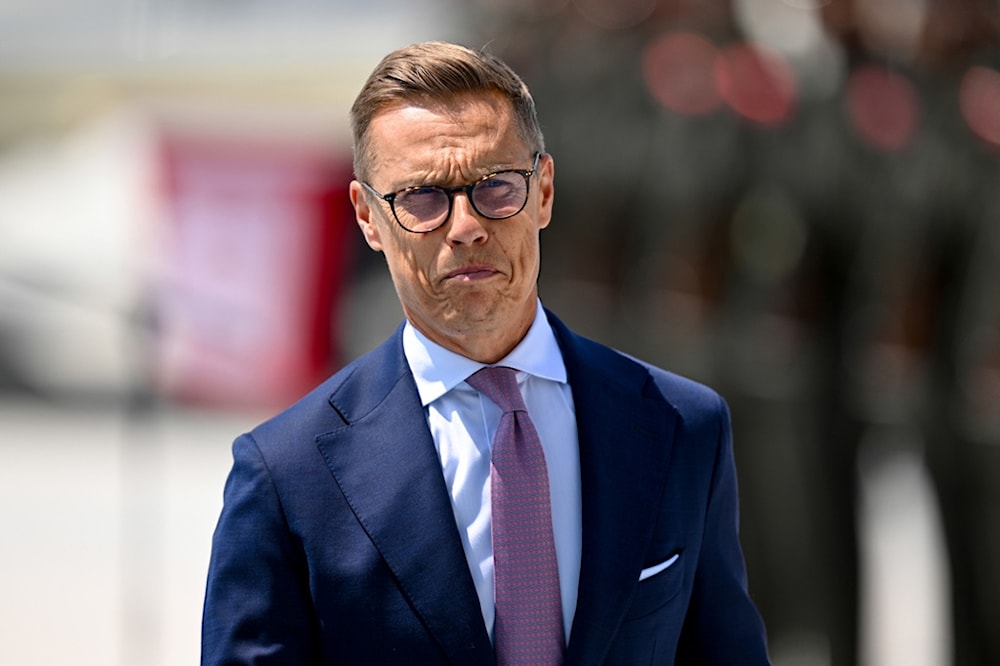
Finland's President Alexander Stubb arrives for the NATO Summit in Ankara, Turkey, Tuesday, July 7, 2026. (Muhammed Abdullah Kurtar, Pool Photo via AP)
Finnish President Alexander Stubb has acknowledged that economic pressure alone is unlikely to force Russia to end the war in Ukraine, while simultaneously calling for European governments to reopen political dialogue with Moscow.
In an interview for the German newspaper Bild, Stubb argued that Russia’s ability to endure economic hardship should not be underestimated, pointing to the experience of the Soviet era.
His comments highlight a dilemma at the heart of Europe’s approach to the conflict: years of sanctions and mounting military pressure have failed to produce an end to hostilities, while direct political engagement with Moscow remains limited.
Read more: Finland deepens military ties with 'Israel', ends UNRWA funding deal
Stubb doubts sanctions can force Russia to end war
Stubb said economic difficulties would not necessarily compel Moscow to abandon its war effort.
“One should never underestimate the Russians’ ability to weather difficult economic times,” Stubb told Bild. “To understand that, we need only look back at the Soviet era.”
He dismissed the idea that financial turmoil alone would bring the conflict to an end, arguing that fluctuations in the ruble, inflation, interest rates, or pressure on Russia’s banking system would not necessarily change Moscow’s calculations.
“Neither the ruble’s exchange rate nor a run on banks, inflation, or interest rates will end the war,” Stubb said.
He added that the impact of economic pressure should be understood in the context of a state operating under wartime conditions, stating, “The pressure is there, but one must understand that a country at war can withstand much more than a country that is not at war.”
The assessment comes after prolonged Western sanctions aimed at restricting Russia’s economy and reducing its capacity to sustain military operations.
Finnish president warns against misreading Moscow
Stubb also questioned whether Russia’s battlefield losses alone would be enough to bring the conflict to an end.
Instead, he suggested that a much more fundamental threat to Russia’s political leadership could become decisive.
The Finnish president’s comments reflect the difficulty European governments face in trying to pressure Moscow into changing its strategic calculations without creating conditions for a wider confrontation.
Finland’s own security position has changed substantially since the conflict began. Helsinki abandoned its longstanding military non-alignment and joined NATO in 2023, bringing Finland directly into the Western military alliance confronting Russia.
The shift has also increased the strategic importance of the Baltic and Gulf of Finland, areas where Finland and Russia share a sensitive regional security environment.
Read more: Medvedev says Finland now a nuclear target after policy shift
NATO confrontation remains unlikely
Despite the tensions, Stubb said he does not expect Russia to attack NATO territory.
“I don’t believe Russia would ever attack the world’s most powerful military alliance, namely NATO,” he said.
He further argued that Russia would have little incentive to directly test the alliance’s military resolve, saying, “It makes no sense for any power in the world to test the resolve of this alliance.”
Stubb pointed to NATO’s conventional forces, missiles, and nuclear deterrent as factors discouraging such a confrontation.
His comments nevertheless underscore the risks created by the increasingly militarized relationship between NATO and Russia, particularly as the conflict in Ukraine continues and military activity expands across the wider European security environment.
Helsinki calls for dialogue with Moscow
Despite his support for pressure on Russia, Stubb also made a case for restoring political communication with Moscow.
“I think someone in Europe—or a few people in Europe—need to engage in dialogue with Russia to understand what’s going on. To discuss matters at the political level,” Stubb said.
He said his main concern about the absence of dialogue was that Moscow could develop mistaken assumptions about Europe’s intentions, particularly regarding the Gulf of Finland and the Baltic Sea.
“And we’re not planning anything,” the Finnish president said.
The remarks point to an increasingly apparent contradiction in Europe’s strategy. While sanctions, military assistance to Ukraine and NATO’s eastern expansion have increased pressure on Russia, European officials also recognize that preventing a broader confrontation requires channels of communication.
For Stubb, dialogue is therefore not necessarily a departure from deterrence but a means of limiting miscalculation between nuclear-armed Russia and NATO.
Read more: Russia warns UK, France over Storm Shadow tech transfer to Ukraine


