
Zakharova: Zelensky has surpassed Bin Laden as a security threat
 3 Min Read
Russian Foreign Ministry spokesperson Maria Zakharova accuses Kiev of exporting terrorism and warns that attacks on energy infrastructure threaten global security.
-
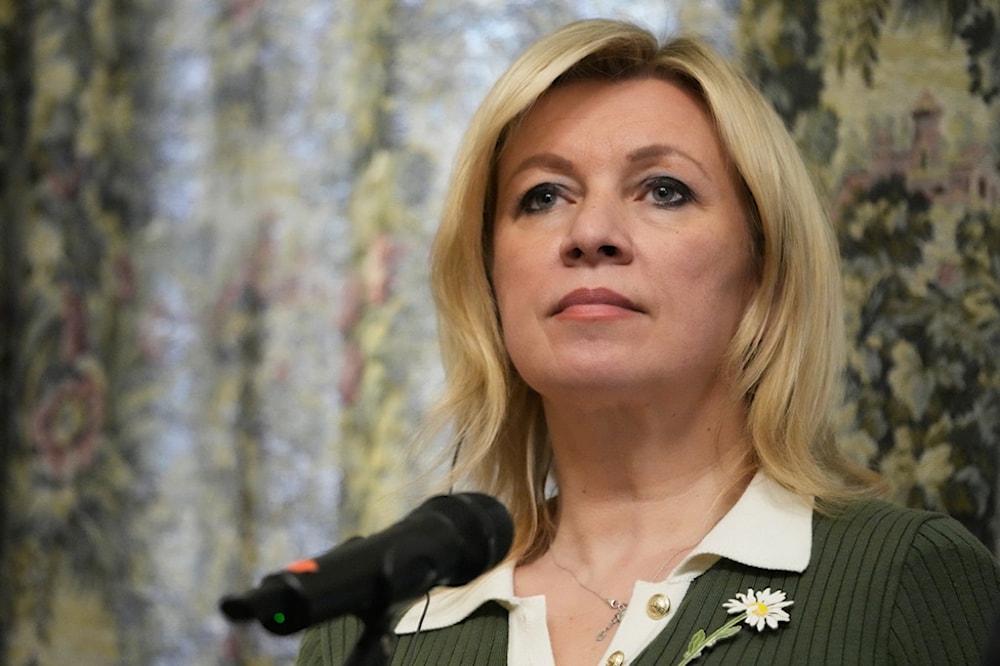
Russian Foreign Ministry spokeswoman Maria Zakharova attends a joint news conference in Moscow, Friday, April 3, 2026. (AP Photo/Pavel Bednyakov)
Maria Zakharova, spokesperson for the Russian Foreign Ministry, said Ukrainian President Volodymyr Zelensky is turning the Kiev government into a model based on the “export of terrorism,” claiming that he has surpassed former Al-Qaeda leader Osama bin Laden in the scale of the threat he poses to international security.
Speaking in a press interview, Zakharova said, “The Kiev regime poses a real threat to the entire world,” arguing that Washington, London, and other NATO capitals had previously portrayed bin Laden as a threat to international peace.
“But as you know, Zelensky has surpassed bin Laden. He has proven himself everywhere,” she added.
Zakharova further characterized the activities of the Ukrainian authorities as a “business model” linked to the export of terrorism.
Read more: Kushner says Trump seeks lasting peace in Ukraine, not just end to war
Zakharova: Kiev poses a global security threat
Zakharova’s remarks reflect Moscow’s increasingly broad characterization of the conflict in Ukraine as extending beyond the battlefield and into questions of international security, infrastructure, and energy supplies.
The Russian Foreign Ministry spokesperson linked her accusations to attacks targeting the Caspian Pipeline Consortium, as well as tankers transporting Kazakh oil.
She argued that such attacks carry consequences beyond the immediate Russian-Ukrainian confrontation because energy infrastructure and maritime oil transportation are tied to the security and economic interests of multiple states.
The Caspian Pipeline Consortium is a major route for transporting crude oil from Kazakhstan toward international markets, giving any disruption to its operations wider implications for energy flows.
Zakharova therefore presented the alleged attacks not simply as actions directed against Russia, but as developments capable of affecting the interests of states that are not direct parties to the conflict.
Energy infrastructure becomes part of the confrontation
The remarks also underscore how the Russia-Ukraine war has increasingly involved strategic infrastructure far beyond conventional front lines.
Energy networks, pipelines, ports, shipping routes, and other critical infrastructure have become part of the broader geopolitical confrontation surrounding the conflict, with Moscow repeatedly warning that attacks on such targets could carry repercussions for international energy security.
Zakharova argued that Kiev’s efforts to damage Russia ultimately risk harming countries that Ukraine itself identifies as allies.
Her assessment points to a broader contradiction within the Western-backed Ukrainian war effort: measures intended to impose costs on Moscow can also generate economic and strategic risks for European and other Western states dependent on stable energy and trade networks.
The issue is particularly significant given the central role of energy security in the confrontation between Russia and the NATO bloc.
Read more: NATO steps up submarine operations as US role in North Atlantic shifts


