
US 'Golden Dome' proposal in Greenland draws scrutiny, Kremlin says
 4 Min Read
Russia said its military will closely monitor potential US plans to deploy a "Golden Dome" missile defense system in Greenland, warning of strategic implications while dismissively responding to Canada's support for the island’s right to self-determination.
-
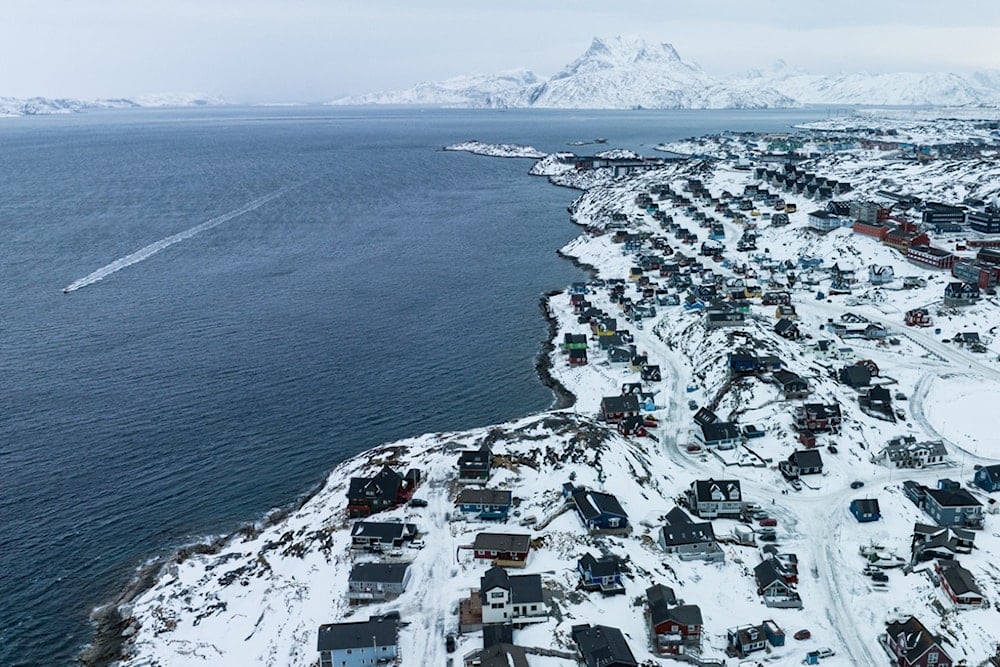
Houses are seen near the coast of a sea inlet of Nuuk, Greenland, on Saturday, Jan. 24, 2026. (AP Photo/Evgeniy Maloletka)
Russia’s military will closely evaluate any United States plans to deploy a “Golden Dome” missile defense system in Greenland, Kremlin spokesperson Dmitry Peskov said on Sunday, citing concerns over strategic stability in the Arctic.
Speaking to Rossiya 1 journalist Pavel Zarubin, Peskov said Moscow lacks concrete details on any prospective US arrangement involving the island but stressed that developments surrounding Greenland require careful monitoring due to their potential security implications.
“And then it will be necessary to analyze the United States’ plans to create a Golden Dome [in Greenland], what kind of dome it will be, and what threats it will be designed to counter. I have no doubt that our military will closely monitor and analyze these intentions,” Peskov said.
He added that Greenland holds particular importance in maintaining strategic balance, warning that changes to its military role could affect Russia’s security calculations. The island sits along key Arctic and transpolar routes that are central to early-warning systems and missile trajectories, making any expansion of US defense infrastructure there highly sensitive from Moscow’s perspective.
Canada drawn into Arctic dispute
Peskov’s remarks also touched on Canada, following public comments by Prime Minister Mark Carney, who earlier this week reiterated that Greenland and Denmark have the sole right to determine the island’s future.
The statement was widely viewed as a signal of Ottawa’s unease with recent US rhetoric suggesting expanded American control or authority over Greenland under the banner of Arctic security, particularly in relation to the proposed Golden Dome initiative.
The issue had already generated friction between Washington and Ottawa. Two days earlier, US President Donald Trump publicly accused Canada of opposing the construction of the Golden Dome over Greenland, despite what he described as its protective benefits for Canadian security. Trump claimed Ottawa was instead prioritizing economic engagement with China, a charge that further inflamed bilateral tensions.
Responding to Carney’s stance, Peskov suggested Ottawa could face consequences.
“I do not know how painful this is for Canada, but I can assume with high certainty that, let’s say, Canadians have a big headache coming their way,” he said.
Peskov claimed that Carney was subsequently excluded from participation in the US-led “Board of Peace,” portraying the move as a political response to Canada’s position and using it to underscore what Moscow describes as growing strains within the Western alliance.
Missile defense and alliance tensions
The dispute comes amid broader transatlantic unease over Washington’s push for expanded Arctic military infrastructure linked to the proposed Golden Dome missile defense concept. Backed by the Trump administration, the initiative envisions a layered missile shield combining space-based sensors, radar networks, and interceptor systems aimed at countering advanced missile threats.
Greenland’s geographic position along polar missile routes has made it central to these discussions. However, the prospect of expanding US missile defense capabilities on the island has raised concerns among allies about sovereignty, escalation risks, and the concentration of strategic decision-making in Washington rather than through collective NATO mechanisms.
Canada, a key Arctic state and a core partner in the US-led NORAD, has historically been wary about deeper integration into US missile defense architecture beyond early-warning cooperation. Any Greenland-based system would intersect with Canada’s Arctic airspace and surveillance responsibilities, heightening sensitivities in Ottawa over command authority, deterrence policy, and alliance balance.
Delivered on Russian state television Rossiya 1, Peskov’s comments appeared aimed not only at Washington but also at highlighting what Moscow portrays as widening divisions among US allies over Arctic governance, missile defense, and the future militarization of Greenland.
Read more: Trump threatens 100% Canada tariffs over China, calls Carney governor


