
US blockade deepens Cuba’s energy crisis, but island adapts
 4 Min Read
US restrictions on fuel supplies have intensified Cuba’s energy crisis, but the island continues adapting through alternative energy and local solutions.
-
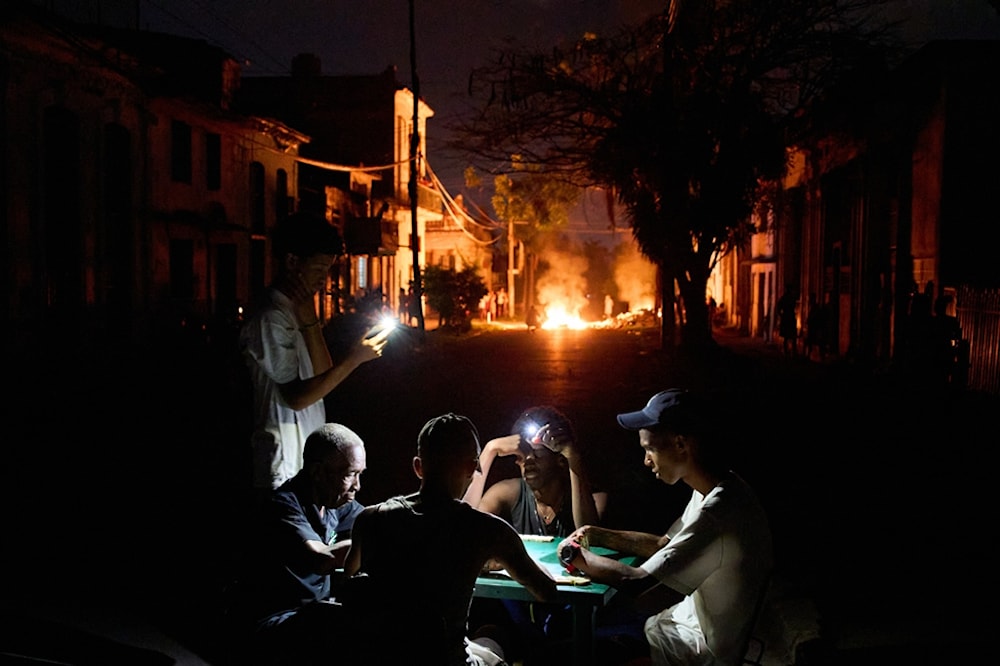
People illuminate themselves with their phones while playing dominoes as a fire set up by residents protesting against prolonged power outages burns on a street in Havana, Cuba, Thursday, May 14, 2026. (AP Photo/Ramon Espinosa)
Cuba is confronting its most severe energy crisis in decades as US economic pressure and restrictions on fuel supplies intensify shortages across the island, according to an analysis published by The New York Times.
The crisis has been worsened by Washington’s efforts to restrict Cuba’s access to foreign fuel supplies, particularly following the disruption of Venezuelan oil deliveries that had long provided critical support for the Cuban energy sector.
Despite expectations from some US officials that economic pressure would force political change in Havana, the Cuban government and population have continued to adapt through alternative energy sources, local initiatives, and efforts to reduce dependence on imported fuel.
The situation has left millions of Cubans facing prolonged power outages, fuel shortages, and rising economic hardship, while authorities attempt to maintain essential services and stabilize the electricity grid.
Read more: US surveillance drone patrols near Cuba's northern coast
US fuel restrictions intensify pressure on Cuba
The latest energy crisis follows decades of US sanctions and restrictions that have limited Cuba’s ability to access international markets, finance, and energy supplies.
The Trump administration has expanded pressure on Havana, seeking to restrict fuel shipments and increase economic isolation. US officials have openly stated that their objective remains political change in Cuba.
The tightening of restrictions has had direct consequences for Cuba’s energy infrastructure, which has struggled with aging equipment, limited investment capacity, and reduced access to fuel imports.
Cuban officials have argued that the economic restrictions are contributing to shortages affecting ordinary citizens rather than only targeting government institutions.
“The economic restrictions are slowly killing us, but we’re pulling through with all our might,” Cuban farmer Humberto Palmero said, according to The New York Times.
Cubans turn to alternative solutions amid blackouts
Facing prolonged electricity shortages, Cubans have increasingly turned toward alternative energy sources and locally developed solutions.
Across the island, residents have adopted solar panels, lithium batteries, electric motorcycles, and modified generators to compensate for declining fuel supplies.
Solar energy projects supported through cooperation with China have expanded, while private citizens have imported smaller solar systems and batteries to maintain basic electricity needs during blackouts.
Electric vehicles have also become increasingly common as fuel shortages make traditional gasoline-powered transportation more difficult. Many Cubans have shifted toward electric motorcycles and rickshaws as practical alternatives.
These adaptations have allowed parts of society to continue functioning despite the crisis, although access remains uneven. Those with financial support from relatives abroad are often better positioned to purchase alternative energy equipment, leaving poorer households facing greater difficulties.
Read more: Cuba says US coercing countries ahead of UN blockade vote
Energy shortages reveal broader impact of blockade
The crisis has affected daily life across Cuba, with residents reporting challenges accessing transportation, preserving food, and maintaining household electricity.
The New York Times analysis noted that some families have been forced to walk long distances for water when fuel shortages affect government pumps, while others have relied on improvised methods to cook and preserve essential goods.
However, the crisis has not resulted in the collapse predicted by US officials. Instead, Cuban society has relied on adaptation strategies developed through decades of navigating sanctions and economic restrictions.
Cuba’s Deputy Foreign Minister Carlos Fernández de Cossio said that the country’s ability to withstand pressure reflects the resilience of Cuban society.
“The intimate expectation in political circles in the United States was that Cuba could not survive beyond April. And here we are,” he said, according to The New York Times.
Cuba expands renewable energy efforts
The energy crisis has accelerated Cuba’s push toward renewable energy, particularly solar power.
The Cuban government has expanded solar parks with Chinese assistance, while officials have outlined plans to increase renewable energy capacity over the coming decades.
However, renewable energy expansion faces limitations due to the lack of large-scale storage capacity required to provide electricity after sunset and during periods of high demand.
Despite these challenges, solar power has become a key component of Cuba’s effort to reduce vulnerability to external fuel restrictions.


