
Cuba rejects US pressure as talks stall despite historic reforms
 5 Min Read
Cuba said talks with the United States have stalled despite Havana’s sweeping economic reforms, accusing Washington of using dialogue to mask renewed sanctions, pressure, and interference in the island’s sovereign affairs.
-
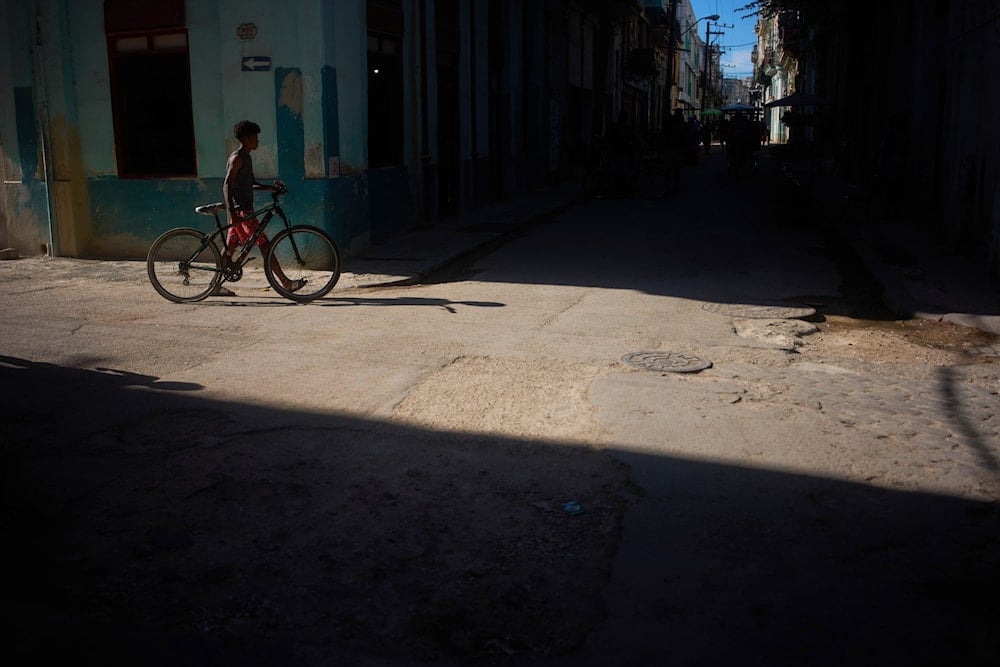
A man with his bicycle in Havana, Cuba, on June 30, 2026 (AP)
Cuba has accused the United States of using dialogue as a cover for renewed coercion, after talks between the two countries stalled despite Havana approving its most far-reaching economic reforms since the 1959 Revolution.
Foreign Minister Bruno Rodríguez said on Tuesday that exchanges with Washington had failed to produce progress, warning that US sanctions and threats continued to undermine any serious path toward normalization.
Talks stall under US pressure
“Talks between Cuba and the US show no progress,” Rodriguez said at a press conference in Havana.
"The conduct of US government delegations, generally respectful, has been accompanied by constant threats against Cuba, the application of coercive measures, and offensive statements regarding our country's independence".
Rodríguez said Cuba remained ready to resolve disputes through diplomacy, but stressed that any dialogue must respect the island’s sovereignty.
"Despite this, Cuba remains open to dialogue and the peaceful resolution of differences, based on mutual respect and non-interference in Cuba's internal affairs".
Havana insists reforms are sovereign
The remarks came shortly after Cuba’s Communist Party and National Assembly of People’s Power approved 176 economic measures aimed at easing pressure on the country’s strained economy. The package expands space for private businesses, allows freer hiring, authorizes private banks, and opens the door to investment by Cubans living abroad.
For Havana, however, the reforms are not a concession to Washington. Rodríguez made clear that Cuba’s internal economic decisions were not negotiated with the United States and would not be presented as a response to US demands.
"The recently announced (measures) are a matter of total and absolute sovereignty", Rodriguez said.
"We have neither listened to nor are we interested in the US government’s opinion on them".
Cuba views Washington’s response as evidence that US policy is not aimed at encouraging reform, but at forcing political submission. Rodríguez said it was striking that the reforms, despite overlapping with some of Washington’s long-standing demands, were answered with more sanctions.
He said the measures "were met with a new package of unilateral coercive measures ... against Cuba".
Sanctions deepen Cuba’s crisis
Earlier this month, the United States imposed new sanctions on Cuban President Miguel Díaz-Canel, other Cuban officials, and companies central to the island’s economy. Washington says its sanctions are meant to pressure Cuba’s government, while Havana says the policy amounts to collective punishment against an entire population.
Rodríguez said US sanctions were “causing deaths” in Cuba, where shortages of fuel, food, medicine, and electricity have pushed daily life into deep crisis.
“The blockade and the policy of aggression and hostility of the United States government against Cuba are a threat to the existence and well-being of the Cuban people, and to the exercise of their human rights,” Rodríguez said.
The situation has sharply deteriorated since US President Donald Trump imposed an energy blockade in late January. The restrictions have worsened prolonged blackouts, fuel rationing, transport disruptions, flight cancellations, internet outages, reduced workdays, and the suspension of basic services such as garbage collection and water delivery.
UN experts have also criticized the US fuel blockade, warning that the restrictions have severe consequences for human rights and daily survival on the island.
UN debate puts blockade in focus
Rodríguez rejected Washington’s claim that Cuba poses a threat to the United States, saying the island cannot be treated as a danger to "a major military and nuclear power".
He also announced that the United Nations General Assembly will hold a July 7 debate on the US energy embargo against Cuba. According to Rodríguez, Washington has been pressuring and intimidating UN member states to delay the discussion.
For decades, the UN General Assembly has overwhelmingly voted in favor of ending the US blockade of Cuba, though the resolutions remain non-binding. This year’s debate carries added weight as Havana argues that Washington’s fuel restrictions have turned a long-standing embargo into a direct assault on Cuba’s basic infrastructure and civilian life.
Despite the pressure, Cuba says it will not abandon diplomacy. But Rodríguez made clear that talks cannot move forward while Washington continues to combine negotiations with sanctions and threats.
"The recently announced (measures) are a matter of total and absolute sovereignty", Rodriguez said, adding: "We have neither listened to nor are we interested in the US government’s opinion on them".
Read more: Cuba's UN Amb. to Al Mayadeen: Ready for dialogue or to fight back


