
US forces fully withdraw from al-Tanf Base, Syrian forces take over
 4 Min Read
US withdrawal from al-Tanf base in Syria completed as American forces relocate to Jordan and redeploy to Qasrak base in Hasakeh.
-
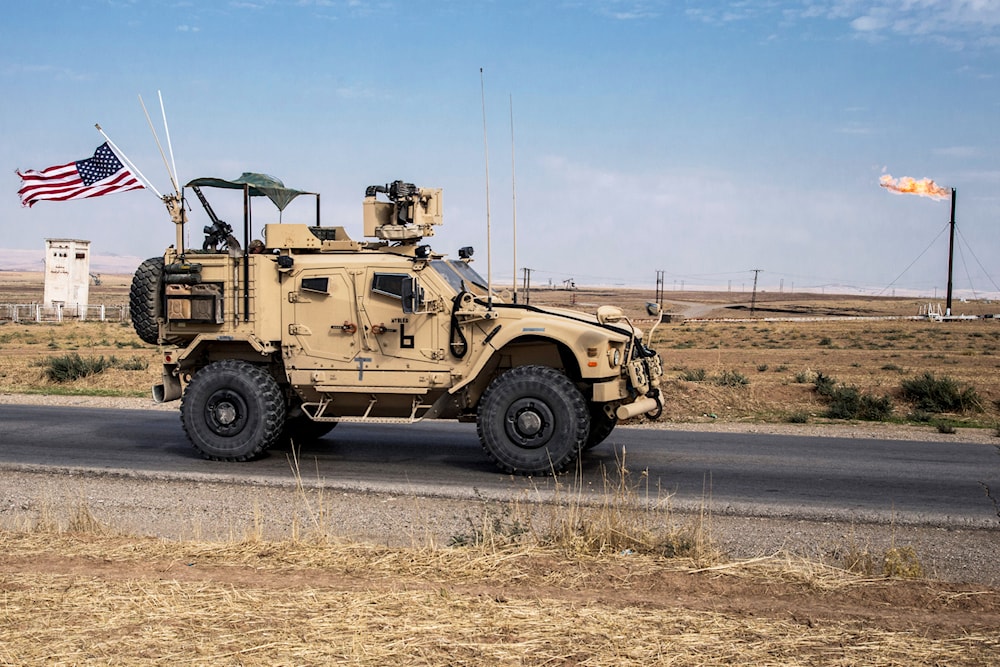
US forces patrol oil fields in Syria, Oct. 28, 2019 (AP)
The Syrian Arab Army has taken control of the al-Tanf base, securing the base and its surroundings, Syria's interim government announced.
In a post on X, the Syrian Defense Ministry wrote: "Through coordination between the Syrian and US sides, units of the Syrian Arab Army have taken control of the al-Tanf base, securing the base and its surroundings."
تصريح بشأن استلام وزارة الدفاع لقاعدة التنف العسكرية#الجمهورية_العربية_السورية#وزارة_الدفاع pic.twitter.com/zg2p8l3Jpi
— وزارة الدفاع السورية (@Sy_Defense) February 12, 2026
The Army has "begun deploying along the Syrian-Iraqi-Jordanian border in the al-Tanf desert," it added, asserting that "in the coming days, Border Guard forces under the ministry will begin assuming their duties and deploying in the area."
US forces withdraw fully
Earlier, it was reported that the US forces had fully withdrawn from Syria’s al-Tanf base and relocated to Jordan, two Syrian military sources told AFP on Wednesday, marking a significant shift in the American military footprint in the country.
One source said “the American forces withdrew entirely from al-Tanf base today” and moved to another base in Jordan, adding that Syrian forces were being deployed to replace them at the strategic site. A second source confirmed the withdrawal, noting that US troops had been transferring equipment out of the base over the past 15 days.
Despite the pullout, the second source said US troops would “continue to coordinate with the base in al-Tanf from Jordan,” suggesting ongoing operational links with the area.
US forces had been stationed at al-Tanf, near Syria’s borders with Jordan and Iraq, as part of the international coalition formed to combat the Islamic State (IS) group. During the war in Syria, American troops were also deployed in the country’s Kurdish-controlled northeast.
Following the withdrawal from al-Tanf and recent advances by Syrian government forces in the northeast, US troops are now primarily based at the Qasrak base in Hasakeh province, according to the Syrian Observatory for Human Rights.
The history of al-Tanf base
Al‑Tanf is a remote military base in southeastern Syria at the strategic tripoint of the Syrian, Jordanian, and Iraqi borders. It was officially established on March 3, 2016, as part of US and coalition efforts to counter the Islamic State group (IS) and train allied Syrian fighters such as the Free Syrian Army.
The base emerged from fighting in the Syrian war, with opposition forces capturing the border post from IS in early March 2016. Coalition forces then expanded the site, creating a training hub and outpost along the Baghdad‑Damascus highway.
Al‑Tanf became central to the anti‑IS campaign and broader regional strategy, hosting around 100–200 US and allied troops. Over the years, it served not only as a training and logistics center but also as a point to monitor movements and counter regional influence.
The base and its surrounding 55‑kilometer “deconfliction zone” were also flashpoints in the wider Syrian conflict, drawing occasional drone and rocket attacks, including an October 20, 2021, strike involving projectiles and drones that coalition officials linked to Iranian‑backed groups.
Throughout its existence, al‑Tanf featured in broader geopolitical tensions, with Syrian government forces and allies at times encircling or challenging the outpost, even as the US and partners sought to maintain their position against IS and other threats.
The geopolitical significance of al-Tanf Base
Al‑Tanf’s geopolitical significance extends beyond its immediate military utility, giving the United States a strategic foothold in a highly contested region of the Middle East.
Positioned near the borders of Syria, Jordan, and Iraq, the base allows the US to monitor regional developments and respond quickly to emerging threats without relying on Syrian urban centers, which are politically sensitive and often heavily contested.
Moreover, the base provides leverage in diplomatic and strategic negotiations. By holding a position on a key corridor between Iraq and Syria, the US can influence the flow of goods, military movements, and counterterrorism operations, giving it bargaining power in broader Middle East affairs.
This allows the US to engage in regional diplomacy from a position of strength, balancing relations with allies like Jordan and "Israel" while constraining the ambitions of its adversaries. Essentially, al‑Tanf acts as a “pressure point” that enhances American influence in the region without the costs or complications of occupying major cities or population centers.


