
US House passes $73bln budget plan for war on Iran funding
 5 Min Read
The House approves a defense policy bill backing higher national security spending, military pay raises, and a proposal to rename the Department of Defense.
-
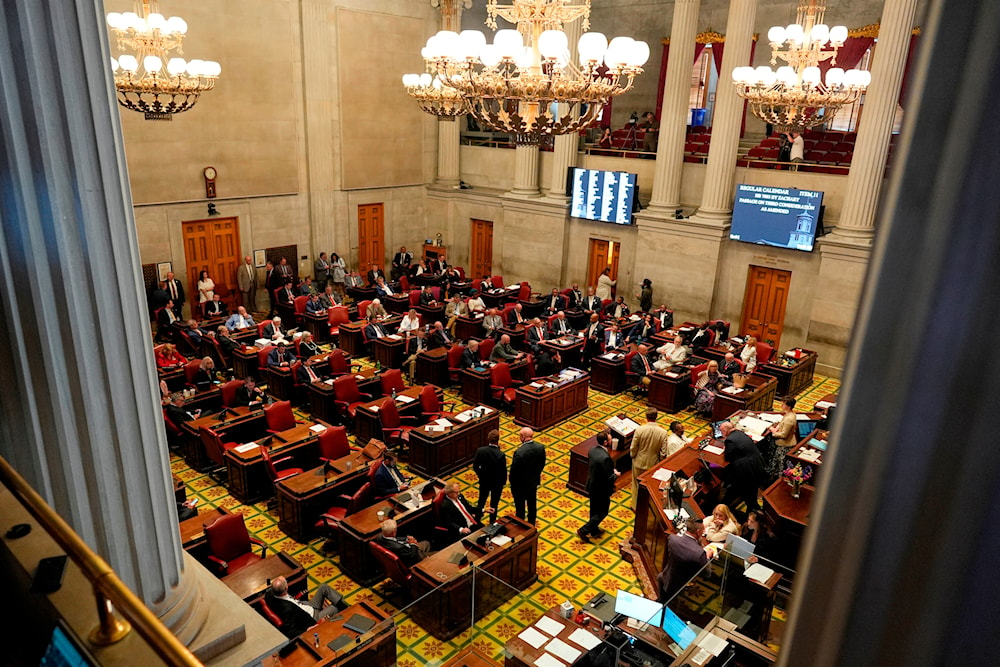
Representatives meet in the House chamber during a special session of the state legislature to redraw US Congressional voting maps Thursday, May 7, 2026, in Nashville, Tenn (AP)
The US House of Representatives approved a $95 billion budget framework on Wednesday, with most of the funding earmarked for the Pentagon to fund the war against Iran, NDTV reported. The plan provides $73 billion for the armed forces and intelligence agencies, notably to fund operations linked to the war against Iran.
The measure was narrowly approved in a 216-214 vote and now heads to the Senate.
The budget package represents the party's last major legislative push before November's midterm elections, the outcome of which will determine whether the party retains its majority in Congress and thus continues to shape the remainder of President Donald Trump's second term.
The resolution, which for now is only a budget framework, would allow House Republicans, if it is approved by the Senate, to draft detailed legislation later in the summer. The aim would then be to try to pass it in the Senate by a simple majority using an expedited budget procedure, thereby bypassing the usual 60-vote threshold and Democratic opposition.
The plan also includes $12 billion in aid for farmers affected by President Trump's trade war. An additional $10 billion would go toward election-related programs as part of Trump's push to enact new nationwide voting restrictions while his broader "SAVE America Act" lacks enough support to proceed.
House Speaker Mike Johnson said the measure approved Wednesday "puts Congressional Republicans on a path to enacting two fundamentally simple and crucial goals: securing American elections and strengthening our homeland."
$1.6T defense policy bill also advances
In a separate vote, the House also approved a defense policy bill that includes Trump's request for substantial national security spending and proposes renaming the Department of Defense to the Department of War, The Independent reported. That legislation mandates a 5 percent to 7 percent pay increase for service members next year based on rank and includes a prohibition on gender-related medical care under the military health program known as TRICARE, as well as easing hurdles for service members to carry a privately owned firearm on base.
The defense policy bill passed by a narrow 216-212 vote, underscoring deep divisions. Democrats voiced strong opposition centered on the considerable spending hike for the Pentagon, particularly as Republicans simultaneously sought to cut numerous non-defense programs through other legislative efforts. Democrats also objected to the inclusion of certain conservative social policy provisions within the bill.
Rep. Mike Rogers, the Republican chairman of the House Armed Services Committee, emphasized that he knows there were areas of disagreement, but he emphasized that Wednesday's vote was a step in a long process. He promised to work in a bipartisan manner on a final product that can pass both chambers and be signed into law.
Rogers said the United States needs to reverse decades of underinvestment and neglect in the nation's armed forces and defense industrial base. "This bill will do that and much more," he said. "It will build the ready, capable and lethal fighting force we need to deter China and other adversaries."
Rep. Adam Smith, the ranking Democratic lawmaker on the Armed Services Committee, said the defense spending the administration has asked for this year is approaching $1.6 trillion when including separate efforts to pay for the war in Iran and boost weapons stockpiles. "The American people are struggling to pay their bills and we're going to put $1.6 trillion into the defense budget. It's not a reasonable thing to ask," Smith said.
Lawmakers are 'de facto supporting' Iran war
Smith also expressed concern about the war on Iran and that in supporting the defense bill, lawmakers are "de facto supporting this war with no end in sight." Smith said, "We are in an incredibly, incredibly dangerous time. I want to maintain the bipartisan nature of this bill. I do. And I know that the chairman does. But if we're going to do this, we're going to need some Republicans to stand up to the president of the United States and say, 'No. No, we're not going to get you $1.6 trillion. No, we're not just going to give you a blank check for a war that is totally out of control.'"
The spending increases authorized in the defense policy bill would not take effect until Congress follows up with a separate defense appropriations bill. The Senate has not yet approved its version of the defense measure. It is possible a final product will not be ready until after the midterm elections.
The White House applauded the spending levels authorized in the House bill and the Department of War designation that it says recognizes the "willingness to fight and win wars on behalf of our nation." The president issued an executive order last year renaming the War Department, but it is up to Congress to make the change official. The Congressional Budget Office has projected that the renaming could cost taxpayers as much as $125 million.
The White House's statement also said that the administration has a number of concerns with certain provisions in the bill and would work with Congress before a final bill is presented to the president. Among those concerns was a section of the bill it said would limit or undermine the president's ability to name military installations and property.


