
US-Iran talks planned for Friday still taking place, Switzerland says
 4 Min Read
The US and Iran will hold initial talks in Switzerland following the signing of a ceasefire agreement, with mediators Pakistan and Qatar participating.
-
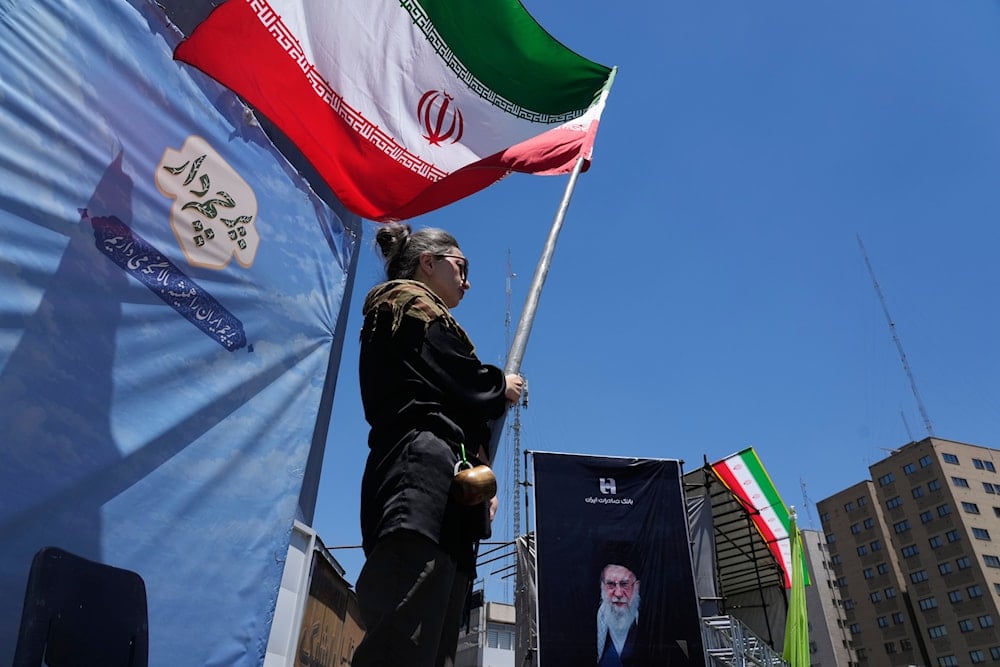
A woman waves an Iranian flag during a demonstration, as a portrait of martyred Leader Sayyed Ali Khamenei is displayed at right, in downtown Tehran, Iran, June 15, 2026 (AP)
The United States and Iran are scheduled to hold initial talks on Friday at the Bürgenstock mountain resort in Switzerland, following the signing of a preliminary ceasefire agreement between the two countries, Reuters reported, citing the Swiss government on Thursday.
The talks will focus on implementing the recently signed memorandum of understanding and will include mediators Pakistan and Qatar, along with other involved nations, according to a statement from the Swiss foreign ministry.
"No further information is currently available regarding the schedule and details of this meeting," the Ministry said.
The 14-point peace framework marks a potential turning point in months of military confrontation between the two countries, which has included maritime disruptions in the Strait of Hormuz and raised international concerns over regional security.
Iran's Foreign Ministry spokesperson Esmaeil Baghaei announced on Wednesday that the MoU had been formally signed by the presidents of both countries and had officially entered into force. Baghaei told IRIB that the delay between finalization of the text on Sunday and its public announcement on Wednesday was due to standard diplomatic procedures and coordination with mediators.
US President Donald Trump signed the document on Wednesday while at dinner at the Palace of Versailles with French President Emmanuel Macron, NBC News reported, citing White House confirmation.
"It's signed," Trump told a reporter as he left Versailles. "Signed in Versailles. Just signed it."
China welcomes deal, says dialogue is 'correct choice'
Chinese Foreign Minister Wang Yi held a phone call with Iranian Foreign Minister Seyed Abbas Araghchi on Wednesday, China's state-run Xinhua news agency reported.
Araghchi briefed Wang on the first-phase MoU and thanked China for its role in promoting negotiations, Xinhua reported.
Wang said China welcomes the signing of the agreement and that "force and power cannot solve problems, and dialogue and negotiation are the correct choices," according to the report.
Chinese observers have said Beijing played an important role in facilitating the deal by advancing a four-point proposal that emphasized peaceful coexistence, national sovereignty, international rule of law, and a balanced approach to development and security.
Speaking at a press conference on the sidelines of the Group of Seven summit in Evian-les-Bains, France, Trump thanked China and Russia for their neutral stance during the US-Israeli war on Iran, Reuters reported.
Trump said Beijing's non-intervention had helped ease the path toward de-escalation and "probably helped get it solved."
Analysts warn agreement remains fragile
Despite the signing, analysts have cautioned that the agreement faces significant challenges, citing deep-rooted differences between Washington and Tehran over Iran's nuclear program and continued Israeli military operations in southern Lebanon.
Liu Zhongmin, a professor at the Middle East Studies Institute of Shanghai International Studies University, told the Global Times that the deal remains "highly fragile".
The BBC has reported that while Trump has insisted the deal ensures Iran will never buy, develop or produce a nuclear weapon, the text of the agreement falls short of that guarantee.
Israeli attacks continue in Lebanon despite ceasefire provisions
Israeli attacks have continued in parts of southern Lebanon, particularly in the Nabatieh area, despite the inclusion of Lebanon ceasefire provisions in the US-Iran MoU.
Iran's Foreign Ministry spokesperson Baghaei said on Thursday that if "Israel" continues its attacks on Lebanon, it will be considered a breach of US commitments, according to Xinhua, citing Iran's Tasnim News Agency.
Ding Long, a professor at the Middle East Studies Institute of Shanghai International Studies University, told the Global Times on Thursday that the Lebanon provisions could provide "Israel" with an opening to sabotage the agreement.
Iranian ships sail through US naval blockade
Meanwhile, Iran's Press TV reported that 11 Iranian ships have sailed through the US naval blockade since Tehran and Washington finalized the text of the MoU on Sunday.
Citing an informed source, the outlet reported that eight vessels sailed from Iranian territorial waters to international waters, while three entered Iranian waters.
Oil prices fell in early trading after the US and Iranian presidents signed the interim deal, Reuters reported.
The agreement includes provisions to reopen the Strait of Hormuz, a key chokepoint for global oil shipments.


