
US-sanctioned tanker crosses Hormuz despite blockade pressure
 3 Min Read
A US-sanctioned Chinese tanker transits the Strait of Hormuz, raising questions over US enforcement of its alleged "blockade" on the strait.
-
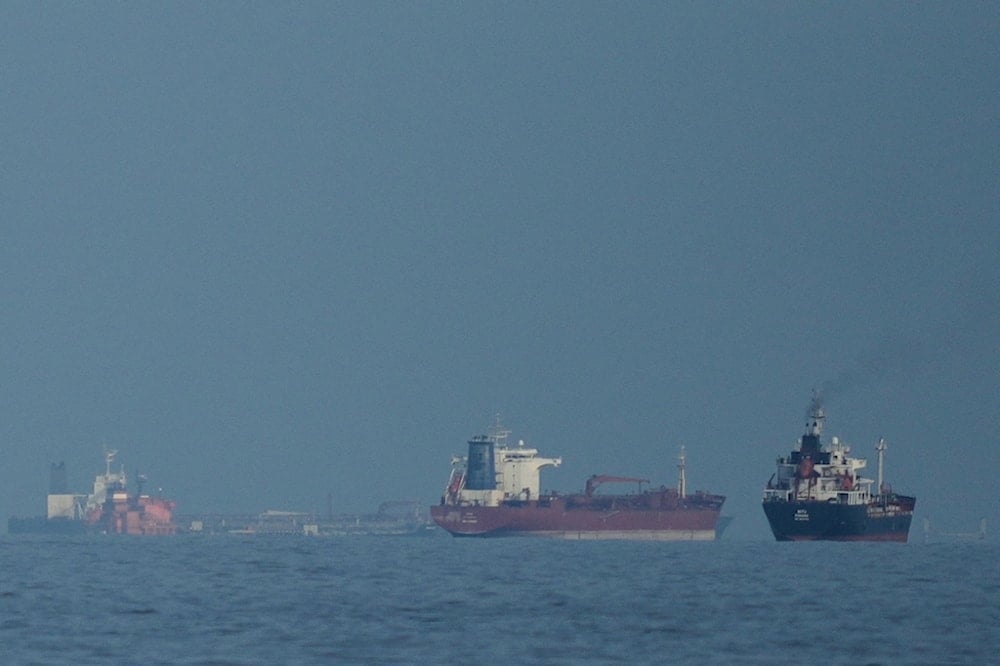
Oil tankers and cargo ships line up in the Strait of Hormuz as seen from Khor Fakkan, United Arab Emirates, Wednesday, March 11, 2026. (AP Photo/Altaf Qadri)
Shipping data revealed on April 14 that a US-sanctioned Chinese tanker was able to pass through the Strait of Hormuz despite Washington's blockade.
Data from LSEG, MarineTraffic, and Kpler revealed that the medium-range Rich Starry tanker would be the first to pass through the strait and exit the Gulf since the US blockade on the vital chokepoint.
According to the data, Rich Starry is carrying roughly 250,000 barrels of methanol on board, which it loaded in the UAE's Hamriyah port.
The tanker and its owner, Shanghai Xuanrun Shipping Co Ltd, were sanctioned by the US for conducting business with Iran.
Shipping in Strait of Hormuz stalls amid blockade
Data shows that maritime activity in the Strait of Hormuz has declined to minimal levels as concerns over the US naval blockade increase.
The announcement of Washington's naval blockade came almost a day after negotiations between Iran and the US in Pakistan failed, with US Vice President JD Vance confirming that the American delegation returned without a deal.
Talks reportedly collapsed over Washington’s demand that Tehran halt uranium enrichment, which Iran strongly maintains is a sovereign right under international law.
Read more: US carrier takes Africa long-route to avoid Red Sea, Bab al-Mandab
Allies reject Trump's blockade
Backlash over US policy surrounding the Strait has increased. US President Donald Trump said confidently that allies would join his naval blockade of the vital waterway, but no country has since stepped forward to join Trump's plan.
British Prime Minister Keir Starmer stated that the UK would not support the blockade, adding that he would not allow dragging his country into Trump's war on Iran.
Spain's Defense Minister, Margarita Robles, pushed aside the idea of the proposed blockade in a television interview on Monday.
"It makes no sense," she said. "Since this war started, nothing makes sense. This is another episode in the downward spiral the world has been dragged into."
Robles further added that Trump and Israeli Prime Minister Benjamin Netanyahu “want to impose rules on the international community, which is illogical.”
The Netherlands’s Defense Minister Dilan Yesilgoz-Zegerius also said that Amsterdam does not intend to participate in any blockade of the strategic waterway.
"We are not dealing with this issue now. It is a new circumstance, isn't it? Sometimes the US blocks it, sometimes Iran, it is very hard to understand who is doing what ... But I do not see us participating in a blockade," the minister told NPO Radio 1.
Separately, ASEAN foreign ministers urged both Tehran and Washington to continue diplomatic efforts in order to achieve a lasting resolution to the war, while also ensuring the ceasefire is fully and effectively implemented.
The ministers, who held a virtual meeting to address the US-Israeli war on Iran, emphasized the urgency of restoring safe, uninterrupted, and continuous movement for ships and aircraft through the Strait of Hormuz.
French President Emmanuel Macron also announced that Paris intends to partner with the UK in hosting a conference focused on securing navigation through the Strait of Hormuz. Any naval deployment resulting from the talks would operate under strictly "defensive" parameters, he claimed.


