
US Senate passes bill to curb Trump's military campaign against Iran
 4 Min Read
The US Senate passed a bill requiring congressional approval for further military action against Iran, reflecting growing opposition to Trump's war.
-
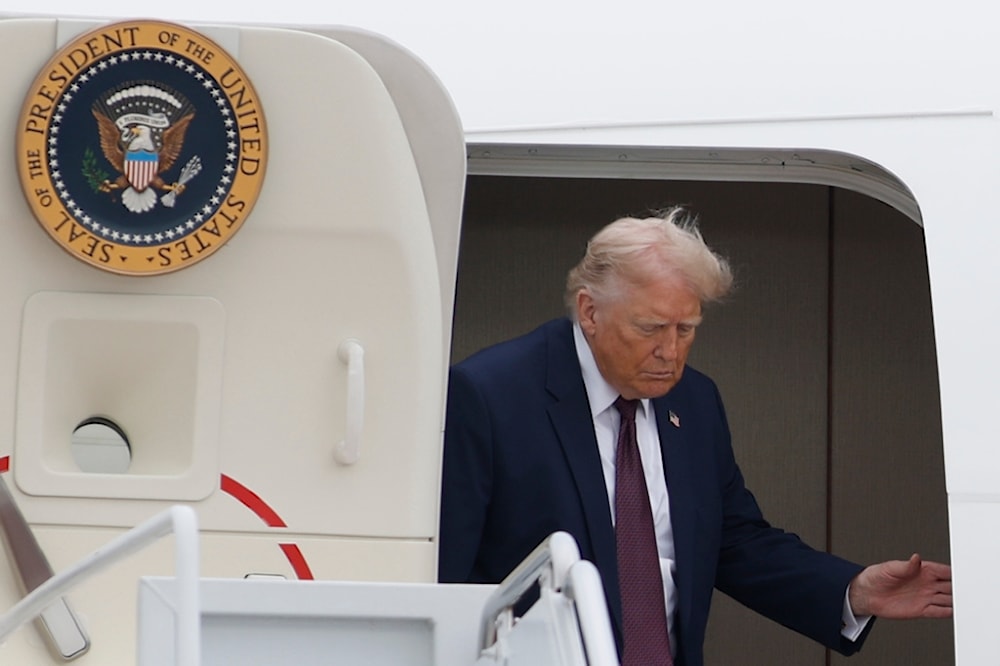
President Donald Trump disembarks Air Force One upon his arrival at Joint Base Andrews, Md., Tuesday, June 23, 2026 (AP)
The United States Senate has passed a bill requiring congressional approval before President Donald Trump can take further military action against Iran, underscoring growing bipartisan concerns over the president's handling of the conflict and the constitutional limits of executive war powers.
The Senate voted 50-48 on Tuesday to approve the war powers resolution, which had already passed the House of Representatives earlier this month. Four Republicans joined nearly all Democrats in backing the measure, marking the first time a war powers resolution concerning Iran has cleared both chambers of Congress.
However, the measure is expected to remain largely symbolic, as Trump is widely expected to veto the bill.
Republicans break ranks over war on Iran
The Republicans who voted in favor of the resolution were Senators Bill Cassidy of Louisiana, Lisa Murkowski of Alaska, Susan Collins of Maine and Rand Paul of Kentucky. Republican Senators Mitch McConnell and Dave McCormick did not vote, while Pennsylvania Democrat John Fetterman sided with Republicans in opposing the measure.
Democratic Senate leader Chuck Schumer said the vote reflected mounting concern over Trump's military campaign against Iran.
"For years, Trump promised to put maximum pressure on Iran, but he ended up delivering maximum confusion, maximum chaos, maximum cost to the American people with his disastrous war," Schumer said.
He accused Senate Republicans of repeatedly backing Trump's military actions instead of reflecting public concerns over the conflict and its consequences.
Negotiations with Iran shape debate in Congress
Trump joined "Israel" in launching attacks against Iran on February 28, triggering a regional war that has continued this month. The campaign followed US strikes in June 2025 on three sites associated with Iran's nuclear program.
The US president has maintained that military action was necessary to prevent Iran from developing a nuclear weapon, an ambition Tehran has consistently denied.
Talks are currently underway in Switzerland between the Trump administration and Iran over implementing a ceasefire outlined in a June 17 memorandum of understanding. Nevertheless, questions remain about the agreement's durability as "Israel" has continued carrying out strikes in Lebanon, violating the terms of the ceasefire arrangement.
Opponents of the Senate resolution argued that restricting Trump's military authority could undermine the ongoing negotiations.
The measure directs the president to withdraw US armed forces from hostilities against the Islamic Republic of Iran unless military action is explicitly authorized by a declaration of war or specific congressional approval. It does, however, permit a limited US military presence in the region to prevent any imminent attack against the US or its allies.
The Bürgenstock blueprint: Key takeaways
Iran and the US wrapped up their first round of Swiss talks with a phased agreement linking security, finance, and sanctions relief to conditional implementation steps.
A “Lebanon de-confliction cell” was established to monitor Lebanon's fragile ceasefire, with Iran formally included, despite recent US efforts to sideline Tehran, and "Israel" explicitly excluded from the mechanism.
On maritime security, the two sides agreed to create a direct communication channel for the Strait of Hormuz, allowing parties to raise navigation concerns directly with Iran as part of broader discussions on gradually reopening the waterway.
Three working groups, on nuclear issues, sanctions, and monitoring, will only activate after Article 13 is implemented, which requires a full ceasefire, initial naval blockade lifting, release of frozen assets, and oil-export waivers. Iran will not enter final-phase talks until these conditions are met.
Separately, Iran and Qatar signed an MoU on releasing frozen Iranian assets, while US Treasury documents reportedly offer a 60-day suspension of OFAC sanctions on oil and petrochemical sectors, enabling resumed sales and Central Bank-managed payment mechanisms.


