
Iran-US talks progress contingent on 'practical adherence': Pezeshkian
 2 Min Read
Iran's president says the success of ongoing Iran-US talks "depends on full commitment to the agreed obligations and their precise implementation."
-
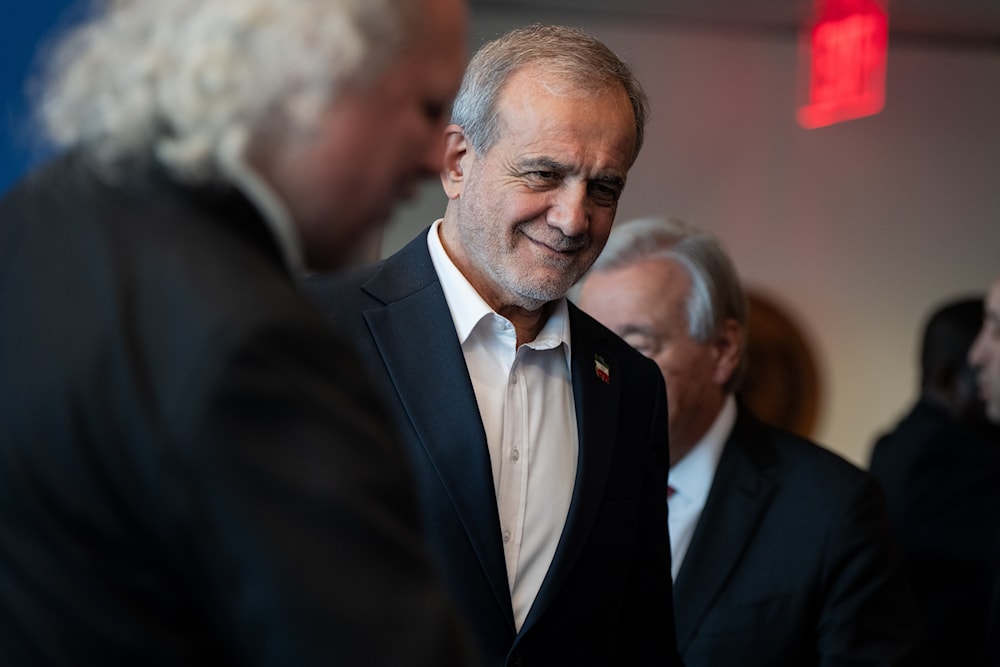
Masoud Pezeshkian, the President of Iran, attends the United Nations General Assembly at United Nations headquarters, on Sept. 25, 2025 (AP)
The success of ongoing talks with the United States hinges on strict adherence to agreed commitments, Iranian President Masoud Pezeshkian stated on Tuesday, warning that extraneous statements outside the negotiated text do not serve the process.
In a post on X on Tuesday, Pezeshkian stated, “The effectiveness of the talks depends on full commitment to the agreed obligations and their precise implementation," while asserting that "progress on this path will be measured by practical adherence to accepted responsibilities."
Emphasizing the need for discipline in public discourse surrounding the talks, Pezeshkian stressed that "statements outside the agreed text do not help advance the negotiations.”
This closely follows talks between Iran and the United States in Switzerland; the first round of talks since reaching an agreement mediated by Pakistan on June 22. Among the key agreements were a Lebanon ceasefire monitoring mechanism, coordinated frozen Iranian assets release arrangements, and temporary sanction relief on the energy front.
The Bürgenstock blueprint: Six key takeaways
Iran and the US wrapped up their first round of Swiss talks with a phased agreement linking security, finance, and sanctions relief to conditional implementation steps.
A “Lebanon de-confliction cell” was established to monitor Lebanon's fragile ceasefire, with Iran formally included, despite recent US efforts to sideline Tehran, and "Israel" explicitly excluded from the mechanism.
On maritime security, the two sides agreed to create a direct communication channel for the Strait of Hormuz, allowing parties to raise navigation concerns directly with Iran as part of broader discussions on gradually reopening the waterway.
Three working groups, on nuclear issues, sanctions, and monitoring, will only activate after Article 13 is implemented, which requires a full ceasefire, initial naval blockade lifting, release of frozen assets, and oil-export waivers. Iran will not enter final-phase talks until these conditions are met.
Separately, Iran and Qatar signed an MoU on releasing frozen Iranian assets, while US Treasury documents reportedly offer a 60-day suspension of OFAC sanctions on oil and petrochemical sectors, enabling resumed sales and Central Bank-managed payment mechanisms.


