
US voters increasingly worse off under Trump ahead of midterms: FT
 4 Min Read
Mounting frustration over inflation, living costs, and the Iran war is posing growing risks for Republicans ahead of the November midterms.
-
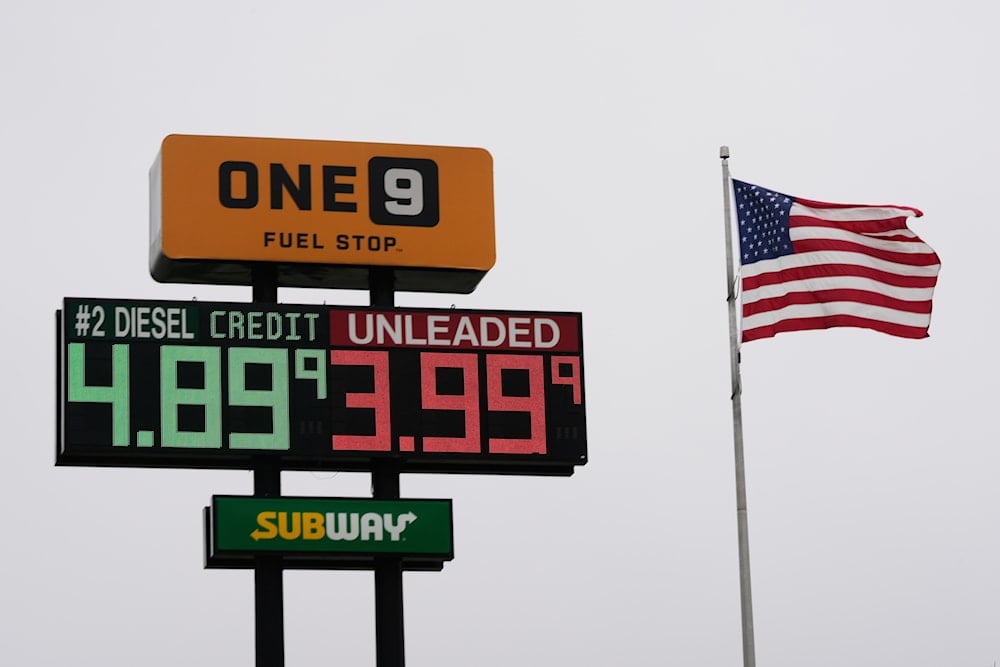
The American Flag flies next to a One9 Fuel Stop sign displaying gas prices for diesel and unleaded gas in Wilmington, Ohio, Wednesday, June 10, 2026 (AP)
A majority of US voters say their financial situation has deteriorated since US President Donald Trump returned to office, a new Financial Times poll has shown, as economic frustration grows less than three months before the November midterm elections.
The survey, conducted by Focaldata, found that more than 53% of registered voters believe they are financially worse off than they were when Trump began his second term in January 2025.
Economic dissatisfaction also extends beyond Democratic voters. Nearly 57% of independents said their finances had worsened, while almost one in four Republicans expressed the same view.
The results come as the Trump administration faces mounting pressure over inflation, the cost of living, and the economic consequences of the ongoing US war on Iran, which has contributed to higher energy prices and broader increases in consumer costs.
Democrats gain ground on economic issues
The survey found Democrats gaining an advantage on several issues traditionally regarded as political strengths for Republicans.
Respondents were more likely to trust Democrats than Republicans to manage inflation and the cost of living, while the Democratic Party also held an edge when voters were asked which party they trusted more on jobs and the broader economy.
Nearly two-thirds of registered voters said the US economy was moving in the wrong direction. That assessment was shared by more than two-thirds of independents and more than one-third of Republicans.
Only about a quarter of respondents said they believed the economy was heading in the right direction.
Recent economic indicators have added to concerns over household finances. Although inflation slowed somewhat in July following a decline in fuel prices, the annual rate remained at 3.4%, higher than when former President Joe Biden left office.
Separate data released Friday showed consumer sentiment falling sharply toward a historic low as elevated prices forced households to cut spending. Government figures also showed a decline in real wages during the previous month.
Cost-of-living record weighs on Trump
Trump's overall approval numbers have also weakened, according to the poll.
Fifty-five percent of registered voters said they disapproved of his performance as president, including nearly 20% of Republican respondents.
His standing was even weaker when voters were specifically asked about inflation and living costs. Sixty-four percent disapproved of his handling of the issue, including almost seven in 10 independents and roughly one-third of Republicans.
Among Republican voters, Trump's net approval rating — calculated by subtracting disapproval from approval — fell eight percentage points from the previous month.
The figures could prove particularly damaging given that voters continue to identify inflation and the cost of living as among the most pressing issues facing the United States.
While Trump himself will not appear on the November ballot, US midterm elections are commonly treated as a measure of public confidence in the sitting president and his party.
Polls in recent months have indicated that Democrats are well positioned to challenge Republican control of the House of Representatives, though the Senate remains a more difficult target.
When asked which party they expected to support in November's congressional elections, 44% of registered voters chose Democrats compared with 39% who backed Republicans.
White House defends economic record
The White House rejected criticism of Trump's economic performance and defended the administration's policies.
“The Trump administration continues to deliver on the President’s affordability agenda by lowering drug prices, reshoring American jobs, and cutting taxes while simultaneously touting a historic drop in violent crime nationwide and the most secure border in history,” White House spokesman Kush Desai said.
The Financial Times poll was carried out online by London-based non-partisan research firm Focaldata between August 7 and August 10.
It surveyed 1,913 registered voters nationwide and carries a margin of error of plus or minus 2.9 percentage points.
Read more: Rising costs put Trump, GOP on shaky ground before midterms: WSJ


