
Trump approval plunges deeper as war on Iran, prices fuel public anger
 4 Min Read
Trump’s approval rating has fallen to a record low as the war on Iran, rising energy prices, and worsening economic concerns erode support among key US voter groups.
-
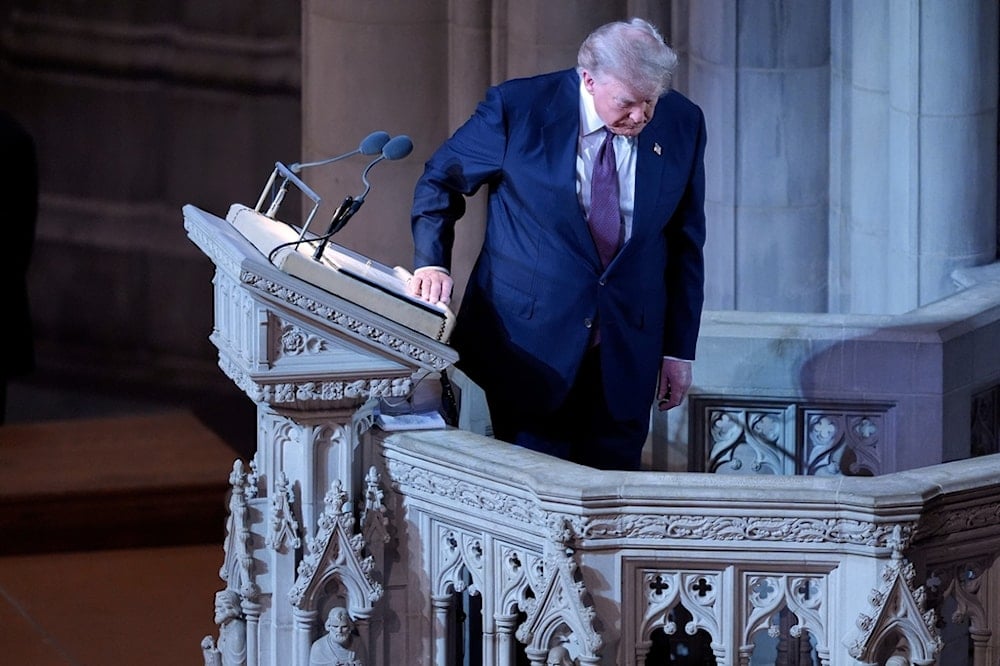
US President Donald Trump walking away after speaking at the funeral of Sen. Lindsey Graham, R-S.C., Tuesday, July 28, 2026, at the Washington National Cathedral in Washington (AP)
US President Donald Trump’s approval rating has fallen to its lowest level of his second term as the war on Iran and its economic consequences deepen dissatisfaction among American voters.
The Economist’s polling tracker, updated on July 28, placed Trump’s net approval at minus 25 points, with 35% of Americans approving of his performance, 60% disapproving, and 4% undecided.
A separate Economist/YouGov survey conducted between July 25 and 27 produced an even worse result for the president. It found that 34% approved of his performance, while a record 62% disapproved, leaving him with a net rating of minus 28, the lowest recorded during either of his presidential terms.
The latest YouGov survey questioned 1,559 US adult citizens and carried an estimated margin of error of 3.3 percentage points.
War on Iran compounds economic pressure
The collapse in Trump’s standing comes as Washington’s war on Iran continues to impose growing financial costs on the American public.
The Economist tracker identified the renewed attacks on Iran in mid-July as a likely factor behind the latest decline, with voters increasingly concerned about the war’s duration, objectives, and impact on energy prices.
Public opposition also extends to the amount of money being directed toward the conflict. The latest Economist/YouGov survey found that 60% of Americans believed the United States was spending too much on the war, compared with 19% who considered the spending appropriate and only 5% who wanted Washington to spend more.
The administration has attempted to reassure voters while simultaneously threatening further escalation if negotiations with Tehran fail, creating additional uncertainty over whether the conflict is approaching an end.
Economic concerns remain the greatest source of dissatisfaction. Trump’s net approval for his handling of inflation and prices has fallen to minus 43 points, his worst rating on any issue covered by the tracker.
Fuel prices have remained above $4 per gallon after the disruption of energy markets and shipping routes caused by the conflict. The US national average stood at about $4.10 per gallon on July 28, nearly $1 higher than a year earlier.
Treasury Secretary Scott Bessent has promised that “help is on the way,” but the administration has yet to provide relief sufficient to reverse growing public frustration over fuel, food and other living expenses.
Support weakens among key voting groups
Trump’s decline is no longer confined to Democratic voters or groups that traditionally oppose the Republican Party.
Among Americans aged between 45 and 64, only 33% approved of his performance while 63% disapproved. His net approval among the group has fallen from plus 15 at the beginning of his second term to minus 29.
Support has also weakened among white Americans without college degrees, historically one of Trump’s most dependable constituencies. Some 43% now approve of his performance, compared with 52% who disapprove.
The sharpest political warning comes from Republicans who do not identify with Trump’s MAGA movement. His net approval among non-MAGA Republicans has collapsed from plus 84 at the beginning of the term to just plus 12.
Independents have moved even more decisively against the administration, with Trump’s net approval among them falling to minus 53 from minus four when he returned to office.
Republicans face midterm warning
The Economist’s state-level projection indicates that dissatisfaction has spread beyond Democratic strongholds and into several states that supported Trump in the 2024 presidential election.
Although most of his 2024 voters continue to approve of his performance, the erosion among independents, moderate Republicans and working-class voters could threaten Republican candidates competing in closely contested races during the upcoming midterm elections.
Inflation and prices are now identified as the most important issue facing the United States, followed by employment and the broader economy.
The figures suggest that Trump’s military escalation abroad is increasingly colliding with the economic priorities of voters at home, leaving the White House exposed as the political and financial costs of the war continue to accumulate.
Read more: US support for Iran war falls to one-third, Reuters/Ipsos poll finds


